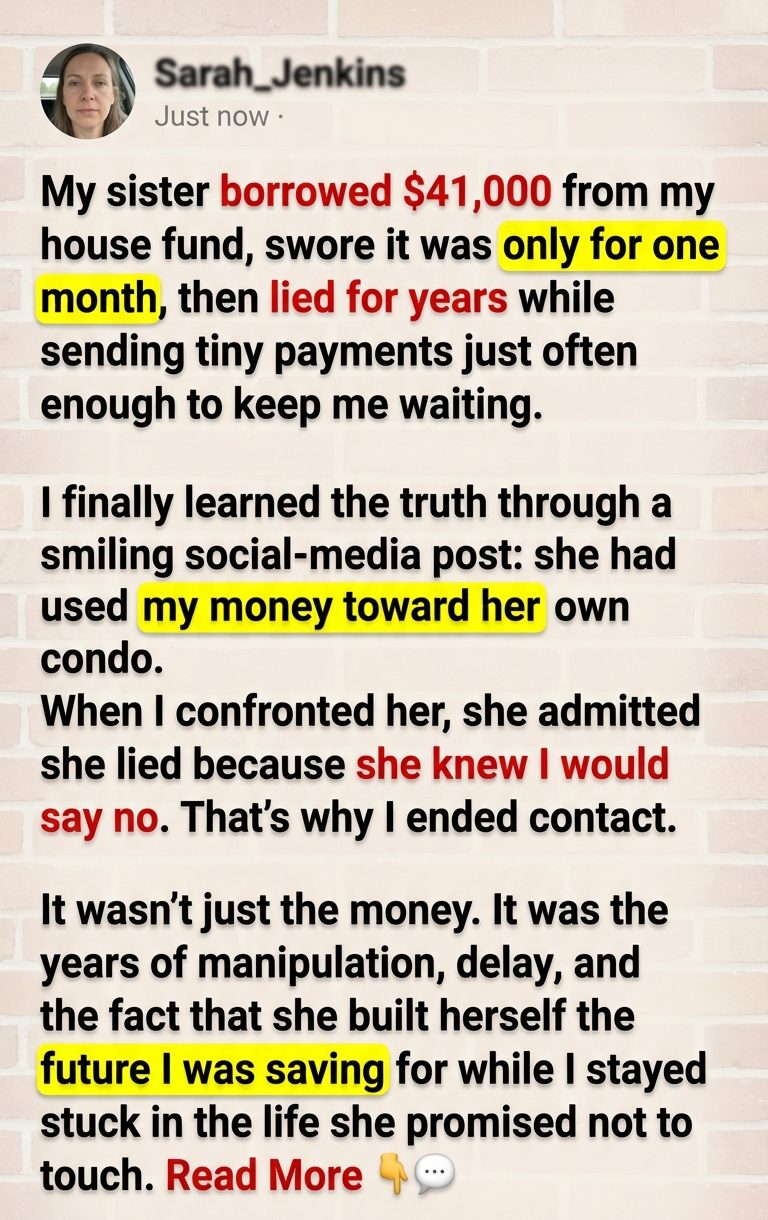
My sister said she needed the money for one month.
That’s the sentence this whole disaster still hangs from. One month. Not six. Not three years. Not “I may never be able to pay you back.” One month. Enough time, she promised, for a settlement check to clear, for some paperwork to resolve, for a life emergency to stop looking like permanent collapse. She cried while she asked. That mattered to me then. It doesn’t now.
The money came from my house fund.
I had been saving for almost seven years. Overtime, skipped vacations, old furniture, side work on weekends, saying no to new things when the old things still technically functioned. Nothing glamorous. Just adult discipline in its least photogenic form. By the time I turned thirty-six, I had a little over $94,000 saved. Not enough to buy outright, but enough to finally start looking seriously.
My sister, Leah, knew all of that.
She also knew how badly I wanted out of renting. She knew which neighborhoods I liked, which listings I bookmarked, how I had spent years trying to build something stable enough that no landlord could suddenly raise my life by four hundred dollars a month on a whim. She knew because I told her. Because sisters tell each other things like that when they still believe trust is part of the relationship instead of a weakness in it.
Leah called me crying on a Sunday night.
Her voice was thin and ragged. She said her ex had left her with legal threats, back rent, and a mess she couldn’t climb out of fast enough. She needed $41,000 immediately and swore it was temporary. She said a settlement was coming, a lawyer had confirmed it, and if I could help her for just one month she would repay every dollar and owe me her life. I remember sitting on my bed staring at the wall, feeling sick but convinced this was what family was for.
I wired the money the next morning.
That first month passed.
Then another. Then another.
At first, Leah sounded grateful and embarrassed. Then she sounded stressed. Then annoyed. Then vaguely offended any time I brought it up, as if expecting repayment on money meant for my future made me somehow unkind once enough time had passed. She always had a reason. The settlement got delayed. Tax complications. Her lawyer was a mess. She needed a little more time to stabilize or else the repayment itself would create another crisis.
I tried to be patient.
That’s the part I sometimes hate in myself—not that I helped, but how long I kept helping by believing words that had already started to rot. Good people call it patience. People like Leah call it room to keep lying. I asked gently, then more firmly, then with spreadsheets and dates and all the practical tools you use when you’re trying to make someone honor their own promises without breaking the relationship.
Three years passed.
In those three years, I rebuilt slower than I should have had to. I kept renting. Watched interest rates change. Watched the housing market move away from me in ways that made my chest tighten. Every month the lost $41,000 sat between my life and the life I’d planned, while Leah sent me tiny payments here and there just often enough to preserve the fiction that repayment was happening.
Then the truth arrived on social media.
Not through confession. Not through a moment of shame. Through a smiling photo of Leah on a balcony holding champagne with a realtor. “Dream condo secured,” the caption said. There she was, glowing in a cream sweater, one hand on the railing, the other holding keys. The building was downtown, all glass and polished concrete. Nothing about it looked accidental or temporary.
I stared at that photo until my face went numb.
I called her immediately. She didn’t answer. I texted the screenshot. Twenty minutes later, she sent, “It’s not what it looks like.” People only say that when it is exactly what it looks like and maybe worse. I drove to the building and waited in the lobby because some lies deserve to lose the comfort of distance.
When she came downstairs, she was angry.
Not ashamed. Angry. Angry I had shown up. Angry I was “causing a scene.” Angry that I apparently did not understand the stress she had been under. That anger turned my own into something sharper and cleaner. I asked whether she had used my money toward the condo. She said, eventually, yes—but only as part of “getting stable.”
Getting stable.
She used my house fund to buy herself property while I stayed in the same overpriced rental waiting for the repayment she swore was one month away. The cruelty of that was almost artistic in its precision. She didn’t just fail to pay me back. She leapfrogged me into the exact kind of future the money was originally saved to help build for me.
I asked why she lied.
She said if she’d told me the truth, I would have said no.
Exactly.
That was the whole crime in one sentence. She knew what my answer would be, so she removed my right to give it. She didn’t borrow honestly. She manipulated. Then she managed me through delay until the outcome was permanent enough that my outrage could be reframed as jealousy.
Our mother took her side at first.
Not overtly, not with full commitment, but in that soft infuriating way mothers sometimes protect the more chaotic daughter because the responsible one is expected to bear pain more quietly. “Maybe she panicked.” “Maybe she really did need stability.” “A condo is an investment.” Investment for whom? Certainly not for me, the person who had spent seven years building the fund she turned into her shortcut.
I hired a lawyer after that.
The paper trail saved me. Texts calling it a one-month loan. Her promises to repay. Her partial payments, which proved acknowledgment of debt. Once the formal demand letter arrived, the emotional language around family started evaporating fast. Funny how quickly “you’re overreacting” becomes “maybe we can work something out” when consequences appear on letterhead.
Leah cried then.
Really cried. Said I was ruining her life over a misunderstanding. Said family shouldn’t sue each other. Said I was punishing her for surviving. That last phrase still amazes me. Surviving. She survived by building herself a condo with money I spent years saving for my own stability. Then she wanted me to admire the resilience.
We settled eventually.
She refinanced. Liquidated part of another account I didn’t know she had. I got the money back with some interest, but recovery doesn’t reverse time. I still lost years. I still lost market position. I still lost the version of sisterhood where I could tell her a dream without wondering whether she heard it as available capital.
So, AITA for ending contact?
No.
I ended contact because she didn’t just borrow my house fund and fail to repay it. She lied for years, bought herself the future I was saving toward, and then tried to make my outrage look petty once the truth caught up. Some betrayals aren’t repaired by repayment because the real loss isn’t only the money. It’s discovering that someone heard your trust as an opportunity.
I hope she enjoys the balcony.
I mean that sincerely in the bitterest possible way. Because every time she steps out onto it, she should remember that the view was partly bought with years of my restraint, my discipline, and my faith in her word. She can keep the condo. What she can’t keep anymore is me.