The first time my cousin used the phrase “caregiving expenses,” my grandmother was sitting ten feet away clipping coupons.
That memory has stayed with me because it now feels like a warning I missed. Grandma was ninety, still sharp in a thousand small ways, and stubbornly proud of paying her own way. She hated waste, kept handwritten ledgers, and thought money should be treated with respect because she had lived long enough to know what happens when it isn’t. My cousin, Melissa, knew all of that. She also knew exactly how to wrap her greed in the language of care.
Melissa lived closest to Grandma.
She took her to appointments, picked up prescriptions, and eventually handled online banking because Grandma found passwords exhausting. The rest of us were grateful. I was grateful. Distance makes you dependent on whichever relative is physically present, and that dependence can become dangerous if no one asks the right questions early enough.
At first, Melissa looked like a saint.
She posted photos of herself bringing soup, fixing lamps, taking Grandma to church, walking her slowly through the parking lot. Everyone praised her. “You’re doing so much,” they’d say. She’d sigh modestly and say, “Somebody has to.” Looking back, she wasn’t just earning gratitude. She was building credibility.
After Grandma died, the numbers started feeling wrong.
Not instantly criminal. Just wrong. A savings account smaller than expected. A certificate of deposit missing. An investment account partially liquidated earlier than made sense. Melissa always had an explanation ready: caregivers were expensive, ramps and home modifications cost more than people think, Grandma wanted comfort at the end. If you hadn’t known Grandma, it sounded plausible. If you had, the edges didn’t fit.
I started asking for records.
Melissa got defensive fast. Said I was being disrespectful during mourning. Said I had no idea what the last years cost emotionally or financially. That’s a common move among people hiding inside family care roles: turn any request for clarity into an accusation that you don’t value sacrifice. For a moment, I almost backed off.
Then I got hold of the statements.
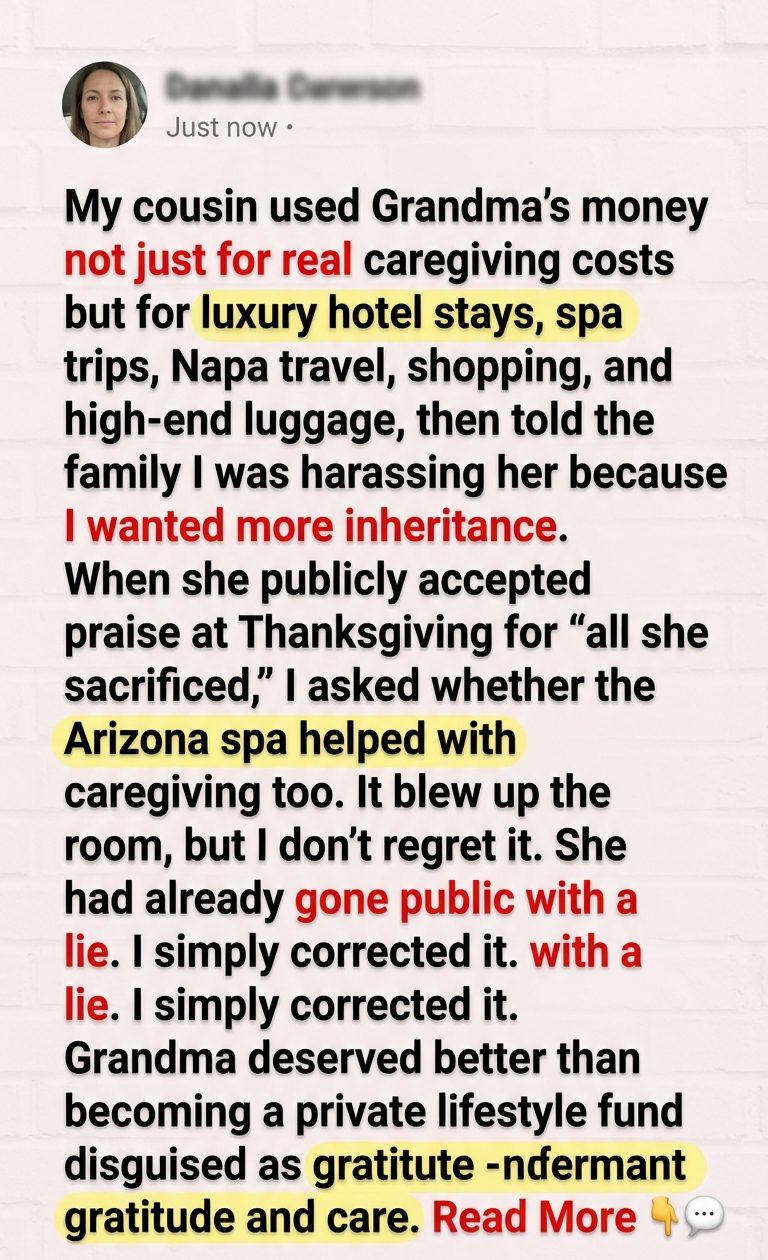
And there it was. Luxury hotel charges. Flights to Napa. A spa resort in Arizona. Boutique shopping. High-end luggage. Restaurant tabs that made no sense for a woman who still complained when grocery strawberries got too expensive. The money trail wasn’t subtle once I had it. Melissa had been using Grandma’s accounts not just for convenience or “small reimbursements,” but to subsidize a lifestyle.
The total suspicious amount was around $93,000.
Not all of it was vacations. Some of it clearly did go toward legitimate things. That almost made it worse. She had mixed care with indulgence so thoroughly that questioning one became socially tangled with questioning the other. That is how family theft often hides best—not in cartoon villainy, but in the blurry zone between what’s deserved and what’s stolen.
I confronted her privately first.
She didn’t apologize. She rolled her eyes. Said I had no clue what caregiving takes out of a person. Said if she used Grandma’s card for a trip here or there, it was because she needed to recover from “carrying the whole family burden.” Then she actually said, “You all got the easy version of Grandma while I did the hard part.” That was the moral frame she’d built: access as compensation, secrecy as fairness.
I might have kept it contained.
That’s the truth. I might have stayed in private outrage, lawyer letters, quiet accounting, family whispers. But then Melissa got ahead of the story. She told relatives I was harassing her over “minor reimbursement questions” because I wanted a larger share of Grandma’s estate. By the time I knew she was saying it, half the family had already heard some version of me being petty and greedy.
Then came Thanksgiving.
I almost didn’t go. But I was tired of losing ground by being the polite one while Melissa shaped the narrative with tears and selective truth. The whole family was there—my aunts, uncles, cousins, spouses, even two of Grandma’s old church friends because my mother still can’t host without feeding half the county. Melissa arrived late, breezy and elegant, carrying a pie like she wasn’t privately using our dead grandmother’s money for luxury trips.
She made it worse during dinner.
Someone thanked her for “everything she sacrificed” for Grandma, and Melissa smiled sadly and said, “You do what you have to do when family disappears.” That line landed like acid. Family disappears? I had sent money, visited monthly when I could, handled insurance disputes from another state, and spent weeks helping after hospitalizations. The difference was not that I disappeared. The difference was that I didn’t get to the debit card first.
I put my fork down and said, “Did the Arizona spa trip help with the caregiving?”
The whole table went silent.
Melissa stared at me like I’d slapped her. I kept going. Napa, the boutique luggage, the luxury hotel, the shopping. I didn’t shout. I listed. Calmly. In detail. You could hear glasses touch the table. One of my aunts whispered, “What?” and my mother actually closed her eyes like she knew the room had just lost its last chance at pretending.
Melissa burst into tears immediately.
That used to work. It didn’t now. She said I was humiliating her. Said I had no right to attack her after all she did. Said Grandma would be heartbroken by this ugliness. I told her Grandma would be heartbroken to know her money paid for massages and wine country while the rest of us were being told home-care costs explained the missing accounts.
The fallout was brutal but clarifying.
Some relatives thought I should have waited. Some said family matters shouldn’t be aired at the table. Maybe. But the table was where she had just accepted praise for virtue financed partly by theft. Public lie, public correction. That’s how I see it now. The timing was ugly because what she did was ugly.
The records eventually spoke louder than either of us.
Once the estate lawyer got involved more seriously, the spending categories became impossible to explain away as ordinary care. The trips, the shopping, the personal charges, the timing—none of it lined up with Grandma’s needs. Melissa tried to claim Grandma wanted her to “take care of herself too,” but that argument collapsed under the volume and repetition. Self-care doesn’t usually look like someone else’s card funding your luxury weekends.
The family divided, then settled.
That’s what families do after enough truth. First comes denial, then discomfort, then quiet rearrangement around whatever can no longer be disputed. Melissa lost access to everyone’s sympathy in the casual way she once relied on. Some apologized to me. Some never did. A few still think I was wrong to say it at Thanksgiving. Maybe I was wrong socially. I don’t think I was wrong morally.
So, AITA?
No.
I confronted my cousin publicly after she used Grandma’s money for luxury trips and called it caregiving because she had already turned me into the greedy one in private. She was counting on politeness, on timing, on family discomfort, on the power of crying first. All I really did was say the truth in a room where she could no longer control the order in which people heard it.
Grandma deserved better than being transformed into a private reimbursement plan.
And I was done helping Melissa hide behind devotion while she packed designer luggage on my grandmother’s dime.