I knew something was wrong when payroll cleared late.
That had never happened before. Not once in seven years. My brother and I ran a small commercial cleaning company together—office buildings, clinics, industrial spaces, the kind of business no one notices unless it stops working. We weren’t flashy, but we were steady, and steadiness is everything when your name is on other people’s paychecks.
The bank blamed “processing timing” at first.
I almost accepted that. Running a small business teaches you to triage, not dramatize. One weird day doesn’t always mean catastrophe. But then a vendor called about an unpaid invoice I had already approved, and the knot in my stomach tightened. Something wasn’t adding up. Not as an abstract fear. As math.
My brother, Aaron, handled more of the field side.
Clients, site visits, staffing emergencies, supply runs. I handled operations, tax filings, contracts, payroll, insurance, and the account reconciliations nobody likes but every business relies on. That division worked because I trusted him not to touch what he didn’t understand well enough to respect. That was my mistake.
When I finally sat down and dug through the business account history, my whole body went cold.
Transfers. Cash withdrawals. Repeated debits to things that had nothing to do with any legitimate vendor. Some were disguised as subcontractor payments. Others were labeled with vague notes like “emergency support” or “temporary advance.” The deeper I went, the less it looked like sloppy bookkeeping and the more it looked like deliberate draining.
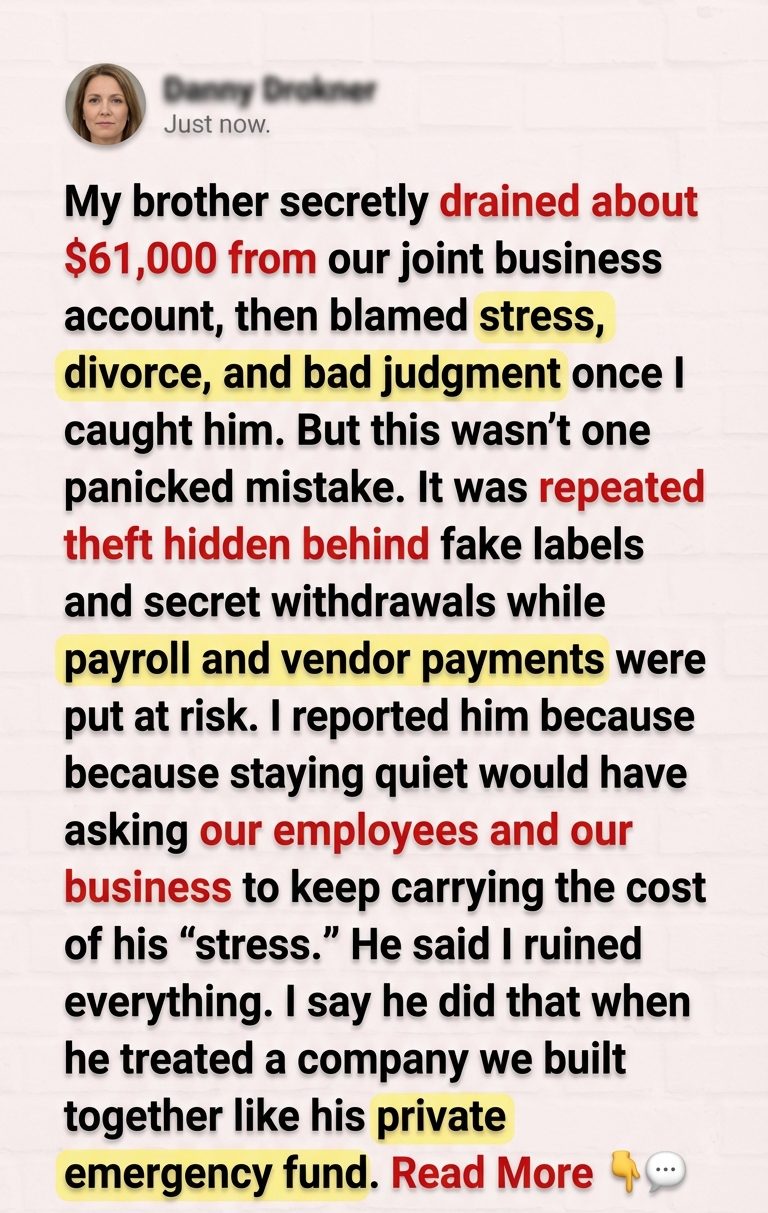
The total was around $61,000.
Maybe that doesn’t sound enormous compared to the huge scandal stories people like to repeat online, but in a business like ours it was devastating. Payroll floats aren’t theory. Tax reserves aren’t decorative. A missing sixty-one thousand dollars can turn a stable little company into a month-by-month panic. It can mean workers wondering if checks will bounce while one owner stands in the warehouse pretending everything is normal.
I confronted Aaron that night in the office.
He didn’t deny it right away. First came the sigh, then the pacing, then the confession phrased like fatigue. He said he was under unbearable stress. His marriage was falling apart. He had gotten behind personally. Then one bad decision led to another. He took money intending to replace it after a “big contract” landed. It never did. So he took more.
He said the word borrowed.
I told him you don’t borrow from a joint business account by hiding the withdrawals from your partner, falsifying labels, and letting payroll come dangerously close to failing. He kept saying stress like it was an argument instead of context. Yes, he was stressed. Adults are stressed all the time. Stress does not turn theft into a coping mechanism I’m morally required to admire.
Then came the line that almost broke something in me.
He said, “I thought you’d understand if you knew how bad it got.”
That sentence revealed the whole structure. He knew exactly what he was doing was wrong. He simply hoped that once it was fully catastrophic enough, I’d be too loyal or too tired to call it what it was. Family, in his mind, was not a bond of mutual protection. It was a cushion he expected to land on once the damage had spread.
I told him I was reporting it.
He looked honestly shocked.
That’s the part people outside families like mine don’t always understand. The guilty sibling often does not expect accountability from the reliable one. He expects anger, yes. Tears maybe. A big ugly fight. But not police, not formal records, not consequences that leave the emotional realm and become real in systems. He was stunned that I wouldn’t keep the damage “in the family.”
Our mother called within the hour.
Apparently he beat me to it. She said he’d made mistakes under terrible pressure. She said involving police would destroy him. I asked whether she planned to personally cover payroll, restore our tax reserves, explain to our employees why their security was less important than her adult son’s pride, or reverse the fraud that now sat in our ledgers like acid. She cried. It changed nothing.
The practical damage showed up immediately.
I had to move money from my personal savings to cover payroll. I delayed a tax payment arrangement and negotiated with two vendors not to freeze deliveries. I spent forty-eight straight hours doing the kind of cleanup people romanticize as “handling business” when what it really feels like is being trapped inside someone else’s secret carelessness.
Employees noticed.
Not the details. But they noticed my face, the bank calls, the tension, the sudden supply cutbacks, the way Aaron stopped showing up consistently after the confrontation. One woman who had worked with us five years asked if she should start looking for another job. That question stayed with me longer than the police interview. Theft inside a business is ugly because it doesn’t only wound the owner. It frightens everyone whose rent depends on the business staying honest.
Aaron kept trying to reframe it.
He said I was making one season of bad judgment define him. He said I knew how hard his divorce had been. He said if I sent this through official channels, I’d be choosing punishment over family. That’s the trick, isn’t it? The thief gets to call it one season. The victim gets to live through all the seasons that follow.
The records were too clear to ignore.
Transfers to cover personal legal bills. Mortgage payments on the house he was trying to keep from his ex-wife. Credit-card payoffs. Even a vacation deposit for a trip he later canceled. Stress might explain the first theft emotionally. It did not explain the deliberate, repeated choices to keep going once he understood the account could feed him if I looked away long enough.
When I filed the police report, some relatives called me disloyal.
Others called me brave in whispers, which somehow felt worse. The whispers told me they knew I was right but still wanted me to absorb the social ugliness of doing the right thing alone. Family often works that way: everyone privately wants boundaries, but only one person is expected to enforce them and then carry the fallout.
I didn’t report him because I hate him.
That’s what people kept misunderstanding. I reported him because once someone steals from a business account and blames stress, the business itself has no feelings to protect it. It only has records, legal obligations, and whichever owner is willing to stop pretending. If I had stayed quiet, I would have been asking every employee to trust a structure I knew had already been compromised by blood.
The case ended in restitution and probation.
No prison. No dramatic courtroom ending. Just official shame, structured repayment, and the permanent loss of whatever version of brotherhood existed before he decided my carefulness was available for conversion into his crisis fund. The company survived, though not intact. Something in my trust for easy family closeness died alongside the old account structure.
So, AITA?
No.
I reported my brother after he drained our joint business account and blamed stress for stealing because stress does not grant access to my labor, our employees’ stability, or a company we built together. He wanted family to mean immunity. I chose to make it mean responsibility instead.
And if that ruined his version of everything, maybe that’s because his version depended on me staying quiet while he stole from both of us.