The first envelope looked harmless.
It came in the middle of a stack of ordinary mail—utility bill, grocery flyer, dentist reminder, something for our daughter’s school fundraiser. I almost tossed it into the pile without opening it because the return address was from a lender I didn’t recognize and I assumed it was junk. But something about the urgency stamp caught my eye.
Inside was a notice about a delinquent loan I had apparently co-signed.
I had never seen the loan before.
At first, I thought it was a scam. Then I looked at the details. My full name. Correct address. Partial social. Specific payment history. My body went cold in that slow, awful way that tells you some part of you already knows the answer before your mind is willing to accept it.
When I called the lender, things got worse.
There wasn’t one loan. There were two. Then, after a full credit pull, I learned there were also hidden credit cards I didn’t know about, a balance transfer account, and a debt consolidation loan carrying my signature. My signature. Except I hadn’t signed anything.
My wife, Nina, had.
We had been married nine years.
We weren’t rich, but we were stable in the sort of ordinary way that feels earned—mortgage on time, one decent car paid off, a manageable second one, childcare structured around both of our jobs, some retirement savings, and the occasional weekend trip if we planned ahead. I handled more of the long-term finances because I’m cautious by nature. Nina handled daily household spending and always acted slightly annoyed when I asked detailed questions. I used to interpret that as personality. Now I know it was partly strategy.
The first confrontation happened at our kitchen table after bedtime.
I laid out the letters and asked, “What is this?”
She stared at them for a long time before saying, “It’s not what it looks like.” That sentence should probably be banned from adult life. It never helps. It only delays the uglier truth by a few seconds.
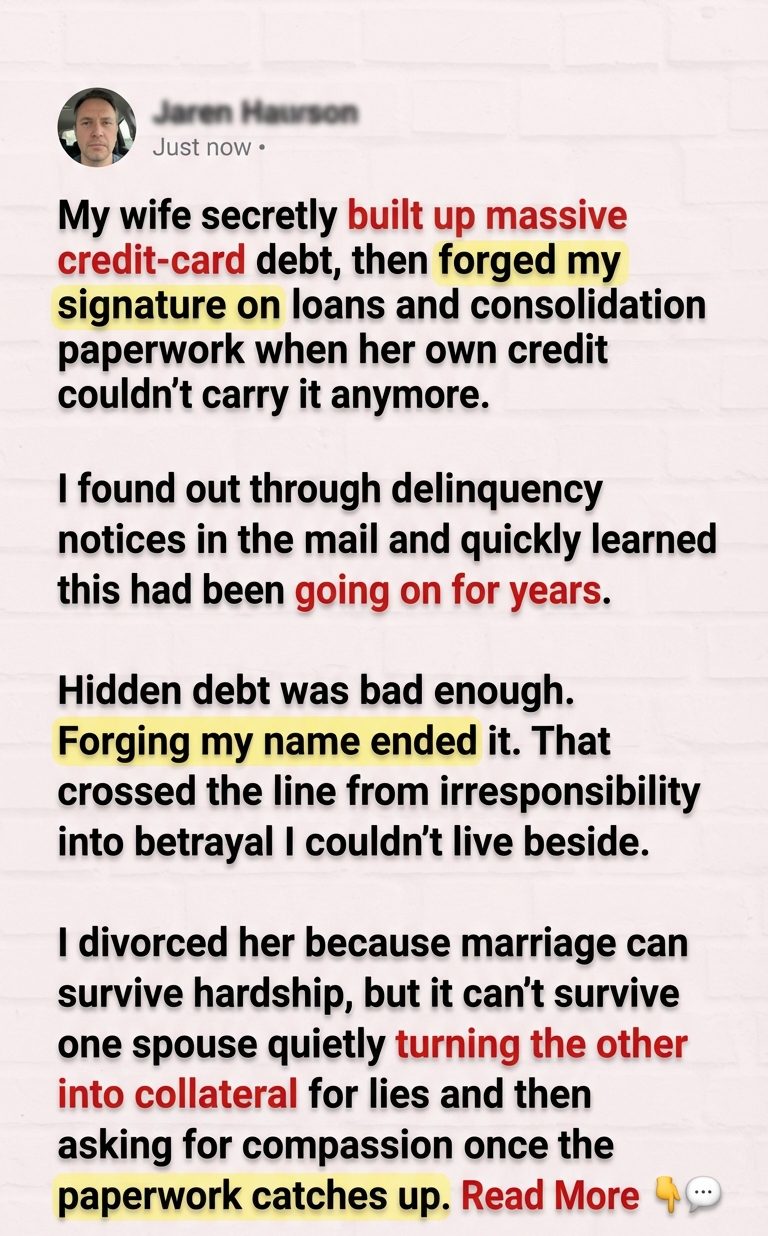
The truth was that she had been hiding credit-card debt for years.
At first it was retail spending. Then “just a few things for the kids.” Then gifts, beauty appointments, trips with friends, online shopping done in quick little hits that looked harmless one by one. When the balances got too high, she opened new cards. Then consolidation offers. Then loans. And when her own credit couldn’t keep carrying the load, she used my information to get better terms.
She forged my signature.
On more than one document.
I asked how long this had been happening. She said almost three years. Three years of her smiling through budget conversations, nodding during talks about long-term planning, and occasionally even criticizing me for being “too anxious” about money while privately building a financial trap around both of us. That level of deceit does something strange to your memory. You start replaying normal moments with an entirely different soundtrack.
She said she meant to fix it before I found out.
Of course she did.
Everyone means to fix things once the fixing can happen without accountability. The fantasy future where the liar restores the money and the victim never learns the truth is one of the laziest moral shelters on earth. I didn’t care what she imagined. I cared that she had used my name like a tool because it was easier than hearing me say no.
Then she started crying.
And for one dangerous second, I almost fell into the old role—comforter, translator, practical husband making order out of the emotional wreckage someone else created. But then I looked at the actual papers. My forged signature. Interest rates. Payment histories. Legal responsibility attached to my name because my wife preferred secret debt to honest shame. The tears stopped working.
I asked why she didn’t tell me sooner.
She said she was embarrassed. Then she said she felt judged in marriage whenever money came up. Then she said I didn’t understand how trapped she felt trying to keep up appearances. That line nearly made me laugh. Keep up appearances for whom? We were a middle-class family in a regular neighborhood, not socialites performing at a gala. The appearances she was preserving were largely for herself.
The deeper I looked, the worse it got.
A personal loan taken during a period when she told me work had cut her hours. A credit card used for a girls’ trip she claimed had been split evenly. Another account carrying charges from a designer site she mocked publicly as “ridiculous.” Lying has a strange side effect: it creates these little twin versions of someone, one for public life and one for the hidden ledger. Once you see both, intimacy never looks the same again.
Our son heard us fighting one night and cried.
That was when the emotional fog lifted completely for me. It’s one thing to wrestle with marital complexity when the damage still feels theoretical. It’s another thing when your child starts asking whether “the bank is taking our house” because he overheard one sentence through a hallway wall. Nina didn’t just make private mistakes. She turned our home into a place where the adults’ dishonesty could leak into the children’s nervous systems.
She wanted to keep it private.
No police. No lenders told about the forgery. No family informed. Just counseling, repayment plans, and a “fresh start.” I might have considered some version of that if the issue were hidden debt alone. But the forged signatures changed everything. Secret spending is one kind of betrayal. Identity-based fraud inside a marriage is another. She crossed from irresponsible into criminal and expected love to downgrade the distinction.
My sister was the first person to say it plainly.
“She stole your signature because she was counting on your reluctance to call it what it is.”
That hurt because it was true.
I consulted a lawyer and froze our joint lines immediately. That made Nina furious. She said I was humiliating her. I remember looking at her and thinking: you still think the worst part of this is what it feels like for you. That realization, more than any number, made divorce inevitable.
Our parents got involved, which was a nightmare.
Hers called me cold. Mine called me devastated but careful. Her mother actually said, “Marriage is bigger than money.” Maybe. But forged documents are bigger than budget arguments. Fraud is bigger than overspending. And trust, once broken at that level, stops being theoretical. It becomes a set of legal and emotional facts you now have to live around.
The divorce took almost a year.
The debt had to be untangled. Some obligations were assigned back to her, some disputed, some settled in brutal compromises that still cost me sleep and money. My credit absorbed damage simply because cleaning up fraud inside a marriage is slower and uglier than people imagine. Institutions are built around simpler villains than spouses.
Nina still says I abandoned her in shame.
No. I left because I could no longer tell where her needs ended and my legal exposure began. I left because a marriage where one spouse quietly signs the other’s name onto debt is not struggling. It is already broken in a structural way. You don’t fix structural breaks with nicer communication and one good month.
So, AITA?
No.
I divorced my wife after I learned she hid credit-card debt and forged my signature on loans because she didn’t just make financial mistakes. She turned me into collateral for her secrecy. Marriage can survive hardship. It can survive debt. It cannot survive one spouse privately converting the other into a financial instrument and calling that love once caught.
The forged signature mattered.
Not just because of the law, but because it revealed something marriage was supposed to make impossible: she knew my name well enough to fake it and my heart well enough to hope I’d hesitate before defending it.