The day I learned my inheritance was gone, my mother said, “Please try to see the bigger picture.”
That sentence still angers me because it arrived before apology, before truth, before any honest acknowledgment of what they had done. They wanted moral perspective before they were willing to admit theft. In my family, that has always been the pattern: the person hurt is asked to widen their heart before the person who caused the pain narrows their excuses.
My grandfather left me the money when I was twenty-two.
It came from farmland he sold near the end of his life, plus investments he had built over decades of terrifying discipline. He was not sentimental about money, but he was very deliberate with it. He told me once, sitting on his porch with sweet tea and his old work boots still dusty, “I’m leaving you something because I want one person in this family to have a little room to breathe.” At the time, I thought he was being kind. Now I know he was also being realistic.
The inheritance was about $210,000.
Not enough to retire. More than enough to matter. Enough to wipe out debt, change housing options, or create the kind of financial cushion that alters how you move through adult life. Because I was young, the money was placed in a managed trust with my parents as temporary overseers until I turned thirty. I didn’t object. I trusted them.
That trust now feels like a story I once told myself.
My sister, Rachel, has always been the family emergency.
Beautiful, chaotic, wounded, persuasive. She could burn down a year of her life in three months and still somehow have everyone around her talking about what a hard time she was having instead of what she had done. Car trouble, bad relationships, credit card spirals, impulsive moves, short-term jobs that somehow all became someone else’s fault. Every crisis she had arrived wrapped in language that made rescue feel like the only loving response.
I was the opposite.
Responsible. Predictable. The one who worked, paid bills, and rarely asked for help. In my family that translated into a strange kind of curse: I was always “doing fine,” which meant my needs could be postponed, resized, or morally discounted because I wasn’t visibly on fire.
For years, I barely asked about the trust.
I was in school, then working, then just trying to build an adult life one paycheck at a time. When I did ask, my parents used vague reassuring phrases—“It’s stable,” “We’re watching it,” “Your grandfather would be pleased.” Sometimes my father added market commentary to make the conversation feel technical enough that I’d stop pushing. I usually did.
Then I turned thirty.
I made an appointment with the trust manager expecting a routine conversation about disbursement options. I showed up with a legal pad and three careful plans: pay off my graduate school debt, put money down on a small townhouse, and keep the rest invested. Instead, I was told the remaining balance sat just under $27,000.
I thought it was a clerical error.
The trust manager did not.
He looked uncomfortable in the way professionals do when they realize they are standing at the moment someone else’s family lie stops working. He asked if my parents had already discussed the prior disbursements with me. I said no. That was the first time I heard the phrase “family support transfers” attached to my inheritance.
Those “family support transfers” had one real destination: Rachel.
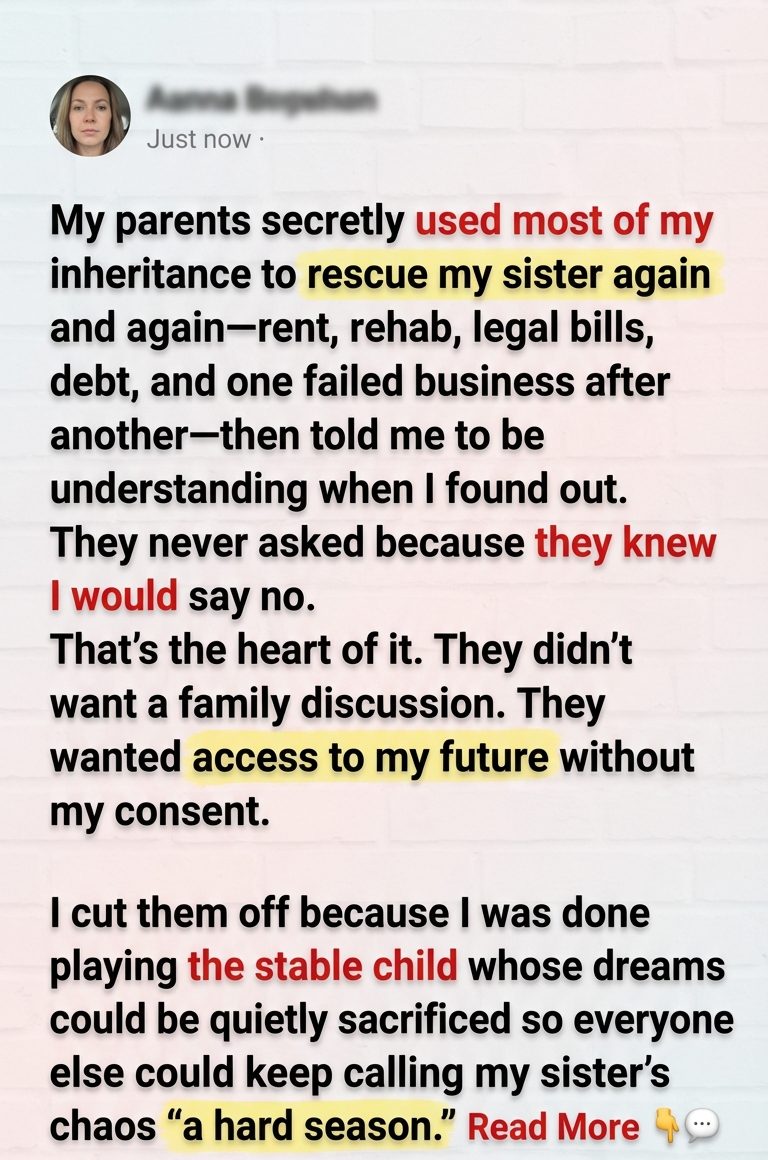
Over six years, my parents had used my inheritance to cover her rent, rehab stays, legal fees, credit card settlements, a failed boutique venture, a custody dispute, and a frightening amount of “temporary stability support.” Temporary, apparently, can last for years when you’re spending someone else’s future.
I drove straight to my parents’ house.
My mother started crying before I got all the way through the front door. My father went immediately into his careful voice—the one he used when he wanted me to confuse calmness with moral authority. He said they had done what they had to do. He said Rachel was in real danger at times. He said family helps family. And then my mother said the line that still follows me around like a stain: “Please try to be understanding.”
Understanding of what?
That they spent nearly $180,000 meant for me because my sister generates more dramatic consequences than I do? That they watched me take out more loans, delay a home, and live with constant financial pressure while quietly using my inheritance to absorb Rachel’s chaos? That they didn’t even tell me because my role in the family was apparently to recover well enough not to ask too many questions?
I asked why they never once came to me.
My father said because they knew I’d say no.
Exactly.
That was the whole point. They did not want a moral discussion. They wanted access without consent. They wanted to preserve the self-image of being generous parents to Rachel without facing the fact that they were financing that generosity with my future. It wasn’t misunderstanding. It was strategy.
Rachel arrived halfway through the fight.
My mother must have called her. She came in defensive, puffy-eyed, and immediately started talking about everything she’d been through. The abusive ex. The addiction. The custody fight. The business partner who stole from her. The world had apparently happened to Rachel so aggressively for so long that no one ever noticed she had become the reason everyone else’s stability was treated as surplus.
When I asked whether she knew where the money came from, she said, “I knew they were helping me. I didn’t ask for details.”
That answer was insult disguised as innocence. You don’t take repeated six-figure rescues from parents living on a middle-class income without understanding something bigger is being tapped. She may not have wanted the exact truth, but she absolutely benefited from not asking.
My relatives were infuriating.
The first wave told me to calm down. The second wave told me my parents were under unbearable pressure. The third wave said Rachel would be dead, homeless, or have lost her child if my parents hadn’t helped. Maybe some of that is true. But every version still required the same hidden conclusion: my future was the most convenient sacrifice because I was functional enough to survive it.
That realization changed something permanent in me.
I hired an attorney, not because I thought I’d recover everything, but because I needed a clean record of what had been done. The trust language was messy. Some distributions were documented under broad discretionary support clauses, and that gave my parents just enough legal cover to make justice partial instead of complete. But the paper trail was still devastating. Their choices were real, repeated, and deliberate.
I recovered some of the money.
Not much. Enough to matter. Not enough to restore what was lost. Time is the part no one ever gives back in family financial betrayal. You can maybe claw back dollars. You cannot restore the years those dollars would have had to grow, the loans they would have prevented, or the opportunities they would have opened earlier.
Then came the emotional demand.
My mother wanted reconciliation. She sent long emails about family, grace, and how she “couldn’t bear losing both children at once.” My father said I was making a difficult situation crueler than it needed to be. Rachel sent one text that simply said, “I guess I know where I stand.” Imagine saying that after spending someone else’s inheritance through your own disasters.
So yes, I cut them off.
Not in a dramatic moment. Just gradually, then fully. Fewer calls. No holidays. No pretending. Because every interaction required me to carry not just my own pain but their preferred version of it. In their version, they were tragic people making impossible decisions. In mine, they were parents who looked at one child’s promise and another child’s emergency and decided the responsible one could quietly absorb the cost.
So, AITA?
No.
I cut off my parents after they gave my inheritance to my sister and told me to be understanding because understanding was never the missing ingredient. Consent was. Honesty was. Respect was. They wanted my compassion after stealing my chance to choose.
My grandfather said he wanted me to have room to breathe.
What my parents did was spend that air on someone else and then ask me why I sounded so angry when I finally started gasping.