The first time I noticed the college fund was wrong, I was packing my daughter’s lunch.
It was a completely ordinary Tuesday morning. Peanut butter sandwich, apple slices, a note folded into the napkin because she had a spelling test and liked finding tiny messages in her bag. I had one hand on the counter and the other checking my phone when I opened the account app to move this month’s deposit into her college fund. I expected to see the usual number rise by a few hundred dollars.
Instead, I saw a balance so low my brain refused it.
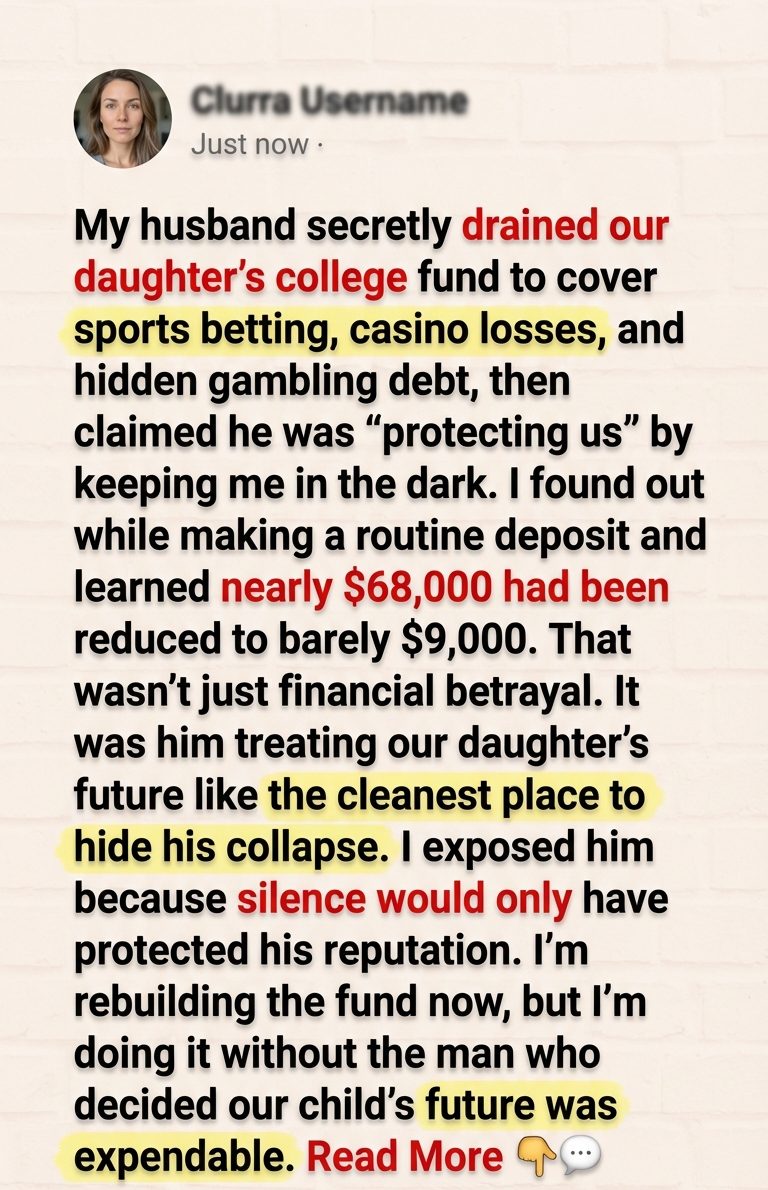
At first I thought the app hadn’t loaded correctly. I refreshed it twice. Then I logged out and back in. Same number. Same awful, impossible number. The account that should have held around $68,000 had barely over $9,000 left.
My husband, Derek, had access to the account.
We set it up together when our daughter, Lucy, was born. We were both children of families that could offer love but not financial help, so from the beginning we promised ourselves she would start adulthood with more stability than we did. Every birthday check from grandparents, every tax refund sliver, every bonus, every skipped vacation, every “we’ll wait another year” fed that fund. It wasn’t just money. It was intention.
I stood in the kitchen staring at the screen while my coffee went cold.
Lucy came in asking if I had seen her library book, and I smiled and helped her look because that’s what adults do while their insides collapse. Real life keeps asking for ordinary things even when your marriage is quietly falling apart. I found the book under the couch, zipped her backpack, kissed her forehead, and watched her leave for school before I let myself start shaking.
I called the investment company that morning from my office parking lot.
The representative was polite and terrifyingly calm. She confirmed that a series of withdrawals had been made over the previous eleven months. Several “temporary distributions,” one partial liquidation, then direct transfers into a linked checking account. Every time she spoke, I felt my body go colder. This wasn’t a one-night mistake. It was a pattern. A plan. A private channel draining my daughter’s future one decision at a time.
The linked checking account was ours.
Which meant the money didn’t disappear into some faceless scam. It came home.
I spent the rest of the day moving through meetings in a blur, pretending I could hear anything anyone said about quarterly staffing or scheduling changes. By the time I got home, I had printed the account history, every transfer, every date, every amount. I laid the papers on the dining table after Lucy went to bed and waited for Derek to come downstairs.
He saw the stack and froze.
That one second of fear on his face told me what I needed to know before he said anything. Then came the sigh. Then the hand across his mouth. Then the sentence I now think should be tattooed on the forehead of every liar who gets caught: “I was going to tell you.”
No, he wasn’t.
He had used the money to pay off gambling debt.
At first he tried to minimize it. “Sports betting,” he said, as if the phrase sounded less ugly than gambling. Then he admitted it had gone further—online casinos, live betting apps, chasing losses with bigger losses. He had hidden credit card debt first. Then personal loans. Then, when those started tightening around him, he began quietly siphoning from Lucy’s college fund because “it was the cleanest source” and he believed he could replace it before I noticed.
The cleanest source.
That phrase still makes me sick. My daughter’s future had become, in his mind, the least inconvenient pile of money to burn through while he tried to keep his lies organized. Not the most sacred account in the house. The cleanest one.
I asked how long this had really been going on.
Two years.
Two years of him standing beside me at school fundraisers, soccer games, parent-teacher conferences, and bedtime routines while privately mortgaging Lucy’s adulthood to cover his secret life. Two years of me believing our sacrifices were still intact while he fed them into an addiction and called it temporary.
Then he did what made it worse.
He said he only touched the fund because he was protecting us from the full fallout. He said if I had known about the debt sooner, I would have panicked and made everything worse. As if my reaction to the disaster was somehow part of the disaster itself. As if his lies were an act of management, not betrayal.
I asked whether he understood what that money meant.
Not abstractly. Specifically. The years I skipped replacing my own car. The extra freelance work I took after Lucy was born. The family vacation we canceled because we wanted “long-term security.” The monthly automatic transfers I never skipped even when groceries got ridiculous and our roof needed patching. He kept nodding, crying, saying he knew. But if he knew, then he did it knowing exactly what he was stealing.
The next morning, I opened a new bank account.
I moved our remaining emergency money, changed passwords, and called a lawyer before Derek even left for work. He cried when he realized this had crossed from emotional disaster into legal and practical consequence. He said he needed help, treatment, grace. Maybe he did. But needing help does not erase what he chose to do before asking for it.
Lucy noticed the tension almost immediately.
Children don’t need the full story to feel when trust has gone bad in a house. She asked why Daddy was sleeping in the guest room. She asked why I kept sitting in the car in silence after school drop-off. She asked one night whether college was still “the thing we’re saving for.” That question almost broke my spine in half.
I told her yes.
Because I meant it, even if I no longer knew how I’d rebuild it.
Derek entered a treatment program within a month.
Some of my friends thought that should have been the beginning of forgiveness. They heard “addiction” and assumed the rest of the story naturally became about compassion. And yes, addiction is real. But so is theft. So is sustained deception. So is the choice to quietly use your child’s future as a hidden pressure valve while your spouse keeps making sacrifices in good faith.
The hardest part wasn’t even the money.
It was the violation of meaning. A college fund is not just a savings bucket. It’s a promise between parents and a child, even if the child doesn’t know the full numbers yet. It says: we are trying to build a bridge for you. Derek didn’t just empty an account. He quietly dismantled a bridge while still smiling in family photos on it.
He wanted me not to tell anyone.
Said Lucy should never know. Said his parents would be humiliated. Said public shame would hurt his recovery. I told him I wasn’t interested in managing the reputation of the man who looted our daughter’s future. His parents learned. Mine learned. My sister learned. Recovery built on secrecy would just become another version of the lie.
I filed for divorce six weeks later.
Not because I don’t believe people can recover. But because I can’t raise my daughter inside a marriage where her future became acceptable collateral for her father’s hidden panic. Some lines, once crossed, don’t leave a relationship wounded. They leave it structurally unsound.
So, AITA for exposing him?
No.
I exposed my husband because he secretly used our daughter’s college fund to pay off gambling debt and then expected me to treat silence as kindness. Silence would not have protected my child. It would have protected his image. Those are not the same thing.
I am rebuilding the fund now.
Slower than I want. More painfully than I imagined. But every deposit feels honest, and honesty matters more than optimism now. That may be the only good thing left from all of this: Lucy will still have a future, but it will be built on truth, not on a father’s promise to put back what he never had the right to take.