The first call came while I was in line at a pharmacy.
A collections agent asked for me by full name, then immediately started talking about a personal loan I had supposedly defaulted on. I interrupted her twice because I genuinely thought she had the wrong person. I’d never taken the loan, never heard of the lender, and had a credit history so boring it could have put people to sleep. But by the time I got to my car, there was already a second voicemail from another creditor.
That kind of panic doesn’t feel cinematic.
It feels administrative. Cold. Numb. The worst part at first isn’t anger. It’s confusion so intense your body starts reacting before your mind can organize the facts. I sat in the parking lot refreshing my credit report on my phone with shaking hands and watched account after account appear that I never opened.
By the end of the week, the damage was obvious.
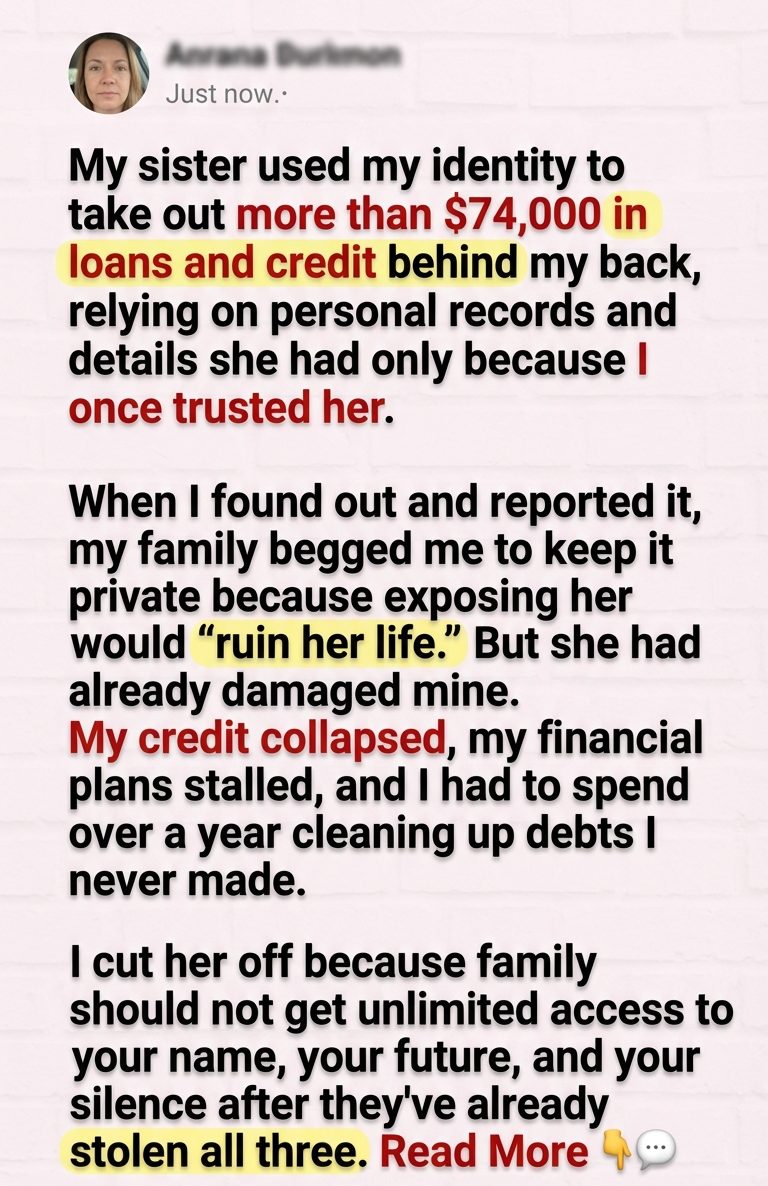
Lines of credit. Personal loans. A retail financing account. Everything tied to me, my social, and my credit. The total fraudulent debt was just over $74,000. That amount may not sound like a tabloid headline, but it is more than enough to wreck years of careful adulthood. More than enough to close doors. More than enough to make your own name feel hostile.
The person behind it was my sister, Renee.
I learned that through details no stranger would have had. Old addresses. Copies of tax records I had once shared when helping her apply for a rental. Security questions built around family history. A mailing address linked to an apartment complex she lived in briefly after her divorce. Identity theft by a stranger would have felt violating. Identity theft by my sister felt like every ordinary act of trust in the last ten years had been turned into inventory.
Renee was always the family emergency.
Not evil. Not monstrous. Just permanently unstable in the way some people learn to call “bad luck” because the actual pattern is too exhausting to say out loud. Failed relationships, job gaps, impulsive spending, new starts, old excuses. She had a talent for making every mess sound like the first unfair thing that had ever happened to her, and my family responded to that performance the way they always did—by cushioning it.
Apparently I was the cushion she chose this time.
When I confronted her, she went silent for a long time.
Then she said, “I was going to fix it before it got this bad.”
That sentence should be engraved somewhere as the anthem of people who steal from family. Not I’m sorry I did this. Not I know this is unforgivable. Just some fantasy version of the future in which the truth would eventually have become more convenient if only it had been left undiscovered a little longer.
She admitted she used my information because her own credit was destroyed.
She said she needed time to rebuild after the divorce. Said she only intended a few temporary loans to get back on her feet. But “temporary” became more accounts, more balances, more missed payments, more fake addresses, more lying. By the time I found out, she had been living inside my name for almost eighteen months.
I asked if anyone else knew.
My mother looked away before answering, so I knew immediately that she did. Not everything, maybe, but enough. Enough to have asked Renee questions. Enough to suspect. Enough to stay quiet because in my family, “keeping things from getting worse” has always meant protecting the person causing the damage from the moment the victim finds out.
That realization hurt almost as much as the fraud itself.
I was not only cleaning up debts I never created. I was also learning, in real time, how many people preferred my quiet suffering to Renee’s public shame. That is one of the darkest truths in families like mine: the stable child is often expected to absorb harm because everyone assumes they can survive it better.
When I filed the identity theft report, my mother cried.
She said I was going too far. That police involvement would ruin Renee’s life. I said Renee had already inserted herself into mine with enough force to knock over years of work. Mortgage options evaporated. My credit score dropped. A car refinance I needed disappeared. Even simple things like checking my email became exercises in adrenaline because every new notice might carry another lie tied to my name.
Renee called me cruel.
Then selfish. Then dramatic. She said family should handle this privately. That word again—privately. As if private means morally smaller. As if secrecy changes the nature of the act instead of just protecting the person who committed it. I told her private handling ended the second she chose my identity as her tool.
The investigators pieced it together quickly.
Device logs. IP records. Store camera stills. Applications from her apartment. The evidence was almost insultingly clear. She wasn’t a criminal mastermind. She was just arrogant enough to believe family loyalty would become legal insulation if she cried hard enough once the truth came out.
My extended family took sides.
Some stopped calling me. Some told me they understood but wished I hadn’t “made it official.” One aunt said, “You know how fragile she is.” That sentence turned my stomach. Fragility has become the family-approved costume for women who leave damage everywhere and then collapse the moment someone asks them to look at it directly. I’m tired of fragility being used as a moral discount.
The cleanup took over a year.
Disputes. Affidavits. Credit bureau fights. Calls during work. More paperwork than I thought one betrayal could generate. People think once fraud is “proven,” life snaps back. It doesn’t. Institutions move slowly. Trust moves slower. And every form asks you to restate the damage in cleaner language than it actually deserves.
My therapist told me something that changed the way I carried it.
She said the fraud was one violation, but the family pressure to protect Renee from consequences was a second violation. That felt exactly right. The debt hurt. The pressure to silence myself hurt differently. It tried to recruit me into my own erasure by making accountability look like aggression.
I cut Renee off after the hearing.
No dramatic speech. No final showdown. Just a quiet decision that I would not spend the next ten years re-explaining why someone who destroyed my credit using my name does not get automatic reentry because we share childhood photos. Blood may explain access. It does not erase choices.
So, AITA for cutting her off?
No.
I cut her off because she used my name for loans, wrecked my credit behind my back, and then wanted me to help preserve her image by suffering politely. I cut her off because some relationships only survive if one person volunteers to become a storage unit for the other person’s consequences. I was done volunteering.
My sister didn’t just take money.
She took the ease with which I used to move through the world under my own name. That may be the hardest thing to forgive. Every time I verify my identity now, part of me still remembers what it felt like to discover my own life had been opened and spent by someone who used to know every version of me. That is not a wound distance heals neatly. It is one boundaries are built to stop from bleeding further.