The first time I understood that my inheritance was gone, I was sitting in a lawyer’s office trying to act like an adult.
I had gone there expecting a calm, practical meeting. My grandfather had died almost a year earlier, and because the inheritance had been held in trust until I turned thirty, this was supposed to be the point where I finally understood what was available and how to use it wisely. I had a notebook, a folder, and three careful plans in my head: pay off my student loans, put a down payment on a small house, and leave the rest invested.
Instead, I learned there was almost nothing left.
My grandfather had left me roughly $280,000.
It was not billionaire money, but it was life-shaping money. The kind of money that changes your margin for error. The kind that lets you begin adulthood with less fear and more room to breathe. My grandfather believed in land, hard work, and clear intentions. He used to say money should be a tool, not a temptation. He was the one person in my family who understood the difference between helping and enabling.
Which is why, looking back, I think he would have been the least surprised by what happened after he died.
My parents were trustees while the money was restricted.
At the time, that seemed normal. I was twenty-three, still finishing graduate school, and they framed it as a responsibility they took seriously. My mother cried in the attorney’s office after the funeral and said Grandpa had “given me a head start.” My father said they would make sure the money stayed safe until I was old enough to use it wisely. I believed them completely because they were my parents, and because trusting your parents is the default setting most children carry into adulthood whether it serves them or not.
For years, I barely asked about the trust.
That part used to embarrass me. It doesn’t anymore. I did what most people do with things they believe are protected: I focused on my life and assumed the adults in charge of the structure were telling the truth. Every now and then I’d ask whether everything was okay, and my mother would smile and say, “It’s fine, don’t worry.” My father would add something about market fluctuations or conservative management. They always sounded slightly annoyed by the question, which made me feel childish for asking it.
Then came the meeting.
The estate attorney sat across from me, flipped through papers, and frowned in a way that told me the conversation was about to stop being routine. He asked whether my parents had already “updated me on the historical distributions.” I said no. That phrase landed wrong immediately. Historical distributions did not sound like a protected inheritance waiting for release. It sounded like a story had been happening without me.
He turned the screen.
I saw years of withdrawals.
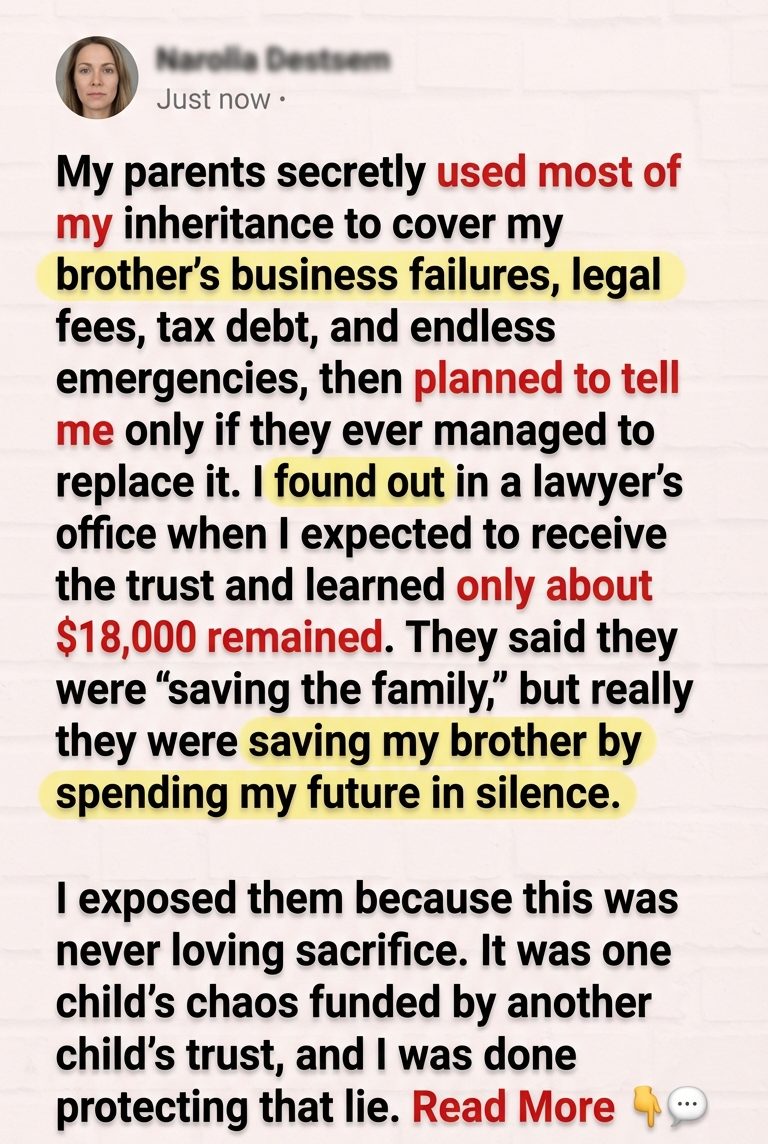
Not one emergency. Not one limited hardship. A pattern. Large transfers over time. The balance remaining was under $18,000. I remember hearing a buzzing sound in my ears and realizing it was coming from inside my own body. When he started explaining the disbursements, I had to ask him twice to repeat himself because the words would not settle into meaning fast enough.
The trust had been used, over several years, to support “family obligations.”
That was the language on paper. Family obligations. Later, when I pulled the detailed records, the truth underneath those words had a name: my younger brother, Tyler. Business failures, credit-card settlements, tax debt, car repossession rescue, legal fees after a DUI, and repeated emergency transfers. My inheritance had become the private shock absorber under the consequences of his life.
Tyler had always been the family’s unfinished project.
He was handsome, reckless, charming, and somehow permanently one bad month away from “really getting his life together.” Every time he crashed into consequences, my parents called it a rough season instead of a pattern. Every rescue was framed as temporary. Every bailout was recast as love. I had spent years quietly watching them pour energy, money, and emotional gravity into him while praising me for being “self-sufficient.”
Now I understood what that self-sufficiency had cost.
I drove straight to my parents’ house.
My mother opened the door and took one look at my face before starting to cry. That told me everything. My father came in from the den, saw the folder in my hand, and immediately began speaking in that calm, managerial tone he used whenever he hoped confidence could replace morality. He said they had planned to explain everything “in context.” Context. Another favorite word of guilty parents.
I asked one question: “Did you use my inheritance to pay Tyler’s debts?”
My mother said, “We did what we had to do.”
That sentence still lives in me like a bruise. Not we’re sorry. Not we panicked. Not we betrayed your trust. They did what they had to do. In other words, they had already morally justified it to themselves. My money was never really mine in their minds. It was family reserve capital waiting to be redirected toward the child who generated more crises.
My father said Tyler would have been destroyed without help.
Maybe that was true. But the part no one in my family seemed eager to name was this: they were willing to let me absorb the destruction instead. Just more quietly. Just more politely. My student loans stayed mine. My future home got delayed. My financial safety margin disappeared. Because I was stable, because I was responsible, because I was not on fire, they decided my future was the easiest thing to burn.
I asked why they never told me.
My mother said they didn’t want to burden me. My father said they intended to restore the money before I turned thirty. That line was so insulting I almost laughed. They had seven years. They didn’t restore it because rescuing Tyler never ended. The next crisis always arrived first, and my trust kept paying for it.
When I confronted Tyler, he shrugged.
That was somehow the most devastating part. He didn’t look ashamed. He looked cornered, maybe inconvenienced, but not morally wrecked. He said Mom and Dad offered to help. He said I still had “more going for me” than he did. Then he said the sentence that made me stop hoping for any decent version of this story: “It’s not like you needed it to survive.”
There it was.
My inheritance had become available in the family’s moral calculus because I was not visibly drowning. Because I had made myself competent enough to function, they treated my future like a pool they could quietly siphon whenever Tyler sank himself again. Stability became my penalty. Reliability became my donation.
I told them all I was getting my own attorney.
That’s when the family shifted from justification to panic. My mother begged me not to “tear the family apart.” My father accused me of ingratitude, which was astonishing given the circumstances. Tyler called me selfish for trying to “punish” them after everything they had done to keep him alive. Funny how often people call boundaries punishment when those boundaries finally interrupt their access.
The legal case was uglier than I expected.
Trust law is full of gray language, and gray language is where families with bad motives go to hide. Some withdrawals were framed as welfare-related support connected to me indirectly, which was absurd but time-consuming to unwind. But the pattern was too strong. There were too many entries. Too many records linking my trust to Tyler’s direct obligations. Too many years of concealment. The judge didn’t need a dramatic speech. The documentation was enough.
I recovered part of the money.
Not all of it. You rarely get all of it back in family betrayal. Some was gone beyond retrieval. Some had become debt settlements that no longer existed to be reversed. But I got enough back to buy a house three years later, though much later than planned and under conditions far tighter than Grandpa ever intended for me. More importantly, I got something else: the right to stop pretending what they did was love.
My parents still frame it as a tragic misunderstanding.
They say they were trying to save the family. But that is the lie at the heart of stories like this. They weren’t saving the family. They were saving Tyler, repeatedly, by quietly spending the child they believed would complain the least and recover the best. My brother’s debts didn’t just eat money. They revealed values. And those values were not mine to protect anymore.
So, AITA for exposing my parents?
No.
I exposed them because secrecy was the only reason they got away with it for so long. Because “family obligation” was just the polite label they gave to choosing one child’s chaos over another child’s future. Because my grandfather left me money to create stability, not to finance Tyler’s endless disasters through a back door I was never supposed to notice.
They called it help. I call it theft with sentimental packaging.
And once I understood the difference, I stopped apologizing for saying it out loud.