My wife asked me to “just hear her out” on a Sunday evening while our daughter was coloring on the floor.
That sentence never means anything good when it comes from a spouse who has already made part of the decision in secret. I knew it the moment she said it. Mara had that tight, careful look people get when they are trying to manage not only your reaction but the timing of it.
Then she told me her brother needed a place to stay.
Julian always needed something.
Rent. A loan. A legal fee. A “bridge.” A chance. A favor that would be temporary until the next temporary thing replaced it. He was one of those men who could make irresponsibility sound like misfortune if you didn’t know him long enough. Unfortunately, I knew him very well. I had been married to his sister for seven years.
I told her no almost immediately.
Not because I’m heartless, but because history exists. Julian had stayed with us before for what was supposed to be ten days and became two months of excuses, missing groceries, late-night noise, and a very suspicious amount of cash disappearing from my desk drawer. Mara called it stress. I called it a pattern. We agreed afterward that he would never live with us again.
That was when she dropped the second truth.
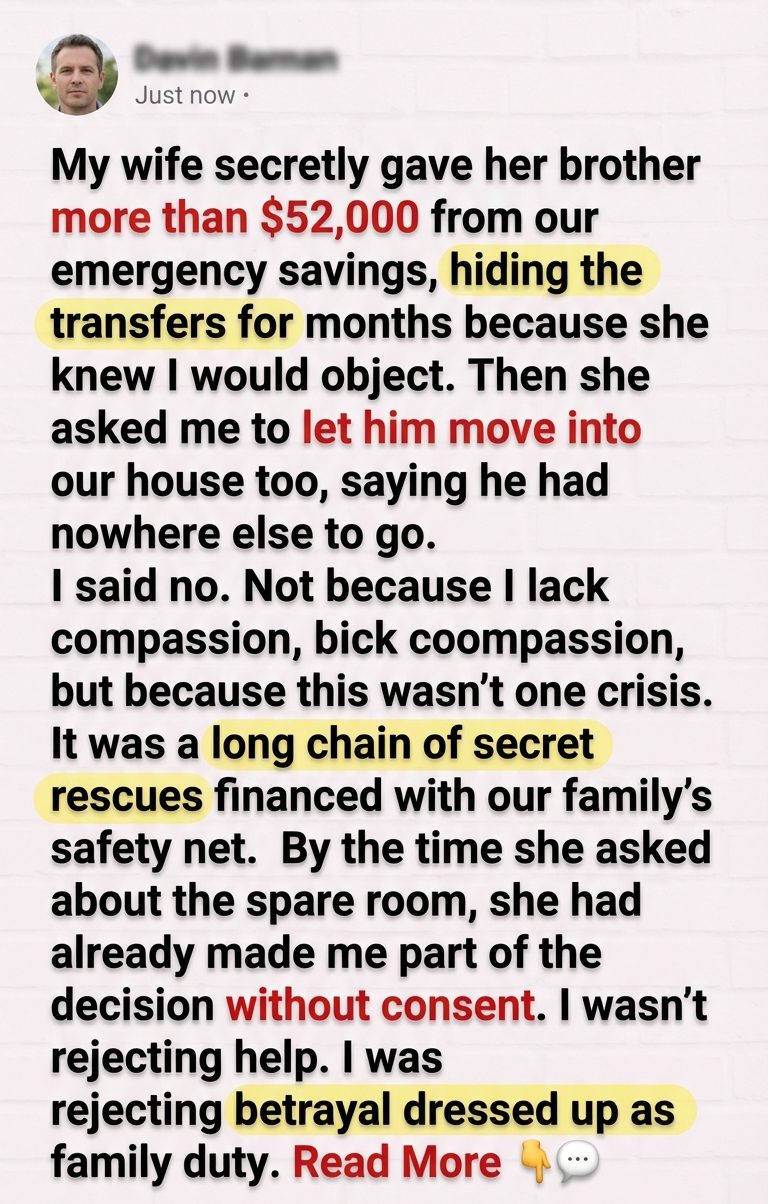
She had already given him money. A lot of money. Not from “her side account,” not from discretionary spending, not from some harmless personal cushion. From our emergency fund. The account we had built for job loss, medical crisis, roof problems, and the other ordinary catastrophes grown adults save for because life has no shame.
“How much?” I asked.
Her silence lasted long enough to make the answer worse before it arrived.
About $48,000.
I sat down because my knees actually weakened.
She said it had happened in stages over several months. First his tax debt, then his rent, then a failed restaurant idea, then legal trouble, then a car situation. Every emergency spawned another one. Every transfer was framed by her as temporary help, and every transfer was hidden from me because she “knew how I felt” about Julian.
Yes. She did know how I felt. That’s why she hid it.
And that is what turned her brother’s chaos into my marriage problem.
If she had come to me and asked for a few thousand, we would have argued, maybe compromised, maybe not. But instead she made unilateral decisions with money we built together and told me only once the damage was large enough that objecting made me look cruel to anyone hearing the story halfway through.
Then she said the part she must have thought would soften me: he had nowhere else to go.
Maybe that was true. Maybe not. Julian was always one conversation away from “nowhere else.” But what I knew for certain was this: my wife had already quietly chosen him over us financially, and now she wanted me to absorb him physically too. She wanted my home, my paycheck, my peace, and my previous boundary all repurposed into one more rescue mission.
I said no again, this time louder.
Mara started crying and accused me of lacking compassion. She said I only see numbers, not people. I told her numbers are people when the money represents our daughter’s safety, our bills, and the future stability of this household. Emergency savings aren’t abstract. They are the difference between one bad month and disaster.
Julian texted me an hour later.
That, more than anything, made my anger go cold. He thanked me in advance for “coming around” and said he knew I would “do the right thing once emotions settled.” Emotions. As if my objection to him burning through nearly fifty grand of our security and then wanting a bedroom in my home was some passing mood rather than basic self-preservation.
I didn’t answer him.
Instead, I spent the next day pulling statements.
The total wasn’t actually $48,000. It was just over $52,000 by the time I traced the full flow—savings transfers, checking reroutes, card payments, cash withdrawals, and a couple of direct wires Mara had mislabeled. She hadn’t merely helped him once or twice. She had been running a private rescue program with shared money and hoping I wouldn’t look closely enough to see the shape of it.
When I confronted her with the corrected total, she got angry that I had “gone forensic.”
That phrase still amazes me. People who hide financial betrayal act offended by the exact level of scrutiny their behavior requires. I told her if she had been honest, I wouldn’t have had to go forensic. She said she was trying to keep her brother alive. I said she was trying to keep me uninformed.
For a few days, the fight became bigger than Julian.
It became about whether a marriage can survive one spouse quietly assigning shared resources to their family of origin while expecting the other spouse to accept the consequences after the fact. Mara kept talking about duty, blood, trauma, and what it means to never abandon people. I kept talking about consent, honesty, and the fact that our daughter should not lose stability because her uncle treats every crisis like a permanent entitlement.
My mother-in-law called.
She said Mara was under terrible pressure and that family helps family. I asked her whether “family” included me and her granddaughter or only Julian. She didn’t answer directly. People rarely do when you ask the question that exposes the whole structure.
Meanwhile, Julian’s version of “nowhere else to go” turned out to include at least two friends, an ex-girlfriend, and a cousin in Arizona. None were ideal, of course. That’s the thing about people like him. Every alternative looks impossible because the only option they really want is the one with the softest landing and the least accountability.
Mara kept insisting I was making her choose.
I wasn’t. She had already chosen repeatedly, quietly, transfer by transfer. I was just the one refusing to decorate that choice with moral language after the fact. There is a difference between forcing a conflict and naming one that already happened.
I changed the passwords on our savings and moved the remaining funds to a new account that required dual approval.
That was the moment she accused me of not trusting her anymore. I said, “Correct.” It wasn’t dramatic. Just true. Trust is not a feeling that returns because the untrustworthy person wants comfort. It either survives the behavior or it doesn’t. Ours didn’t.
Julian never moved in.
Not because Mara accepted my boundary gracefully, but because by the time he realized I meant it, he had already found somewhere else. That discovery made everything even uglier. My marriage had nearly broken open not over literal homelessness, but over a man who simply wanted the easiest option and a sister willing to make that option my problem.
So, AITA?
No.
I refused to let my wife’s brother move in after she had already secretly given him our emergency savings because the issue was never only his need. It was her dishonesty, her unilateral decisions, and the way my objections were treated as cruelty instead of the very normal response of someone protecting his household.
I was not refusing generosity.
I was refusing to let my home become the second half of a betrayal that had already cost us the first.