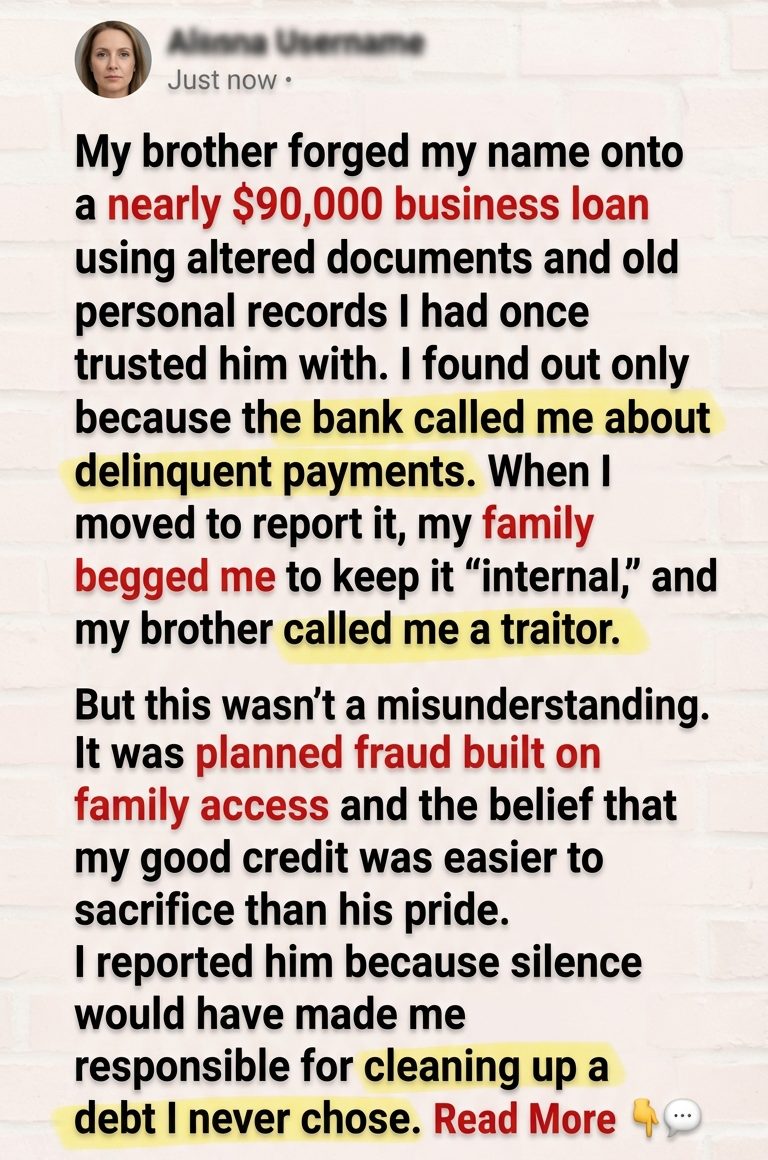
The bank called me at work and asked when I planned to make my overdue payment.
That would have been alarming enough if I had actually had a business loan. But I didn’t. I had never owned a business, never applied for commercial financing, never even discussed doing so. I work in municipal procurement, pay my bills on time, and live the kind of carefully ordinary financial life that keeps emergencies from becoming disasters. That call should have had nothing to do with me.
Instead, it changed my life.
The woman on the phone gave me just enough detail to make denial impossible. The loan was commercial. The balance was nearly $90,000. It was under my legal name, my Social Security number, and my current address. My whole body went cold before I even reached the bank parking lot.
I thought it had to be identity theft by some stranger.
That would have been awful, but simple in its own terrible way. You report it, freeze things, file the paperwork, and start fighting faceless systems. What I wasn’t prepared for was discovering the fraud came from inside the family. Specifically, from my older brother Mason, who had apparently decided my good credit was easier to borrow than actual honesty.
The documents were all there.
Forged signatures. Fake income support using altered copies of records I had once emailed him years ago. A trucking-related business application. A personal guarantee with my name on it. The emergency contact was him. The business address was tied to a warehouse district he’d been talking about for months in those vague, inflated terms he always used—“big move,” “next level,” “just getting things aligned.”
I called him immediately.
He denied it for less than a minute.
Then he switched to explanation. Said he only used my name temporarily. Said his own financing hit delays. Said the contracts were real and he planned to refinance it out of my name before it became “an issue.” That phrase almost made me black out. An issue? My identity attached to ninety grand of debt was not a paperwork inconvenience. It was a deliberate choice to turn me into collateral without asking.
I drove straight to my mother’s house.
Part of me still hoped she would tell me there was some angle I had missed, some misunderstanding large enough to explain what no decent person would do. Instead, one look at her face told me she knew more than she admitted. Not everything, maybe, but enough. Enough to have warned me. Enough to have chosen family quiet over my financial safety.
She cried and said Mason told her it was temporary.
Temporary seems to be the favorite moral deodorant of people who do permanent damage. She said she begged him to fix it before I found out. That sentence enraged me more than if she’d defended him outright. She had known I was being used and decided the right thing was to wait and hope the person harming me sorted himself out before the harm became visible.
The first few days were a blur of fraud reports and disbelief.
I had to explain, over and over, to bankers, investigators, and eventually police officers that yes, my brother had access to old personal documents; yes, I had once trusted him with practical things; yes, the signatures were fake; yes, I wanted it formally recorded. Every sentence felt like translating heartbreak into bureaucracy.
Mason’s defense hardened fast.
He said I was overreacting. Said business is messy. Said I knew how hard life had been for him and should have let him solve it privately. Privately, of course, meaning silently, at my risk, while he protected the version of himself that still got invited to dinner without people checking his hands under the table.
When I told him I was filing a police report, he called me a traitor.
That word spread through the family faster than the actual truth. Suddenly aunts, cousins, and even an uncle I hadn’t spoken to in years had opinions about how siblings should handle things “internally.” Nobody seemed as disturbed by the forged loan as they were by the idea that I might let outsiders know it happened. That is one of the uglier realities of family betrayal: exposure is often treated as the greater sin than the act itself.
My credit took a hit almost immediately.
The bank had already reported payment issues. My score dipped. A mortgage pre-qualification I had been considering quietly disappeared from reach for a while. It’s hard to explain how violating it feels to watch your financial life react to decisions you didn’t make, as if your own name has started misbehaving behind your back.
The bank’s investigator eventually confirmed what I already knew.
The application trail ran through Mason’s devices, his email, and supporting files pieced together from records only a relative or close acquaintance would have had. This wasn’t a one-night panic. It was planned. He had decided long before the call ever reached me that my reliability was a resource he could exploit.
What hurt most was not only what he did, but what he believed.
He believed my stable life made me absorbable. He believed my caution could be converted into his opportunity. He believed that because I had always been the dependable sibling—the one who kept documents organized, showed up on time, and never made the family clean up after me—my identity was easier to use than his own was to repair.
Our mother kept begging me to reconsider the criminal complaint.
She said Mason would never recover from a record. I said I might not recover from his debt if I stayed quiet. She said family should protect each other. I said family should not turn each other into guarantors without consent and then hide behind childhood memories when the bill arrives. We went in circles until finally she had no words left that didn’t sound like excuses.
The hearing was brutal.
Not because there was any mystery left, but because public truth is humiliating even when you are the victim. Hearing my own brother described through evidence, signatures, and surveillance stills felt like watching family become a case file. He avoided prison through a plea and restitution arrangement, but not because he deserved softness from me. Because the evidence and circumstances pushed the system that way.
Relatives still say I “could have handled it differently.”
Maybe. I could have quietly refinanced my own trust around his deception. I could have absorbed months or years of stress, credit repair, and legal risk while pretending siblings just sometimes forge each other onto loans. I could have turned my own injury into the price of family peace. But that isn’t peace. That’s tribute.
So, AITA for reporting him?
No.
I reported him because he forged my name onto a huge business loan and expected family guilt to do the cleanup. I reported him because my mother already knew enough to worry and still said nothing. I reported him because if I stayed quiet, the people who harmed me would have learned the worst possible lesson: that blood makes consent optional and truth negotiable.
My brother didn’t ruin our relationship when I called the police.
He ruined it when he signed my name like my future was his emergency fund.