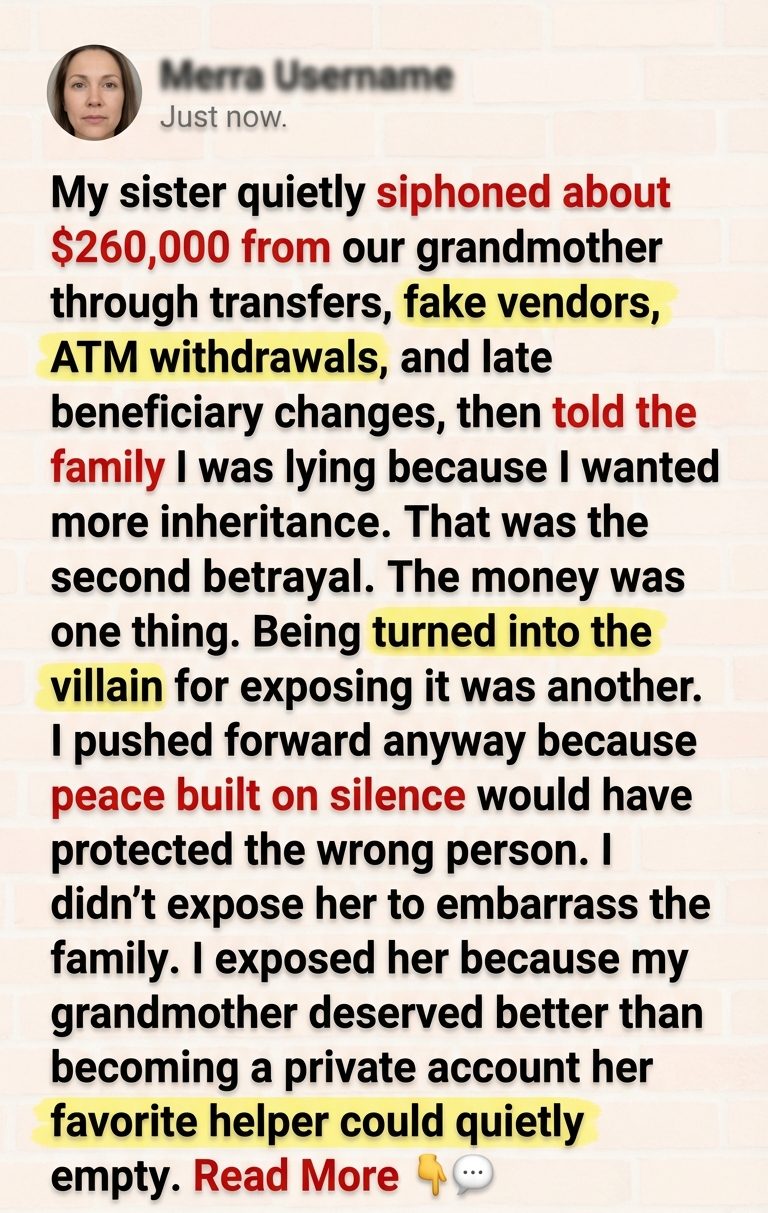
My sister cried first.
That matters, because in my family, whoever cries first usually gets mistaken for whoever was hurt most. Carla has understood that since childhood. She can weaponize tears faster than most people can form a full sentence, and by the time anyone else catches up, the room has already tilted toward protecting her.
When Grandma died, Carla was already positioned exactly where she wanted to be.
She lived closest. She drove Grandma to appointments. She had the debit card “for emergencies.” She had online banking access because Grandma hated passwords. She knew the doctors, the church ladies, the pharmacist, the neighbors, and most importantly, she knew how to look indispensable while slowly becoming financially invisible. Everyone in the family praised her devotion. I did too.
I lived two states away.
I called often, visited when I could, and sent money for extras Carla said Grandma needed—new shoes, a recliner, a better hearing aid. Carla always thanked me warmly, updating me with detailed little stories that made me feel included instead of absent. Looking back now, I realize how carefully that image was managed. She wasn’t just helping Grandma. She was controlling the narrative around Grandma.
At the funeral, people kept hugging Carla and saying, “You did so much.”
I remember feeling grateful toward her, even guilty that I hadn’t carried more of the day-to-day burden. She looked exhausted and fragile in all the right ways. If anyone had told me that week that she had spent years quietly draining Grandma’s accounts, I probably would have defended her.
Then the numbers started not to make sense.
Grandma was cautious to the point of obsession. She kept ledgers in a floral notebook. She clipped coupons for toothpaste. She knew the exact balance of every CD, checking account, and savings bucket because she had built all of it through decades of scrimping. So when Carla started saying Grandma had “burned through much more than people realized” in the last three years, something in me went still.
Grandma simply wasn’t that kind of spender.
I asked for statements. Carla said everything was a mess and she was still sorting it out. I asked again two weeks later. She said the bank had been slow. Then she said some accounts had already been closed. Every answer was vague in exactly the way concrete truth usually isn’t. I didn’t want to accuse her of anything. I just wanted the discomfort to stop growing.
So I called the banks myself.
That was the moment the story split in two—hers and reality.
There were large ATM withdrawals from locations near Carla’s house. Transfers into accounts Grandma had never mentioned. Cashier’s checks to contractors with no clear work history. A brokerage account that had been partially liquidated. One certificate of deposit had disappeared entirely. The deeper I dug, the more obvious it became that this wasn’t bad recordkeeping. It was extraction.
By the time the forensic accountant finished his review, the amount missing or suspiciously diverted was about $260,000.
I remember reading that number and feeling physically embarrassed, like I had failed Grandma by letting someone get that close to her money and then still not seeing it soon enough. People don’t talk enough about how humiliating betrayal can feel for the person who trusted the wrong family member. You start questioning not only what happened but why you didn’t stop it.
When I confronted Carla privately, she laughed.
That was almost worse than denial. She laughed and said I had always resented how close she was to Grandma. Then she told me Grandma had wanted her to have more because she “did everything.” It was a neat little moral frame: I was the distant relative arriving late and counting pennies, while she was the devoted caregiver being punished for sacrifice. If you didn’t know the records, it almost sounded plausible.
The problem for her was that I had the records.
I listed the transfers. The ATM patterns. The fake “home modification” payments that lined up with a kitchen remodel at Carla’s own house. The beneficiary changes made when Grandma was too weak to even drive, much less reorganize her finances. Carla stopped laughing then. But she didn’t confess. She went on offense.
Within forty-eight hours, half the family had heard her version.
According to Carla, I was lying because I wanted more inheritance. I couldn’t stand that Grandma trusted her. I was bitter about living far away and guilty that I didn’t do more, so I was inventing fraud to ease my conscience and grab cash. By the time I realized how aggressively she’d started spinning it, relatives were already texting me things like, “This isn’t the time for ugly money fights.”
That part broke my heart more than I expected.
I could handle legal paperwork. I could handle statements and calculations. What I wasn’t ready for was being painted as greedy while trying to protect my grandmother’s name. Carla didn’t just steal from Grandma. She tried to make truth look like envy. She knew that if she got to people emotionally first, facts would have to fight uphill.
My mother begged me to let it go.
Not because she believed Carla was innocent, but because she wanted peace. She used all the usual family language—don’t tear everyone apart, think of the kids, Grandma wouldn’t want this, maybe it was a misunderstanding. I told her there is no misunderstanding large enough to explain $260,000, fake vendors, and changed beneficiary forms. Peace built on silence is just another reward for the person who already took the most.
The court process was ugly.
Carla cried in hallways and clutched tissues like props. Her lawyer emphasized caregiving stress, family jealousy, emotional labor, and informal gifts. Some of that probably sounded compelling to people who wanted the world to stay morally convenient. But paper is stubborn. Dates, surveillance, transfer logs, signatures, device records—those things don’t cry. They don’t need to. They just sit there and make storytelling smaller.
The judge didn’t need dramatic language.
The facts did the work. The court froze certain distributions, reversed some late changes, and ordered restitution measures tied to Carla’s home equity and assets. It wasn’t cinematic. No one shouted “thief” in a courtroom. But the ruling said what needed saying: this was not family confusion. It was misappropriation.
Afterward, some relatives apologized.
Some didn’t. A few did that irritating half-apology where they admit Carla went “too far” but still say I could have handled it “more quietly.” Quietly how? By letting the lie stick? By preserving family comfort while Grandma’s life savings turned into Carla’s remodel and shopping money? People love the idea of quiet when the noise would force them to choose sides honestly.
I still think about Grandma’s hands.
She had these tiny strong hands, always warm, always smelling faintly of lotion and tea. She trusted Carla because she thought love and usefulness meant safety. That is the part that makes me ache most. Grandma was not foolish. She was old, dependent, and family-trusting in the way many elderly people become because they think blood will guard what strangers might exploit.
Carla and I don’t speak anymore.
Sometimes people say, “That’s so sad.” It is sad. But sadness isn’t the same thing as uncertainty. I know exactly why we no longer speak. She stole from our grandmother, then tried to save herself by telling everyone I was a liar who only wanted more money. What ended us was not merely the theft. It was her willingness to hand me the shame of it and hope the family would wear it for her.
So, AITA for exposing her?
No.
If anything, I waited too long because I still wanted my sister to be the person I thought she was when I first started asking questions. But facts do not stop existing because they make holidays awkward. Carla counted on family discomfort, sentiment, and her own performance to bury what she’d done. She was wrong.
My grandmother deserved better than being turned into a private funding source in her final years.
And I deserved better than being called greedy for refusing to let that happen in silence.