The day I found out my husband gave away our house fund, I was holding paint samples.
I had spread them across the kitchen table in neat little rows—soft gray, warm white, muted sage—trying to imagine what our first real home would feel like after years of renting. I had spent months saving listings, comparing school districts, and calculating what we could finally afford. For the first time in a long time, our future looked close enough to touch.
Then the mortgage broker called.
At first, I thought it was just another routine document request. She had already asked for pay stubs, tax returns, and bank statements twice. But her tone sounded different that morning—careful, professional, the way people sound when they suspect they are about to deliver news that doesn’t match what you think is true.
She asked if I was aware that our down payment account had dropped significantly in the last six months.
I laughed because I thought she must be talking about some other account.
It wasn’t another account. It was our house fund. The account we had built together over four years by skipping vacations, driving our old cars until they rattled, saying no to dinners out, and telling our kids “maybe next summer” every time they asked for something extra. It had once held just over $96,000. According to the statement she emailed me while we were still on the phone, less than $14,000 remained.
I stared at the number so long my vision blurred.
My husband, Caleb, had access to the account just like I did, but I handled most of the budgeting. I paid bills, moved money between savings buckets, and kept spreadsheets because I like knowing where our life actually stands. Caleb used to tease me about it, calling me “the family CFO,” but it never seemed cruel. I thought he appreciated that someone was paying attention.
What I didn’t know was that while I was tracking our future, he was quietly dismantling it.
When he got home that night, I had the statements printed and laid out in order on the dining table. I didn’t scream. I didn’t cry. I just asked, “Where did the money go?”
He didn’t answer right away.
That hesitation told me everything before his words did. Then came the sigh. Then the hand over his face. Then the line every betrayed spouse eventually hears in one form or another: “I was going to tell you.”
He had not been going to tell me.
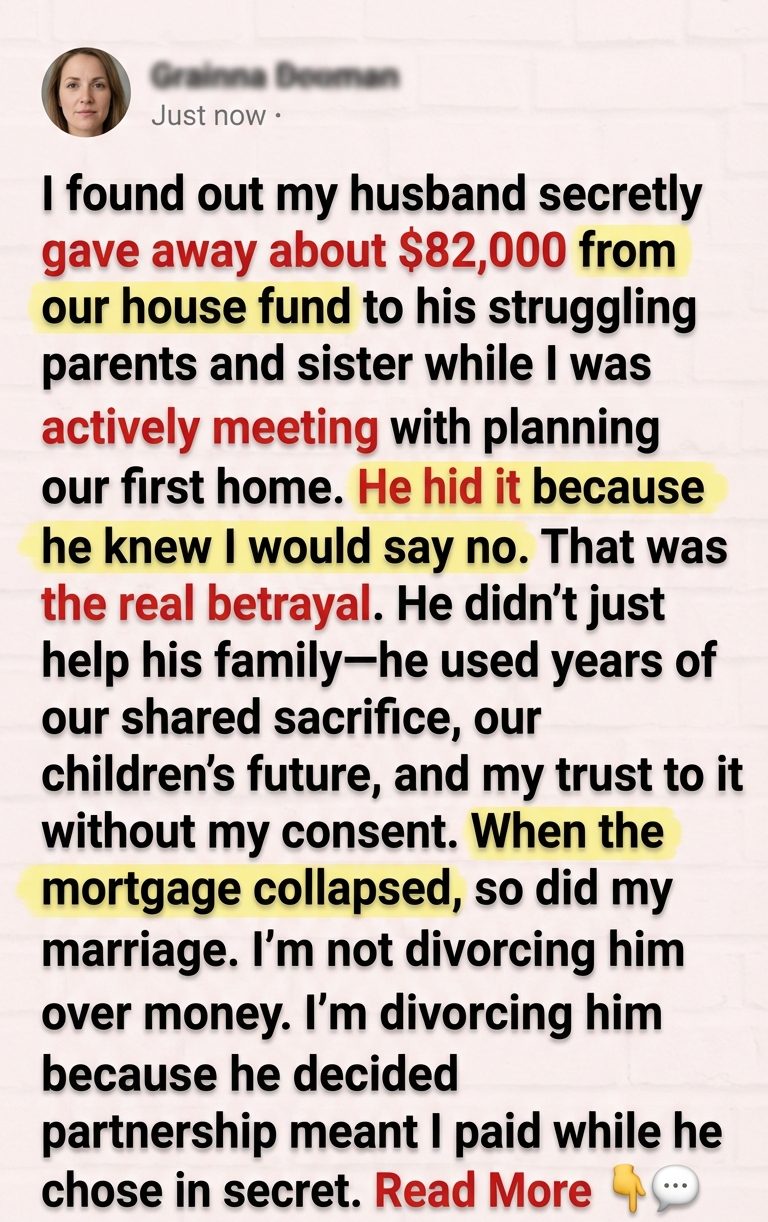
Over the previous eight months, Caleb had transferred roughly $82,000 from our house fund to his parents and younger sister. At first, he said, it was temporary help because his father’s contracting business had collapsed. Then there were medical bills for his mother. Then his sister needed rent and tuition assistance after leaving an abusive boyfriend. Each crisis led to another transfer, and each transfer became easier once the first one had already crossed the line.
I asked why he never told me before making any of those decisions.
He said he knew I would say no.
That answer hit me harder than the money itself.
Because he was right—I would have said no, at least not without a real discussion, not without boundaries, not without understanding what helping would cost our own children and our own future. But instead of respecting that, he had simply removed my right to participate. He didn’t ask for compromise. He bypassed me completely.
Then he said something worse.
He said, “They’re my family. I couldn’t just let them drown.”
I looked at him and thought, And what are we?
Were our children not his family? Was I not? Was the home we had spent four years trying to build somehow less urgent than the endless emergencies of people who had never once paid our bills, watched our kids, or helped us carry anything? His loyalty was not the issue. The secrecy was. The scale was. The fact that he had made himself a hero in one household by betraying the other.
I asked whether anyone in his family knew where the money came from.
He admitted his sister knew. His mother suspected. His father, according to Caleb, “didn’t ask too many questions.” That part made me feel physically sick. They all accepted help from my children’s future and let me keep browsing houses, comparing loan rates, and dreaming about front porches and school pickups like I wasn’t financing their rescue behind my own back.
For a week, I moved through the house like someone living inside a noise only she could hear.
I made lunches. I drove the kids to school. I answered work emails. I folded laundry. Real life does not pause just because your marriage cracks open in the middle of it. That may be one of the cruelest parts of betrayal. You still have to buy milk while your whole understanding of your spouse is rearranging itself.
Caleb kept trying to frame what he did as generosity, not deceit.
He said he never spent the money on himself. He said he was trying to prevent homelessness, debt collectors, and more suffering in his family. He said he believed we could rebuild faster than they could. That sentence stayed with me. We could rebuild faster than they could. Meaning he knew the loss was real. He just decided I was strong enough to absorb it.
That was when I understood the deeper betrayal.
He had not simply taken money. He had spent my discipline, my planning, my years of saying no to myself, and the little sacrifices our children had made without ever knowing their father was privately undoing them. He did not just empty an account. He quietly volunteered me to subsidize another family’s collapse.
My friends were split when I finally told them.
Some said he had a good heart and made a terrible decision under pressure. Some said financial betrayal is still betrayal. One friend asked the question that ended all my confusion: “If he believed it was the right thing to do, why did he hide it?” There was no good answer to that, because all good motives collapse under deliberate secrecy.
I asked Caleb whether his family planned to repay us.
His expression changed immediately. He said repayment wasn’t the point. He said they were surviving, not borrowing. In that moment, the truth became painfully simple. I had not been part of a temporary sacrifice. I had been drafted into a permanent one without my knowledge.
The next time I met with the mortgage broker, I went alone.
She was kind, which somehow made it worse. She explained, gently, that with our reserves reduced and cash flow tighter than expected, we would not qualify for what we had planned. We could either wait years and rebuild or lower our expectations dramatically. I nodded like a competent adult and then cried in my car for twenty minutes with the engine off.
When I got home, Caleb asked how it went.
I said, “We’re not buying a house.”
He looked devastated then, but I couldn’t comfort him. I had spent too much of the last week resisting the urge to comfort the person who created the wound. Women are trained to do that. I was done.
The divorce conversation happened on a Thursday night after the kids were asleep.
He stared at me like he had not considered that consequence seriously, which only made me angrier. He thought I would scream, punish him emotionally, maybe freeze him out for a while—but ultimately stay and rebuild around the betrayal because that is what wives are expected to do when men make “impossible choices.”
I told him this was not about money alone.
It was about partnership. About trust. About the fact that he looked at years of shared effort and decided he was entitled to redirect it without my consent. It was about him choosing to be honest with everyone except me. It was about our children losing a home they never even got to want yet because he needed to feel like a savior elsewhere.
His mother called me three days later.
She cried and said she never wanted to come between us. She said family should pull together in hard times. I listened, then asked one question: “When you took that money, did you ever once ask what your grandchildren were giving up for it?” She had no answer. That silence told me everything I needed to know about how much my family had mattered in their version of events.
The divorce is still ongoing.
The house fund is gone. The kids and I still live in the same rental, and every time the upstairs faucet rattles or the landlord delays repairs, I feel a stab of grief for the life we almost had. But the grief is cleaner now because it belongs to reality, not deception. I can survive disappointment. What I cannot live inside is a marriage where my sacrifices are considered available for secret reassignment.
So, AITA?
No. I don’t think I am.
My husband did not just help his struggling family. He used false partnership to fund it. He made unilateral six-figure decisions with money we built together, hid it while I planned our future, and expected me to admire the compassion he showed everyone but me. Divorce was not punishment. It was the first honest boundary I had left.
And the hardest truth of all is this: if he had come to me with the truth from the beginning, maybe we could have faced it together. But he didn’t want partnership. He wanted permission without the risk of hearing no. When someone takes that from a marriage, the account isn’t the only thing they empty.