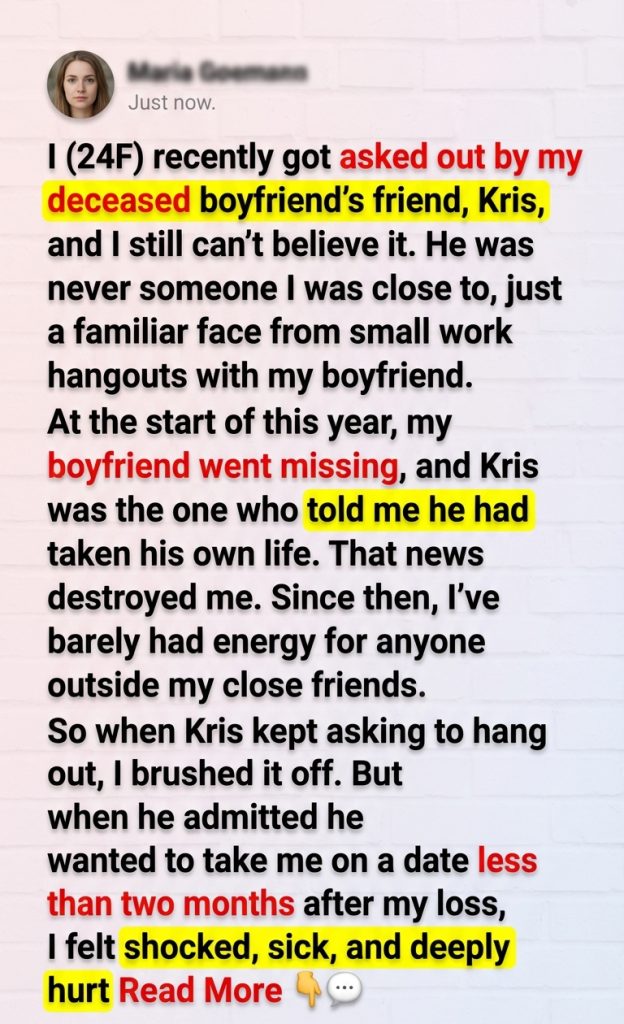
I (24F) recently got asked out by my deceased boyfriend’s friend (30M), and I’m at a loss for how to respond.
For context: My boyfriend had a friend that he was semi-close with due to work ties. They weren’t super close, but they were friendly enough that my partner and I would get invited to small hangouts and parties. For the sake of the story, we’ll call the friend Kris. Kris and I didn’t talk much during these parties, but we’d make small talk here and there. Always just casual things about how work was going or different shows we were currently watching. But other than that, not much interaction.
Fast forward to the start of this year: My boyfriend had gone MIA, and Kris ended up contacting me to let me know that my boyfriend had tragically taken his life, and that Kris had only found out because of a family friend they worked with. This news shattered me. Kris and I talked a bit over text about how out of left field this felt and how truly heartbroken we both were. Since then, we haven’t really communicated other than hanging out once so that I could debrief Kris about how my partner’s funeral went since he could not attend. This all happened back in January of this year. Since then, Kris has asked me a few times to hang out, but truthfully I haven’t had the energy nor the desire to try and hang out with anyone outside of my close friend group. So I kept making excuses. Alarm bells didn’t start going off, however, until he texted me saying how he’d love to “take me out to dinner sometime.” I first figured I was reading into it until I declined due to being busy and he came right out with it. He flat-out texted me, “No worries, I really just want to ask you out on a date.”
To say I’m gobsmacked is an understatement. My partner passed not even two months ago, and he made the bold move to ask me out. I’m just at a loss about how to even respond to this situation because I have zero feelings for him, and it feels wildly inappropriate.
I would love any advice on how to move forward. I’m still very hurt from losing my partner, and this for sure wasn’t on my 2026 bingo card.
Grief does not arrive with order or dignity. It crashes into the body in strange ways, stealing appetite, sleep, focus, and even language. Some mornings, I wake up and forget for half a second what happened, and in that small, merciful pause, life feels normal again. Then it hits me all over, and the whole day bends under the weight of remembering.
Before all of this, my life was simple in the kind of way I used to take for granted. My boyfriend and I had routines, inside jokes, favorite takeout places, and those little habits couples build without noticing. I knew the sound of his footsteps, the way he texted when he was in a hurry, and how he always acted like he didn’t care what we watched as long as we were watching it together.
He was not just someone I dated. He was the person woven into my day in a hundred invisible ways. He was the first person I wanted to tell things to, the one I reached for when something funny happened, the voice I expected at the end of the night. Losing him didn’t just mean losing a person. It meant losing the shape of my life.
Kris had always existed somewhere at the edge of that world. He was never central, never someone I thought deeply about. He was just one of those familiar faces that become part of the social background when you’re with someone long enough. If my boyfriend was the center of the picture, Kris was somewhere in the corner, smiling politely, holding a drink, asking harmless questions.
That was why none of this felt strange at first. When he texted me to tell me what had happened, I didn’t think of him as anything other than a messenger of terrible news. In some twisted way, he became attached to the worst day of my life. Even now, I can still remember the sensation of reading those words and feeling like the room had changed temperature.
I remember staring at my phone, rereading the message because my brain refused to process it. There are some sentences that do not feel possible even when they are in front of you. My chest felt tight, my hands went cold, and the floor beneath me suddenly didn’t feel stable. I think I sat down without realizing I had moved.
The hours after that were a blur of shock and disbelief. Phone calls. Tears. Silence. More tears. At some point, time stopped moving normally. The world outside kept going, but mine had split open. People say they are sorry for your loss, but those words never seem large enough for a loss that takes the air out of your lungs.
During those first few days, Kris and I exchanged some texts. Nothing unusual, nothing intimate. Just shock, sadness, and confusion. It felt natural at the time because we were two people trying to understand the same terrible reality from different angles. I thought that was all it was—a brief thread of grief between two people who had both cared about the same man.
Then came the funeral, which somehow felt both unbearably fast and impossibly delayed. I don’t think anything prepares you for seeing someone’s life reduced to flowers, framed photos, and trembling voices. I stood there listening to people talk about the man I loved in the past tense, and every sentence sounded wrong, like the world had started speaking a language I never agreed to learn.
Kris couldn’t attend, so later I met with him once and told him how it went. I filled in the details he had missed. I told him who came, what people said, how the room felt, and how hollow I was by the end of it. It wasn’t some emotional bonding moment. It was more like completing an unfinished task, something I did because it felt polite and maybe necessary.
After that, I withdrew. Not dramatically, not in a way people on the outside would necessarily notice. I just stopped having space for anyone. My close friends were the only people I could tolerate for long. They were the ones who let me be quiet, let me cry, let me cancel, and never made me explain myself. Everyone else felt exhausting.
That included Kris. When he started texting to ask if I wanted to hang out, I kept it casual and distant. I said I was tired. I said I was busy. I said maybe another time. The truth was much simpler: I did not want to spend time with him. I barely wanted to spend time with myself. The idea of forcing conversation with someone outside my small safe circle felt unbearable.
Still, he kept asking. Not aggressively, but enough that I noticed the pattern. At first, I told myself he was probably just trying to be nice. Maybe he thought he was helping. Maybe he thought I needed company. Grief can make you suspicious, but it can also make you overly forgiving because you don’t want to believe anyone would choose this moment to make things harder.
Then came the dinner text. “I’d love to take you out to dinner sometime.” I must have read that line ten times. Something in it felt off immediately, but I still doubted my own instincts. Maybe I was reading too much into it. Maybe I had become so fragile and defensive that even an innocent offer felt loaded.
So I declined and blamed being busy. I handed him the easiest exit possible. It was polite, clear enough, and left no room for awkwardness if he wanted to back out. But instead of taking the hint, he stepped straight through it. That was when he texted that he really just wanted to ask me out on a date.
I wish I could explain the exact feeling that washed over me in that moment. Shock, yes. Disgust, maybe. Hurt, definitely. But more than anything, it felt like something sacred had been mishandled. My grief was still raw, still open, still bleeding into every part of my day, and somehow he had looked at that and seen a possibility.
What made it worse was how recent everything still was. Not years. Not even many months. Barely two months since the man I loved died. Barely two months since I learned the news in the most brutal way possible. Barely two months since I had stood at a funeral trying to understand how a future could vanish so suddenly. And here was his friend, asking me out like enough time had passed.
That was the part that made me feel almost dizzy. Because it wasn’t just that I had no feelings for Kris. I truly didn’t, and I never had. It was that the timing itself felt offensive. Wildly inappropriate. Almost like my heartbreak had made me visible to him in a new way, not as a grieving person, but as someone suddenly available.
I hated that thought. I hated it because it made me question every text he had sent since January. Had he really been checking on me because he cared? Were the invitations really about friendship? Or had he been slowly circling, waiting for a moment that he believed was acceptable? Once that doubt entered my mind, it poisoned everything.
And grief already poisons enough. It changes memory, sleep, appetite, patience, and trust. It makes you doubt yourself, then hate yourself for doubting. The last thing I needed was to start wondering whether someone had been using my most vulnerable season as an opening for romance. There is something deeply unsettling about realizing that while you were mourning, someone else may have been calculating.
I sat with my phone in my hand for a long time, unable to answer. Part of me wanted to ignore him forever. Part of me wanted to send a message so sharp it would leave no room for confusion. I wanted to tell him how incredibly inappropriate this was, how offensive it felt, how little regard it showed for what I was living through.
But another part of me was just tired. Tired in the bone-deep way grief creates. Tired of explaining, tired of being the one who had to stay composed, tired of having to manage not only my own pain but other people’s behavior around it. Some days, surviving my grief felt like a full-time job. I did not want this added to my workload.
The more I thought about it, the clearer one truth became: I did not owe him a soft landing. I did not owe him gratitude for his interest. I did not owe him a carefully edited response that protected his ego while I was still trying to survive the wreckage of my own life. If anything, I owed myself honesty.
So I started imagining what I actually wanted to say. Not the polite version. Not the version shaped by fear of seeming rude. The real version. The version that said: I am not interested. I am grieving. This feels inappropriate. Please do not ask me again. Those words were simple, but they carried something I had been struggling to reclaim—my boundaries.
That was when I realized how much this situation had shaken me. Not because I was tempted. Not because I was confused about him. But because loss leaves you feeling stripped down, and when someone crosses a line during that time, it reminds you how exposed you really are. I had already lost my partner. I didn’t want to lose my sense of safety too.
I also thought about what my boyfriend would think if he knew. That thought hurt, but it also grounded me. He trusted the people around him, and I had trusted his world because it was his. Maybe Kris had convinced himself this was harmless, or maybe he thought enough time had passed. But deep down, I think most people know when something is wrong, and this felt wrong.
The truth is, some people do not understand grief unless they have lived inside it. They think pain softens quickly. They think funerals create closure. They think surviving something means moving forward at a pace that makes sense to them. But grief is not neat, and it is not efficient. It lingers. It circles back. It lives in the body long after everyone else has resumed normal life.
That is why this hit me so hard. Because I am still in it. I am still waking up into a reality I did not choose. I am still carrying questions that will never have answers. I am still trying to make peace with a silence that used to be filled by someone I loved. There is no emotional room in me for someone else’s timing, desire, or misplaced confidence.
If I have learned anything from the last two months, it is that the people worth keeping close are the ones who respect pain without trying to turn it into something useful for themselves. They sit beside it. They do not force it to move faster. They do not treat a wound like an opening. They let grief be grief.
My close friends have done that for me. They have let me be messy. They have let me cancel plans. They have let me tell the same story more than once, or say nothing at all. They do not ask me to perform healing so they can feel comfortable. They simply show up. That kind of love asks for nothing in return.
By contrast, Kris’s message felt like a demand disguised as courage. Maybe he thought he was being honest. Maybe he thought honesty would earn him points. But honesty without empathy is just selfishness in cleaner clothes. And asking out a grieving woman so soon after her partner’s death is not bold in a romantic way. It is deeply tone-deaf.
I know now that how I respond matters less than the fact that I do respond in a way that protects me. Whether I choose a direct message, a short rejection, or silence followed by blocking him, the important thing is that I do not betray my own instincts to make someone else comfortable. My discomfort is already telling me everything I need to know.
So if I answer, it will be simple and clear. I’m not interested. I’m still grieving. Your message felt inappropriate, and I need space. No extra softness. No room for interpretation. No apology for having boundaries in the middle of heartbreak. There are seasons in life where being direct is not cruelty. It is survival.
And maybe that is the real ending here. Not that a man asked me out at the worst possible time. Not even that I was gobsmacked by it. The real ending is that grief, for all its devastation, is teaching me something about clarity. It is teaching me who is safe, who is selfish, and who deserves access to me when I am most fragile.
I still miss my partner every day. I miss the future we were supposed to have, the ordinary moments we never got to finish, and the comfort of being known by someone who felt like home. That loss does not get smaller just because the calendar keeps moving. It stays heavy in new ways, reshaping everything I thought I understood about love and life.
But one thing I do know is this: I do not have to accept behavior that makes an already unbearable situation worse. I do not have to entertain someone just because they were brave enough to ask. I do not have to make room for romance where grief still lives. And I do not have to feel guilty for shutting a door that never should have been opened.
This was not on my 2026 bingo card. Losing my partner wasn’t either. Neither was learning that some people can stand close to tragedy and still center themselves. But if there is any strength I can claim right now, it is this: even in the middle of heartbreak, I still know when something feels wrong. And I am allowed to trust that.