I started the education fund when my daughter was five.
At that age, she still slept with one hand curled under her cheek and believed every adult voice around her had the power to define the world. I would stand in her doorway at night and think about how fragile a beginning really is. You do not just raise a child with food and rules. You raise them with the things they never fully see—safety, planning, the invisible financial scaffolding that lets them imagine adulthood without fear.
So I built that scaffolding quietly.
Every bonus, every tax refund, every side contract I took as a consultant, I skimmed something into the account. I did not tell many people. Not because I was secretive, but because I wanted the fund protected from exactly the kind of family entitlement that can wrap itself around a child’s future before the child is old enough to defend it.
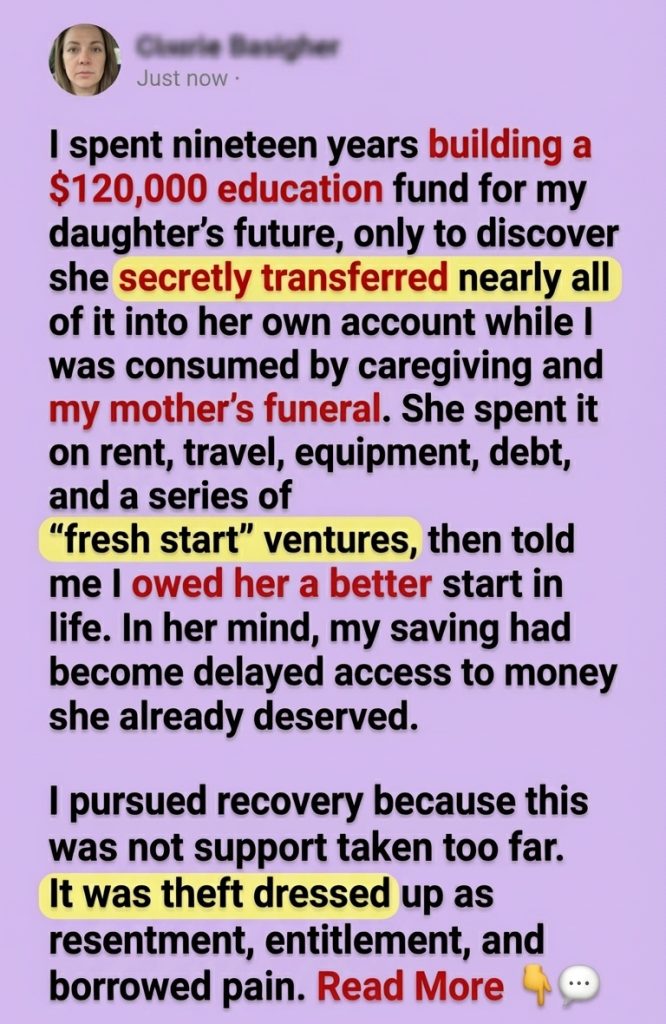
By the time Ava turned twenty-four, the account held just over $120,000.
She knew about it in broad terms. I had always told her there was money set aside for education, training, graduate school, or the kind of early-adult stability that real ambition requires. I said it was there for her future, not for nonsense. She would laugh, hug me, and tell me I worried too much. Mothers often confuse being heard with being understood.
Ava was brilliant, charismatic, and chronically dissatisfied.
She changed majors twice, then left college with one semester remaining because she said the system was stifling her. She wanted to launch a design brand, then pivoted to digital marketing, then talked about documentary filmmaking, then a community-art nonprofit. Every new identity arrived with thrilling language and very little structure. She was never exactly lazy. She was simply addicted to the feeling of beginnings and resentful of everything that came after.
I helped too much.
A security deposit once. Software for freelance work. A used car when hers died. A small bridge loan after a breakup. Each time, she framed the request as part of a bigger plan. Each time, I told myself support was not the same as enabling. Each time, the line blurred further.
The theft happened during the year I cared for my mother through the end of her life.
Grief is a terrible time to be responsible for both an aging parent and an adult child whose relationship to money is built on aspiration instead of discipline. I was traveling constantly between work, hospice, paperwork, and exhaustion. Ava visited often and offered to “help organize” my documents, passwords, and online access because I was visibly fraying at the edges.
I thanked her for being thoughtful.
Three months after my mother’s funeral, I logged into the education fund because I wanted to move part of it into a more conservative vehicle. The balance was so low I first thought I had clicked the wrong account. Then I saw the transfers. Large ones. Repeated ones. A linked external account added weeks earlier. Verification settings changed. Alerts silenced.
I called the institution in a state of stunned disbelief.
The representative was calm, almost too calm, as she walked me through the access history. The logins traced to Ava’s device. The external account belonged to her. The transfers, totaling nearly the entire fund, had been executed over two months while I was buried in caregiving and funeral arrangements. My daughter had chosen the season of my deepest distraction to take the money intended to give her a future.
When I confronted her, she did not crumble the way innocent people do under false accusation.
She sat on my sofa with her hands wrapped around a mug I had bought in Santa Fe years earlier and said, “You were always going to use it on me.” There was no shame in her voice, only logic twisted around entitlement. That was the moment my grief shifted into something colder.
I asked whether she understood that the account was not available for whatever she wanted whenever she wanted it.
She told me I had spent years promising her security and then using the money as leverage to control the timing and shape of her life. She said she deserved a better start than the one I had actually allowed. She said watching friends get help with apartments, travel, and creative ventures made it obvious I was hoarding her opportunities in the name of caution.
I stared at her and understood, perhaps for the first time, how thoroughly she had rewritten care into oppression. In her mind, my saving had not been protection. It had been delayed access to something she believed was already hers by emotional right. The fact that she took it during the worst season of my adult life seemed, to her, merely efficient.
She had spent the money fast.
Debt payoff. A loft rental. Brand design packages. Equipment. Travel marketed to me later as “networking opportunities.” A car upgrade. A retreat in Joshua Tree with people whose social media bios promised transformation and likely delivered invoices. The account I had built over nineteen years disappeared into one year of curated reinvention.
I asked why she never came to me honestly.
Her answer was chillingly simple. “Because you would have said no.”
Yes, I would have. That was the whole point. Not because I wanted to deny her life, but because education money exists to secure possibility, not finance mood and momentum. She had not been forced into theft by need. She had bypassed consent because permission would have slowed desire.
My sister tried to mediate. She said Ava was acting from pain and comparison, that maybe she had always felt my standards were impossible. Perhaps. But pain does not authorize theft, and comparison is not an emergency. What most upset me was how many people wanted to discuss her feelings before discussing my loss. That is one of the crueler social reflexes around family betrayal: the victim is expected to parent the offender through accountability.
Ava cried when she realized I was serious about legal action.
Until then, she seemed to believe outrage was just another maternal weather pattern that would pass if she stood still long enough. But lawyers, account records, and frozen assets create a different atmosphere. Suddenly she talked about misunderstanding, future repayment, emotional overwhelm, and how crushed she felt by my response. My response. Not her theft.
She even said, at one point, “I thought you wanted me to have a better start than you did.”
That sentence gutted me because it touched the deepest truth and distorted it beyond recognition. Yes, I wanted her to have a better start. That is why I spent almost twenty years building something structured, patient, and stable. She did not want a better start. She wanted immediate access to the symbol of one, without accepting the discipline that makes it last.
I pursued civil recovery rather than criminal charges, partly because I could not yet bear the full public destruction of what remained between us. A judge sees theft clearly, but a mother must then go home and live with the fact that the defendant once held her finger crossing parking lots. That complexity is not weakness. It is simply one of the prices of loving someone before they betray you.
The court documents were merciless in their clarity.
Unauthorized transfers. Access changes. Device links. Beneficiary confusion weaponized into false entitlement. The law had a cleaner language for what my heart had been drowning in. It was not a family misunderstanding. It was misappropriation. That word gave me more peace than most apologies ever could.
Ava now repays me monthly under a structured agreement she hates and pretends is oppressive. We speak rarely. Holidays, sometimes. Stiff check-ins. Her life, unsurprisingly, did not transform under the weight of stolen money. The loft ended. The brand dissolved. The network vanished. All that remained was debt, embarrassment, and the mother she accused of denying her what she had already thrown away.
My daughter secretly took $120,000 meant for education and said I owed her a better start in life. But a better start is not something you can steal from the future without consequence. I built that money to become a bridge. She used it as a bonfire. And the worst part was not the loss itself. It was realizing she had looked at years of my care and seen only a delayed payout.