My parents liked to tell the story of my college fund as if it were proof of their devotion. At family gatherings, my mother would pat my shoulder and say, “We started saving when he was little.” My father would nod proudly and mention compound interest as if he had personally invented discipline. The story became part of my identity long before I ever saw an account statement. I was the kid whose future was being protected.
I believed them completely.
Why wouldn’t I? My parents were not reckless people in the obvious sense. They paid their bills on time, owned a tidy home, hosted Thanksgiving every year, and loved presenting themselves as practical adults who did things the right way. We were not rich, but we were stable, and stability is persuasive when you’re young enough to confuse appearance with truth.
From the time I was twelve, my mother reminded me not to worry too much about student debt because “we’ve been preparing.” When I got good grades, my father would grin and say, “That fund better be worth it.” It was all spoken with love, or what looked like love. So I studied hard, joined clubs, and applied to schools believing the financial base of my future was real.
By senior year of high school, I had been accepted to two state universities and one private school that offered a partial scholarship. I was thrilled, overwhelmed, and proud. More than anything, I felt ready. I had worked for this. My parents had prepared for this. For once, life seemed to be unfolding exactly the way adults always promise children it can if everyone does their part.
Then the financial-aid forms came due.
I asked my parents for the account details so I could estimate how much we needed to cover after scholarships and grants. My father said he would pull everything together over the weekend. My mother told me not to stress. I noticed the way they avoided my eyes, but I interpreted it as normal parental anxiety about tuition numbers. I had not yet learned that guilt and worry can look similar from across a kitchen.
The following Sunday, they sat me down at the dining table.
There are conversations that divide a life into before and after, and sometimes they begin in a tone so calm it feels almost insulting. My mother folded her hands. My father stared at a water ring on the table. Then he said, “There’s less in the fund than there used to be.”
Less.
That soft little word crashed into me harder than shouting would have. I asked what he meant. My mother jumped in quickly, saying the recession years had hit them harder than expected, then the roof needed repairs, then Dad’s business had a slow period, then there were medical costs, then “we intended to replace it.” Each phrase landed like a brick. I kept waiting for the amount, for some version of bad but survivable.
Finally, I asked, “How much is left?”
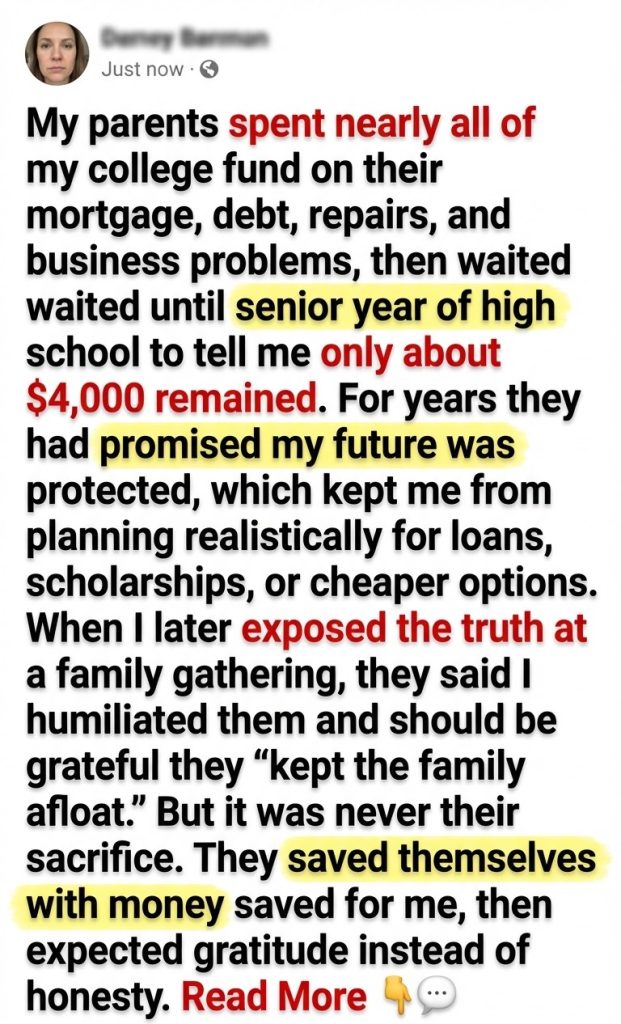
My father said, “About four thousand.”
I laughed. Not because it was funny, but because the number was so far from what I had been led to believe that my body rejected it like poison. Four thousand dollars. After years of promises. Years of speeches about preparation. Years of telling me not to worry. They had not just under-saved. They had emptied the future they had marketed as secure.
I asked where the money had gone.
The answer was a parade of adult failures dressed as necessity. Mortgage payments during a bad year. Credit cards after my mother’s surgery. A business loan my father had personally guaranteed. Car repairs. HVAC replacement. Some home-equity shuffle that made no sense even after they explained it twice. Every problem they described may have been real. But none of it changed the core truth: they had used my college fund to save themselves and simply hoped time would hide the damage.
“What was I supposed to do?” my father snapped at one point. “Let us lose the house?”
That question haunted me for years because it was both manipulative and revealing. In his mind, the only available options were his crisis or my future, and he had long ago chosen himself without fully admitting it. Worse, he expected that once I understood the pressure, I would bless the choice retroactively. Sacrifice, he called it. But sacrifice usually means surrendering your own comfort, not your child’s promised foundation.
I ended up going to the state school closest to home because it was the only financially viable option after grants and loans were calculated. The private school disappeared from consideration overnight. So did the dorm experience, campus independence, and the version of young adulthood I had spent years imagining. I commuted from home, worked twenty-five hours a week, and learned the precise weight of private disappointment.
My parents acted wounded by my anger.
That was almost harder than the missing money itself. They wanted me to be sad with them, not at them. My mother cried and said they had “done everything they could.” My father grew defensive whenever I brought up the fund and accused me of lacking perspective. To them, my pain was an unfortunate side effect of their struggle, not the direct consequence of their choices and deception.
The deception mattered most.
If they had told me years earlier that the fund was gone, I could have planned differently. Chosen different schools. Sought more scholarships. Worked sooner. Lowered expectations gradually instead of having them detonated at the finish line. But they did not tell me because silence preserved their image. They wanted to remain the kind of parents who had prepared, right up until the moment proof was required.
College became a season of bitterness I worked hard not to let define me. I studied accounting, not because it was my dream, but because after that betrayal I wanted a life that made numbers impossible to hide. I interned, worked weekends, skipped spring trips, and graduated with honors and a loan balance that felt like a scar made visible. I was proud, but not in the uncomplicated way I should have been.
Years later, after I had married and bought a small home, the subject came up again at a family barbecue.
My cousin’s daughter had just gotten into college, and everyone was discussing tuition. My mother, smiling with that same familiar pride, said, “At least parents do what they can.” Something in me broke loose then. Not loudly. Just finally. I said, “Some parents also spend the college fund and tell their kid when it’s too late to change anything.”
The yard went silent.
My father went rigid. My mother looked stricken, as though I had dragged a private cruelty into public air. But that was exactly the problem: they had kept it private long enough to protect themselves. Secrecy had always been their ally. Truth felt like aggression only because it arrived after years of concealment.
Later that evening, my mother cornered me in the kitchen and said I had humiliated them. I asked whether they remembered how humiliation felt when I had to explain to my guidance counselor that my “secure college fund” was mostly fictional. She cried. I did not. Tears had long since been replaced by something flatter and more durable.
Then came the part that truly settled my view of them. My father said, “You should be grateful we kept the family afloat. Everything we did was for all of us.”
All of us.
There it was again, that family plural used to disguise unequal sacrifice. They kept the house. They kept their image. They kept options I lost. Yet somehow I was expected to frame the theft of my future as a collective victory. Gratitude, in my family, often meant agreement not to name what was unfair.
I stopped trying after that.
We still speak, but carefully. Holidays. Obligatory calls. Weather, recipes, blood pressure. Never trust. Never money. Some people assume time heals family wounds. Time can also simply teach you where not to lean. I no longer expect remorse from my parents because remorse would require them to admit they used my college fund not in one desperate moment, but across years of choices they kept hiding while continuing to take credit for intentions they had already betrayed.
The loans are paid off now. I built a solid career. My own kids have education accounts with statements I show them openly because I want them to grow up understanding that transparency is part of love, not separate from it. Sometimes I wonder whether that lesson is the only good thing my parents gave me in this story—the example of what I refuse to become.
My parents used my college fund to save themselves. Then they expected me to understand, empathize, and eventually thank them for the sacrifice. But it was never their sacrifice. It was mine. I paid for their survival with a future I had been told was safe. And when I finally named that truth out loud, they called it disrespect. I call it accounting.