My wedding fund began when I was fourteen years old with a glass jar and my grandmother’s handwriting. She taped a little label to it that read “For Something Beautiful Later.” Every birthday, every babysitting payment, every holiday envelope with folded cash went into that fund. By the time I was in college, the jar had long been replaced by a savings account, but the idea stayed the same.
I was not one of those girls who dreamed obsessively about centerpieces or dresses. The fund meant more than a party. It meant choice. A wedding if I wanted one, a honeymoon if I needed rest, or even a down payment if life turned practical instead of romantic. It was money saved in my name for my future, whatever form that future took.
My parents knew that. More than knew it—they celebrated it. My mother loved telling relatives how disciplined I was. My father bragged that I had “old-fashioned financial habits” and would never enter marriage already drowning in debt. They helped me open the account when I was eighteen and encouraged me to keep it at the local bank they used.
Because I trusted them, I added my mother as a secondary name on the account during college in case paperwork ever became complicated while I was studying out of state. It felt normal then. Supportive. Practical. I did not yet understand how often trust is simply access waiting for a motive.
By twenty-eight, my fiancé Ethan and I had been together for four years and engaged for ten months. We were not planning anything extravagant. A garden ceremony, good food, a jazz trio, close friends, and enough left over for a week by the coast. I had nearly $31,000 in that account—more than enough to give us options and start married life without panic.
The first sign of trouble came when the florist requested a deposit and my debit card declined.
I laughed in embarrassment and assumed it was a processing glitch. I stepped aside, checked the app, and felt my face go numb. The balance was under two hundred dollars. For a second I thought I had opened the wrong account. Then I refreshed the screen and saw the transaction history.
Withdrawal. Transfer. Withdrawal. Transfer.
My chest tightened so sharply I had to sit down on a folding chair near a display of roses while the florist politely pretended not to notice. Nearly all of it was gone, stripped out over six weeks in a series of large transfers and cashier’s withdrawals. The destination account was one I didn’t recognize, though something about the last four digits made my stomach turn.
I called my mother first because denial still had a voice then. I wanted a simple explanation. A bank error. Fraud. Anything external. She answered cheerfully, heard the panic in my voice, and went silent. That silence told me before her words did.
“It was temporary,” she said.
I don’t remember leaving the florist. I remember getting into my car, gripping the steering wheel, and hearing my own heartbeat. Temporary. That was her word for draining the account I had been building since childhood. I called again and demanded the truth. She said Dad’s business had hit a rough patch, creditors were pressing, and they were “about to put it all back” before I noticed.
Before I noticed.
Not before the wedding. Not before I needed it. Before I noticed. That detail still burns. Their plan had not been restoration. It had been concealment. They hoped to quietly refill the account in time, preserve the family image, and never force themselves to admit they had raided their daughter’s future to patch their own failures.
I drove straight to my parents’ house.
My father was in the garage, sorting tools like nothing had happened. My mother met me on the porch crying already, which in our family usually meant she wanted sympathy before accountability arrived. I held up my phone and asked, “Did you take my wedding money?”
Dad stepped in before she could answer. “Watch your tone,” he said.
My tone.
That was the first thing he cared about. Not the money. Not the breach. Not the years of saving. My tone. It was such a pure expression of entitlement that I almost laughed. Instead, I asked again. This time he admitted they had “borrowed against” the account because the family was in crisis and “family helps family.”
I said, “Then why didn’t you ask?”
He had no good answer. My mother muttered something about not wanting to burden me. Burden me. They had stolen $30,800 and called it protection. They had not spared me a burden. They had detonated one.
Ethan came over that night after I called him crying so hard I could barely speak. Telling him was one of the hardest moments of my life. I was ashamed, not because I had done anything wrong, but because betrayal by parents makes you feel childish, like you should have known better. Ethan did not blame me for a second. He sat with me on the couch, took the phone from my shaking hands, and started helping me gather records.
What we learned over the next two days was worse. My father’s business had not hit a sudden rough patch. He had been in trouble for nearly a year. There had been tax problems, unpaid vendor invoices, and a personal line of credit maxed to the limit. My parents had been juggling debts while attending tastings, asking about wedding venues, and smiling through planning conversations as if my fund still existed.
When I confronted them with that, my mother said, “We were going to make it right.” It is always the same sentence. Liars love future redemption because it excuses present theft. But making it right later does not erase what you were willing to do in the meantime.
The wedding itself became uncertain. We could have postponed. Ethan offered that without hesitation. But something in me rebelled at the idea of restructuring my joy around their greed. We scaled the event down dramatically, used our own current income, and accepted a small loan from Ethan’s parents only after they insisted it was a gift if needed. Their kindness made my parents’ choices look even uglier by contrast.
Still, I said nothing publicly at first. I thought perhaps shame and legal pressure would be enough. My attorney sent a demand letter. My parents stalled, denied specifics, and begged me to “keep this private.” Private, in their vocabulary, meant hidden until they could escape consequences.
Then came the engagement dinner my aunt hosted three weeks before the wedding.
Nearly forty people were there—relatives, family friends, neighbors who had watched me grow up. Midway through dessert, my mother stood to make a toast. She smiled through tears and talked about how much parents sacrifice, how hard it is to let go, how blessed she felt to see her daughter entering marriage “surrounded by family support.” My father raised his glass beside her like a man accepting applause for virtue he had not earned.
Something broke in me then.
Not from revenge. From disgust. They were not just stealing my money anymore. They were trying to convert the theft into public image, to stand in front of witnesses and collect admiration while hiding what they had done. I had spent weeks absorbing humiliation in silence. I was finished.
I stood up and said, clearly enough for the whole patio to hear, “Since we’re talking about family support, maybe we should mention the part where Mom and Dad emptied my wedding account and took $30,800 without asking.”
Silence hit the table like dropped glass.
My mother actually gasped, as if I had shocked her rather than the other way around. My father’s face flushed a violent red. Someone set down a fork. My aunt whispered, “What?” Ethan was already beside me, not to stop me, but to steady me.
I kept going because once truth enters a room like that, it either gets buried or named fully. I explained the withdrawals, the account access, the excuses, and the fact that they had known for months while helping me plan a wedding they had already undermined. I even held up the statements. No one interrupted. Even the cicadas outside sounded quiet.
Then my father did the predictable thing. He called me dramatic and accused me of humiliating him. There it was—the only pain he seemed capable of recognizing was his own public embarrassment. Not the loss of my savings. Not the panic at the florist. Not the weeks of uncertainty. His humiliation. That was the center of his moral universe.
My grandmother’s sister, who had contributed to that fund for years, stood up and asked my mother directly whether it was true. My mother started crying harder and said they had only taken it as a loan. My aunt answered, “A loan requires permission.” That sentence landed harder than anything I had said.
After that, the evening collapsed in fragments. Some relatives left quietly. Others stayed and demanded details. A few tried to defend my parents by saying families should not expose each other publicly, but the support was thin and embarrassed. Too many people in that yard had given birthday checks, graduation cash, and bridal gifts into that fund over the years. It was not just my parents’ greed on display. It was their contempt for everyone’s trust.
The fallout was immediate. My father’s brother refused to lend him another dollar. My mother lost the protective sympathy she had counted on. Extended family members who had always viewed them as stable and respectable suddenly saw the truth: they had stolen from their daughter and then tried to toast themselves as supportive parents in front of dessert plates.
The repayment took time. They sold equipment from Dad’s business, liquidated a small investment account, and signed a formal repayment agreement under attorney supervision. The money came back slowly, but not before the wedding. We married under string lights in Ethan’s parents’ backyard instead of the garden venue I had chosen. And you know what? It was beautiful anyway. Maybe even more beautiful because nothing in it was borrowed under false pretenses.
I do not speak to my parents often now. There are cards on holidays, stiff messages, carefully edited check-ins. They still think the worst thing that happened was that I told the truth in front of other people. I think the worst thing was that they were willing to steal from me at all.
My wedding fund was never just money. It was years of trust, discipline, family gifts, and a future saved piece by piece. My parents stole it, then acted shocked when I exposed them in front of everyone. But greed hates light, and sometimes public truth is the only language private betrayal understands.
500-character trim:
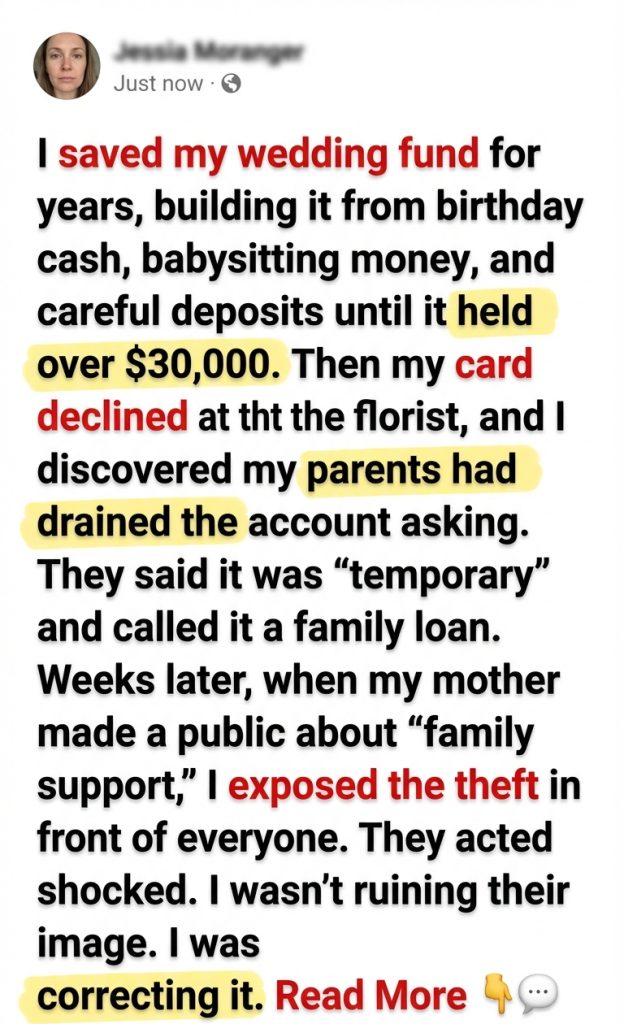
I saved my wedding fund for years, building it from birthday cash, babysitting money, and careful deposits until it held over $30,000. Then my card declined at the florist, and I discovered my parents had drained the account without asking. They said it was “temporary” and called it a family loan. Weeks later, when my mother made a public toast about “family support,” I exposed the theft in front of everyone. They acted shocked. I wasn’t ruining their image. I was correcting it.