If you had asked my family who carried the household after my father died, they would have said “all of us.” That was the version they preferred because it sounded noble and equal. The truth was uglier and more ordinary: I paid almost everything, and they treated my effort like background noise.
I was twenty-nine when Dad’s heart gave out and left behind a half-paid mortgage, a stack of utility bills, and a family that had relied on his income more than anyone admitted. My mother had not worked in years. My younger brother Tyler drifted between jobs and excuses. My older sister Monica contributed opinions, which she valued much more highly than money.
I moved back into the house “temporarily” to help stabilize things. Temporary became four years.
During those years, I paid the mortgage whenever Mom came up short, covered groceries most weeks, handled internet and electric without discussion, and even paid Tyler’s car insurance twice because “he needed his vehicle to get to work.” Monica lived across town with her boyfriend and arrived mostly for holidays, advice, and criticism.
Still, I was the one they mocked.
Because I worked long hours in hospital administration and dressed plainly, the family liked to call me rigid, boring, obsessed with receipts. Monica joked that I probably filed my grocery lists alphabetically. Tyler called me “the landlord” whenever I reminded him to contribute. Mom laughed along, telling people I had “a big heart under all that control.”
What they never seemed to notice was that control becomes attractive when no one else is carrying weight. Somebody has to care where the money goes when everyone else treats bills like they settle themselves. I did not enjoy being strict. I enjoyed not losing the house.
After a while, I started depositing my paycheck into a separate account and transferring exact amounts into the family account for shared expenses. It was not secretive. I told Mom I needed clarity for budgeting. She nodded and said that made sense. But her tone changed. From that point on, my carefulness became something to resent.
“You act like we’re going to steal from you,” Monica said once, laughing over wine at the kitchen table.
I laughed too. That memory bothers me now. Sometimes the truth announces itself as a joke first, just to see if anyone’s listening.
The shared account was mostly used for mortgage and utility autopay. Because I handled setup, I assumed I knew its rhythm intimately. Then little discrepancies started appearing. A grocery total was higher than expected. An ATM withdrawal I didn’t recognize appeared on a Friday morning. A transfer for two hundred dollars landed in an account ending in numbers I didn’t know.
When I asked Mom, she said Tyler must have used the debit card for gas and forgotten to mention it. Tyler shrugged and said maybe Monica had borrowed the card when she took Mom shopping. Monica rolled her eyes and said I was making a federal case out of loose change. Their collective casualness made me feel petty for noticing. That is how hidden theft survives: not through brilliance, but through social pressure against precision.
The amounts stayed small enough to dismiss individually but frequent enough to accumulate. Fifty dollars here. One hundred eighty there. Cash withdrawals. Grocery purchases at stores we never used. Online orders no one admitted making. Every time I questioned it, they treated me like the problem. “We’re family,” Mom would say, wounded. “Why are you interrogating everyone?”
Because money was leaving, that’s why. Because I was paying more than anyone else and somehow being asked to feel rude for wanting accuracy. Still, I kept doubting myself. Grief, work stress, fatigue—those are fertile ground for manipulation. I told myself maybe I was losing perspective.
Then the bank letter arrived.
It was a fraud alert notice sent by mail, not email. Apparently an address confirmation had triggered a secondary verification because someone had attempted to add a new authorized user and link a digital wallet to the shared account. The notice looked routine at first, but when I read the details, my blood went cold. I had never requested that change.
I called the bank immediately.
After a long hold and several security checks, a representative told me that the recent request had come from a device registered under Tyler’s name. Worse, there had already been multiple “card not present” transactions tied to the same credentialed access over the last six months. Someone had not merely borrowed the debit card. Someone had quietly integrated the account into their own spending life.
I sat in my car in the hospital parking garage staring at the steering wheel after that call. The theft I had half-suspected, half-denied had just been given structure. Device names. access logs. timestamps. It was no longer vague family sloppiness. It was deliberate.
That evening I came home early and asked everyone to sit in the living room.
Tyler looked annoyed before I even spoke. Monica had dropped by with coffee and was sprawled on the couch like she owned moral superiority by default. Mom kept folding laundry in her lap, a performance of calm that did not fool me. I laid the bank letter on the table and said, “Who linked the family account to a digital wallet?”
Silence.
Then Tyler laughed. “Seriously?”
I repeated the question.
Mom looked at Tyler. That was enough. Monica noticed it too. Everyone in that room understood the answer one second before Tyler opened his mouth. He said he had only used the card “a couple of times” because he was short and “it was for the house anyway.” The sentence kept mutating while he spoke, which is how lies reveal themselves—they cannot find one shape and stay there.
I asked whether he had been taking money for six months. He said it wasn’t taking because he always intended to pay it back. Monica jumped in to defend him, saying I was overreacting over small amounts. I turned to her and asked whether she knew. Her face changed for half a second. That half second told me everything.
She knew.
By the time the shouting ended, the truth was wider than I expected. Tyler had been using the shared account for food delivery, gas, streaming subscriptions, nights out, and online gaming purchases. Monica had borrowed the card details twice for shopping and once for a weekend trip she later described as “mental health recovery.” Mom had known there were “some small uses” and said nothing because she didn’t want conflict.
Conflict. What she meant was accountability. She had watched me pay nearly every real bill while allowing my siblings to siphon money behind my back because asking them to stop would have felt uncomfortable. Instead, she let me become the family villain for noticing patterns and asking questions. That hurt more than Tyler’s theft.
I demanded exact numbers. No one had them. Of course not. People who steal through carelessness and entitlement rarely keep honest ledgers. The bank did. I spent the next two nights reconstructing every unauthorized transaction from statements and device logs. The total came to $9,340.
Nine thousand three hundred forty dollars.
Not millions. Not enough to make headlines. But enough to matter when it came from overtime shifts, skipped vacations, and the paycheck of the one person keeping the lights on. Enough to delay my own plans to move out. Enough to make every joke they had ever thrown at me feel poisoned.
Tyler cried when I told him he had to repay me or I would file a police report. Monica called me dramatic and heartless. Mom begged me not to destroy the family over money. That line enraged me in a way I cannot fully explain. I was not destroying anything. I was naming what had already been done.
I changed the account, removed all access, froze the card, and informed the bank of the unauthorized use. Because Tyler had been linked as an attempted unauthorized user, the paper trail was ugly enough that he finally understood I was not bluffing. Monica refused responsibility until I showed her the merchant records tied to her phone number. She went quiet after that.
Repayment came in painful installments. Tyler sold his gaming console, cashed out a small retirement account, and took extra shifts. Monica paid a lump sum after I threatened civil action. Mom, who had not stolen directly but had enabled all of it through silence, took out a personal loan and covered the remainder because she said she “couldn’t bear the shame.” For once, shame proved useful.
I moved out three months later.
The first night in my new apartment, I sat on the floor eating takeout from the carton and felt something close to peace. No one was mocking me for caring where the money went. No one was rolling their eyes when I asked basic questions. No one was calling me controlling because I refused to subsidize dishonesty. The silence was almost holy.
What the bank letter exposed was not just theft. It exposed hierarchy. In that house, my labor was expected, my standards were mocked, and my money was treated as communal until I asked for respect. Then suddenly I was selfish. Funny how quickly a provider becomes the enemy once access is threatened.
I paid every bill while my family joked about my caution and painted me as severe. The truth was simpler: I was the only one acting like money had consequences. When the bank finally put the fraud in writing, all their little jokes collapsed into what they had always hidden in plain sight—entitlement, enabled by affection, dressed up as family.
500-character trim:
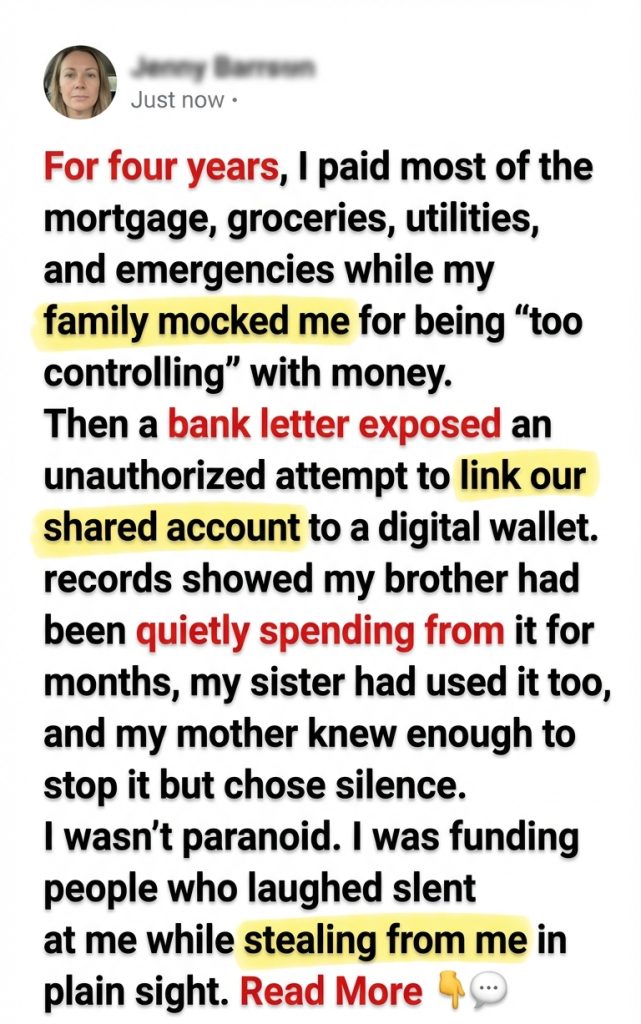
For four years, I paid most of the mortgage, groceries, utilities, and emergencies while my family mocked me for being “too controlling” with money. Then a bank letter exposed an unauthorized attempt to link our shared account to a digital wallet. The records showed my brother had been quietly spending from it for months, my sister had used it too, and my mother knew enough to stop it but chose silence. I wasn’t paranoid. I was funding people who laughed at me while stealing from me in plain sight.