The first time my family called me selfish, it was over a wedding. The second time, it was over a medical bill. By the fifth or sixth time, I stopped counting. In our family, selfish did not mean cruel, greedy, or uncaring. It meant unwilling to surrender your boundaries on demand.
I had always been the financially stable one. Not wealthy, not flashy, just careful. I worked as a payroll specialist, kept a strict budget, and maintained an emergency fund that made other people weirdly emotional. My brothers lived louder. My cousins spent faster. My aunt Barbara treated every paycheck like a rumor. Then, whenever chaos arrived, everyone turned toward me like sunflowers finding light.
At first, I helped. I co-signed a car loan for my cousin Dean after he promised he had changed. I covered part of Aunt Barbara’s rent one winter. I paid for my younger brother’s certification exam when he said it would change his life. Every favor came wrapped in gratitude and repayment promises. Very few ended with either.
Over time, I started noticing a pattern. They did not resent my money exactly. They resented my ability to say no. The money itself was not offensive until I protected it. Then suddenly I was cold, difficult, obsessed with control, and “forgetting where I came from.” It is amazing how quickly responsibility becomes arrogance in the eyes of people who benefit from your guilt.
The final straw began with my uncle Raymond. He was charming in the dangerous way some older men are—half wise, half manipulative, always speaking like he was mentoring you while quietly moving toward your wallet. He called one Thursday afternoon saying he needed short-term help to “unlock” a business opportunity.
I asked questions. He gave vague answers.
“How much?” I said.
“Twenty-five thousand,” he replied, as casually as if he were asking for a ride to the airport.
When I laughed in disbelief, he sounded offended. He said family should want to see each other succeed. He said I was too suspicious. He said he had always believed I was generous underneath my “guarded nature.” By the end of the call, I felt less like a niece and more like a bank declining a risky application.
I told him no.
He did not take it quietly. Within days, the family narrative had shifted. At Sunday dinner, Barbara sighed loudly about how “some people have plenty and still sleep just fine while others struggle.” My brother muttered that I had become “all about money.” Raymond told anyone who would listen that I had turned arrogant since getting promoted at work.
I defended myself at first. Then I stopped. Explaining boundaries to people who profit from violating them is a form of unpaid labor. Still, the whisper campaign stung. These were people who had watched me help again and again, yet the moment I refused a reckless request, they rewrote my entire character around that one refusal.
Matters escalated when Grandma’s health declined. Suddenly there were more family meetings, more urgency, more talk about who was doing what. I offered practical help: grocery runs, prescription pickups, scheduling appointments. Raymond kept circling back to money. He said Grandma needed “a support pool” and suggested everyone contribute into a family-managed account for emergency needs.
“No,” I said immediately.
That one word made the room shift.
Barbara called me selfish to my face. Dean said I must think I was better than everyone. My brother accused me of acting like an auditor instead of a granddaughter. But I had been through this too many times. A vague shared fund managed by the least reliable people in the family was not support. It was a theft opportunity waiting for a label.
So I offered a different arrangement. I would pay providers directly. Pharmacy, medical transport, home care supplies—anything legitimate, I would cover my share directly. Raymond hated that idea at once. He said it was controlling and insulting. Which, to me, was the clearest sign I had proposed exactly the right thing.
The argument simmered for months. I remained the villain in every family retelling. “She has money but has to supervise every penny.” “She doesn’t trust anybody.” “She’d rather embarrass us than help.” I got so used to it that the accusations began to lose texture. They became background noise to the more important fact that Grandma was actually being cared for.
Then Grandma died.
Grief does strange things. It softens some people and exposes others. Within two days of the funeral, Raymond was discussing her jewelry, Barbara wanted to know where the insurance paperwork was, and Dean asked whether Grandma had “left anything liquid.” It was vulgar, but not surprising. Greed hates delay.
I was not executor of the estate. That role belonged to my cousin Melanie, a quiet attorney who lived out of state and had never been deeply involved in the family drama. In hindsight, Grandma had chosen well. Melanie was calm, precise, and impossible to emotionally stampede. She scheduled a formal family meeting at a law office rather than someone’s home, which should have warned everyone to behave. It didn’t.
At the meeting, Raymond began with an attack on me before the paperwork was even opened. He said there had been “difficulties” caring for Grandma because I had refused to cooperate financially. Barbara backed him up, adding that my selfishness had “hurt the family” during a vulnerable time. For one surreal moment, I almost admired the boldness. They were trying to frame the story before facts arrived.
Melanie listened without expression. Then she opened a folder and asked, “Before we discuss the estate, would either of you like to explain the withdrawals from Grandma’s account?”
The room went still.
Raymond actually smiled at first, like someone confident there had been a misunderstanding. Barbara looked annoyed. Melanie placed printed bank records on the table. There were multiple withdrawals over nine months—cash, transfers, checks. Some were labeled as caregiving reimbursements. Others had no explanation at all. The signatures were inconsistent. The timing was worse.
Grandma had been paying for her own care the entire time.
Not only that, but Raymond and Barbara had been taking money from her account while publicly pressuring the rest of us to contribute to this so-called emergency support fund. The very fund I had refused. The very refusal that made me selfish. They had not been trying to organize care. They had been trying to create a second stream of money they could control.
Barbara started crying immediately. Raymond got angry, which is the favorite refuge of guilty men. He said the withdrawals were repayment for errands, gas, stress, lost work hours. Melanie calmly slid another document forward: Grandma’s written complaint to her bank from four months earlier, expressing concern that “unauthorized family borrowing” had occurred.
That was not all. Grandma had also written a statement for her estate file saying that any claims of her needing family money for care were false and that she specifically distrusted Raymond’s attempts to organize group contributions. She had seen what was happening. She had simply waited until she could put it somewhere official.
I wish I could say the room exploded dramatically, but the truth was more interesting. Shame arrived in layers. Dean went pale as he realized he had helped spread lies about me. My brother stared at Barbara like he no longer recognized her. Raymond kept talking, but every sentence made him sound guiltier. Once a liar loses the room, volume cannot win it back.
Melanie then announced that Grandma had left instructions reducing Raymond’s and Barbara’s shares significantly due to “financial misconduct and abuse of access.” The language was devastating precisely because it was so clean. No theatrical disowning. No rant. Just an old woman who had finally documented what everyone else preferred to gossip around.
As for me, Grandma had left a letter.
In it, she thanked me for “protecting my own money wisely” and for refusing to join what she called “foolish and dishonest family pooling.” She wrote that people who resent your boundaries often reveal their intentions by how angry they become when you require transparency. I have read that sentence more times than I can count.
After the meeting, the apologies began arriving from people who had spent months calling me selfish. Some sounded sincere. Others sounded embarrassed. My brother admitted he had let Raymond shape his view because it was easier than confronting the possibility that our elders were lying. Dean said he had “never meant for it to go that far.” Funny how betrayal often comes with accidental language, as though harm simply wandered into being.
Raymond threatened legal action, then disappeared when he realized the documentation was overwhelming. Barbara tried to claim confusion and stress, but the bank records, Grandma’s letters, and the estate adjustments were too clear. Their lies had not just collapsed. They had folded inward on themselves until everyone could see the structure of the fraud.
People in the family started calling me smart. Careful. Wise. I did not enjoy the change as much as they probably imagined. Vindication is satisfying, but it does not erase the months I spent isolated for doing the right thing. It does not erase the way they all found it easier to believe I was selfish than to believe habitual manipulators were lying.
That is the real lesson, I think. In families built on guilt, the person with boundaries becomes the easiest villain because their refusal interrupts the flow of convenience. I was never selfish for protecting my money. I was simply the only one refusing to finance a lie. Everyone saw that eventually, but only after the lie became expensive enough to expose.
They called me selfish because I would not hand over control. Then Grandma’s records came out, and everyone learned what I had suspected all along: the betrayal was never mine. I was the target, not the cause. Their lies collapsed under the weight of evidence, and all that remained was the truth they hated most—that my boundaries had been right.
500-character trim:
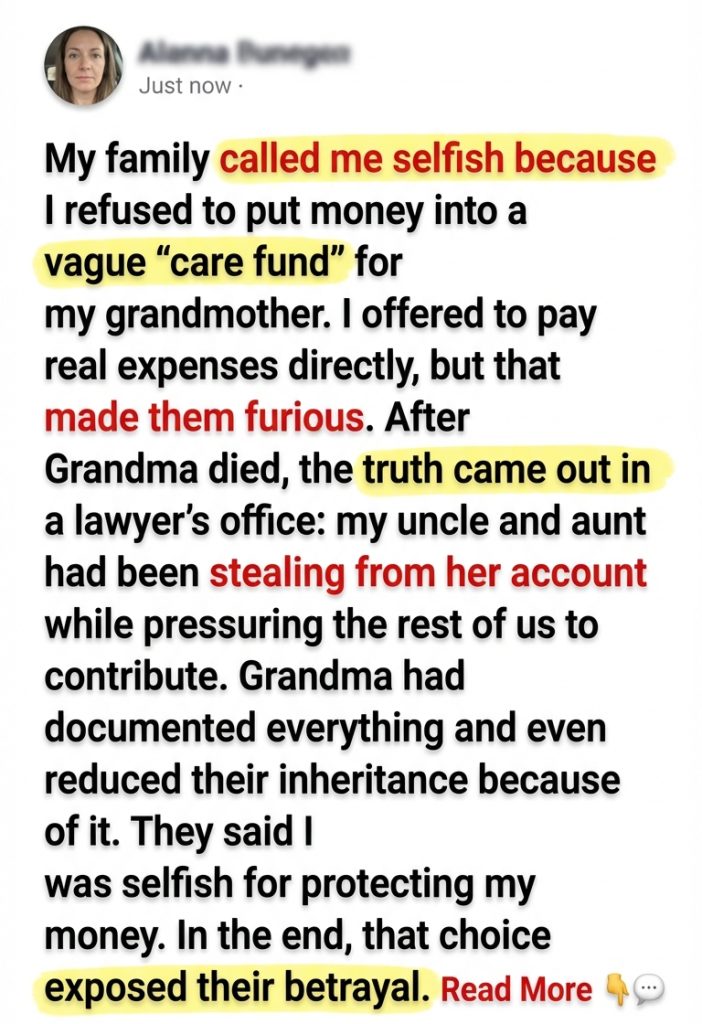
My family called me selfish because I refused to put money into a vague “care fund” for my grandmother. I offered to pay real expenses directly, but that made them furious. After Grandma died, the truth came out in a lawyer’s office: my uncle and aunt had been stealing from her account while pressuring the rest of us to contribute. Grandma had documented everything and even reduced their inheritance because of it. They said I was selfish for protecting my money. In the end, that choice exposed their betrayal.