When I married Daniel, I believed I had chosen a safe man. He was the kind of person who held doors open, remembered birthdays, and spoke in a voice so calm it could make chaos feel organized. I thought that kind of steadiness meant honesty. I was wrong.
We had been together for eight years, married for six, and living what everyone around us called a stable life. We owned a modest house, drove sensible cars, and never looked flashy. I worked as a dental hygienist, and Daniel managed inventory for a regional construction company.
Because I had grown up watching my mother struggle after my father left, I was careful with money. I saved obsessively. I packed lunches, skipped expensive vacations, and picked up extra shifts whenever someone at work wanted a day off. Every dollar I saved felt like a brick in the wall protecting my future.
Daniel knew that about me. He used to kiss my forehead and joke that if the world ended, I would be the only one with a retirement plan and canned soup. I used to laugh. I thought he admired my discipline. I didn’t realize he had quietly turned it into his opportunity.
We kept a joint checking account for bills, but I also had a personal savings account. It held the money I had saved before marriage and the extra income I earned after. I was transparent about it. I told him it made me feel secure, and he always said he understood.
The first sign that something was wrong was so small I almost ignored it. I was reviewing my monthly statement online when I noticed a transfer for $1,800. I didn’t remember moving it. I assumed I must have forgotten or clicked something by accident between shifts. Life was busy then, and exhaustion makes fools of careful people.
A month later, there was another transfer. Then another. They were irregular enough not to form a pattern, but frequent enough to create a wound. I told myself there had to be a banking mistake. I even blamed the app. I spent more energy defending the mystery than questioning it.
When I brought it up to Daniel, he looked at me with concern so perfectly performed that I still remember it like theater. He tilted his head, frowned slightly, and said, “You’ve been under so much stress lately. Are you sure you didn’t move the money yourself and forget?” The softness in his voice made me feel embarrassed for asking.
I let it go. Not because I believed him entirely, but because doubt is exhausting when it’s aimed at someone you love. It felt easier to suspect myself than to face what it would mean if Daniel were lying. Marriage teaches you strange habits, and one of them is protecting the image of the person who hurts you.
Over the next year, the account kept shrinking in ways that didn’t match my deposits. Sometimes I’d notice a withdrawal and Daniel would have a reason ready before I even finished my sentence. “Insurance,” he’d say. “Emergency payment.” “Temporary transfer, I’ll move it back.” He always had an answer. He never had the truth.
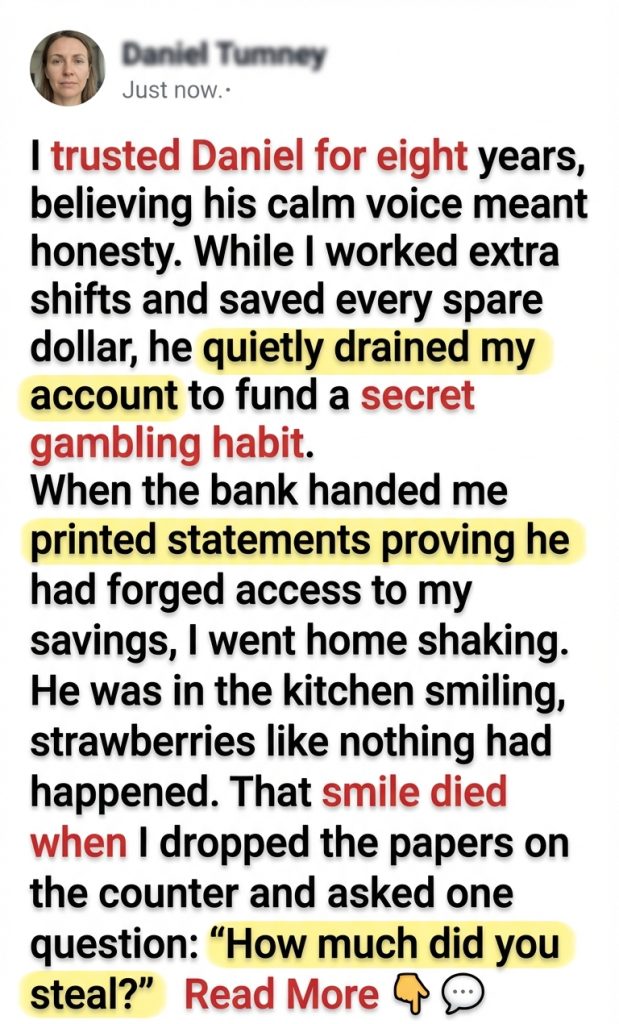
The turning point came on a rainy Tuesday afternoon. I had left work early because the office had a plumbing issue, and I stopped by the bank in person to get printed statements for the last eighteen months. I told the banker I wanted a full record, every transfer and every authorization method.
The woman behind the desk was kind, and perhaps because she had seen this before, she didn’t make me feel foolish. She printed everything, slid the papers across the desk, and circled one section with her pen. “These transfers were authenticated with a device registered to your household,” she said carefully. “And here… this one was made in person.”
“In person?” I asked.
She nodded. “Yes. With identification.” Then she looked at me, really looked at me, and added, “It was not your identification.”
My hands went cold. I sat there staring at the page while rain smudged the windows behind her. Daniel had forged access to my savings. Not once. Not during some desperate emergency. Repeatedly. Methodically. Over nearly two years. He hadn’t made a mistake. He had built a system.
I drove home shaking so hard I had to pull over twice. When I walked into the kitchen, Daniel was standing at the counter, smiling, cutting strawberries like a man in a commercial. That image still haunts me more than the statements. Not the theft itself, but the normalcy of him. The casual joy. The confidence.
I laid the papers on the counter and asked one question: “How much?”
The smile vanished slowly, like a light dimming. First confusion. Then caution. Then calculation. He didn’t deny it right away, which told me more than any confession could have. Finally, he exhaled and said, “I was going to replace it.”
That sentence changed me forever. Not because it was dramatic, but because it was so insulting. He had stolen over $46,000 from me, and his defense was a fantasy wrapped in entitlement. He spoke as though my money had been a temporary loan issued by a loving wife who simply hadn’t been informed.
I demanded the truth, all of it. He admitted he had been gambling online for over two years. Sports betting at first. Then high-risk trading forums. Then personal loans to cover the losses. When those stacked up, he started taking from my savings because, in his words, “you’re better at rebuilding than I am.” I thought I might stop breathing.
That was the moment I understood the ugliest part of betrayal: he had not just stolen my money. He had stolen my effort. Every skipped dinner out. Every extra shift. Every sore back and aching feet. Every little sacrifice I made to build peace for myself had been scooped up and fed into his lies.
I asked if anyone else knew. He said no. Later, I learned that was another lie. His younger brother knew. One friend knew. Even his mother knew he was “having money problems,” though she conveniently claimed she didn’t know where the money came from. They all let me sit at family dinners smiling beside a man who was looting my future.
I did not scream. I did not throw plates. I did something colder. I called my sister, asked if I could stay with her, photographed every document, opened a separate checking account at a new bank, contacted an attorney the next morning, and filed a police report by Friday. Daniel kept texting apologies as if remorse could become reimbursement.
People judged me for involving the law. Some said marriage should stay private. Some said addiction is an illness. Some said I should have more compassion. But theft is still theft, and love does not require financial self-destruction. Daniel had smiled through every lie. He had watched me worry, watched me doubt myself, and let it happen.
The divorce took ten months. I got the house because his debts were catastrophic and because my attorney proved a pattern of financial fraud. The criminal case ended in a plea agreement. Daniel avoided prison, but only barely. He had to repay a portion through wage garnishment, though everyone knew I would never recover the full amount.
The strangest part came months later, when he asked to meet for coffee. He said he wanted closure. I agreed, not because I owed him anything, but because I wanted to see what was left of the man I had once trusted with my whole life. He looked older, smaller somehow, like guilt had finally found a place to sit on his shoulders.
He cried at the table and said, “I never meant to hurt you.” I looked at him and realized that people like Daniel often confuse intention with permission. He may not have wanted consequences, but he accepted my pain every time it bought him one more week of comfort. That is harm, whether you name it or not.
I left the café lighter than I had arrived. Not healed. Not triumphant. Just clear. I understood then that betrayal is not always loud. Sometimes it wears a wedding ring and slices strawberries in your kitchen. Sometimes it smiles while emptying the account you filled with your own tired hands. But the truth has a way of printing itself in black and white. And once you see it, you never have to pretend again.