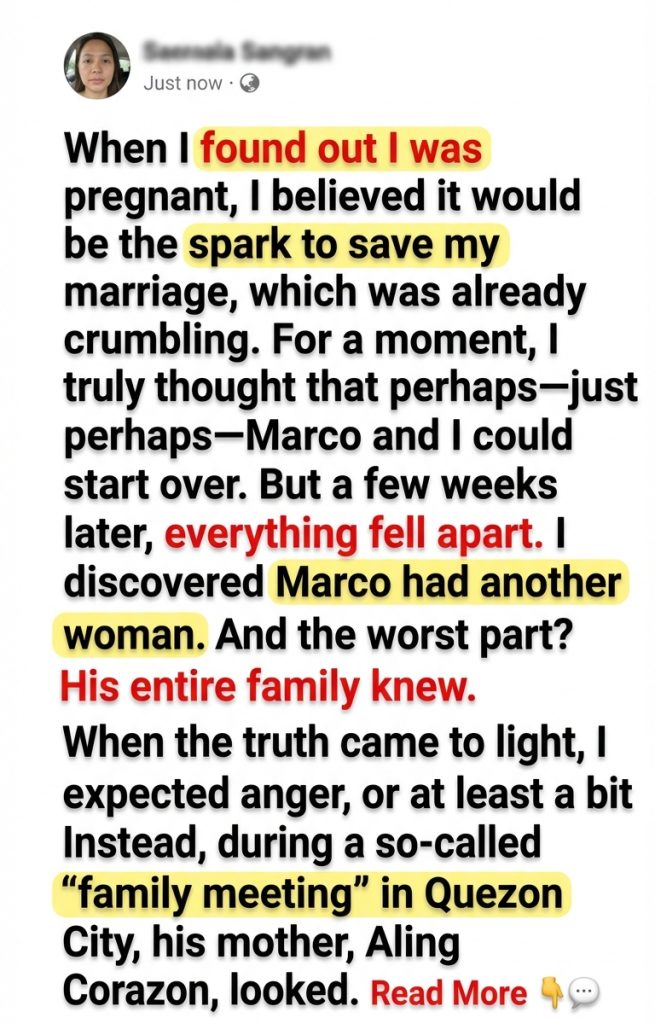
When I found out I was pregnant, I believed it would be the spark to save my marriage, which was already crumbling. For a moment, I truly thought that perhaps—just perhaps—Marco and I could start over.
But a few weeks later, everything fell apart. I discovered Marco had another woman. And the worst part? His entire family knew.
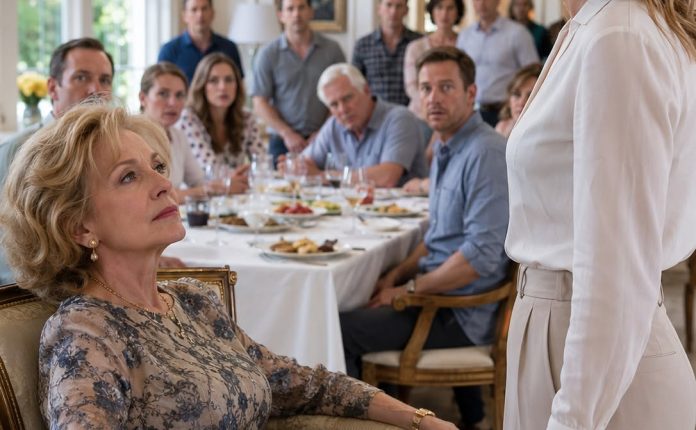
When the truth came to light, I expected anger, or at least a bit of shame. Instead, during a so-called “family meeting” in Quezon City, his mother, Aling Corazon, looked me dead in the eye and said coldly:
—“There is nothing to discuss. The one who gives birth to a boy will stay in the family. If it’s a girl, she can leave.”
Her words left me paralyzed. To them, a woman’s value was measured solely by the gender of the child in her womb. I turned to Marco, expecting him to defend me… but he remained silent, his gaze fixed on the floor.
The room felt smaller after that, as though the walls themselves had leaned in just to hear my humiliation. I could hear the ceiling fan spinning above us, slicing through the silence with a lazy whir that somehow made everything feel even crueler. No one spoke for me. No one even looked sorry.
I sat there with both hands resting protectively over my stomach, as if I could shield my unborn child from the poison in that house. My heart pounded so hard it almost hurt. That was the moment I understood something that changed me forever: I was completely alone in a room full of people who called themselves family.
Marco’s sister busied herself with her phone. His uncle stared out the window. Aling Corazon folded her arms like she had just settled an ordinary household matter. To them, I was no longer a wife, no longer a person with feelings, fears, and dignity. I was simply a womb waiting to prove its worth.
I wanted to scream. I wanted to stand up and throw every truth I knew into their faces. I wanted to ask Marco how long he had planned to let me sit there like a fool while he shared himself with another woman and let his family judge the baby I was carrying. But the words got stuck somewhere between my chest and my throat.
When the meeting ended, no one stopped me as I left. No one followed me down the narrow stairs of that house in Quezon City. Outside, the evening traffic roared like the whole city was alive and moving while I stood frozen on the sidewalk, trying to understand how my life had broken open so quickly.
I did not cry right away. I walked for several blocks beneath the tangled electric wires and faded street signs, passing sari-sari stores, tricycles, and neighbors chatting like it was any other evening. The normalcy of it all felt almost offensive. My marriage had just been reduced to a cruel condition, and the world did not even pause.
By the time I reached the corner where jeepneys slowed to pick up passengers, my knees felt weak. I climbed into one without thinking, pressed myself near the window, and finally let the tears fall. I kept my head down so strangers would not stare, but inside I was unraveling. Every memory of Marco suddenly looked different.
I remembered how tender he had seemed when I first told him I was pregnant. He had touched my face, kissed my forehead, and whispered that maybe this was our second chance. I had clung to that moment. I had needed to believe it. Now I saw it for what it likely was: guilt dressed up as hope.
That night, I went back to the apartment I shared with him and stood in the doorway for a long time. His shoes were still by the entrance. His watch sat on the table. The mug I had bought him during our first anniversary was still in the sink. Everything looked painfully ordinary, and yet nothing felt the same.
I did not pack much at first. Just a few dresses, my prenatal vitamins, some documents, and the ultrasound photo I had tucked inside my Bible. My hands trembled as I folded clothes into a small bag. Part of me kept expecting Marco to walk through the door, apologize, and beg me to stay. Another part of me already knew he would not.
He came home past midnight. I heard his key turn in the lock and the soft drag of his footsteps on the floor. When he saw the bag beside me, he froze. For one brief second, I thought maybe he had finally understood the depth of what he had allowed. But all he said was, “Do you really have to make this harder than it already is?”
I stared at him, unable to believe that was all he had. Harder? He had betrayed me, humiliated me, and sat silently while his mother decided whether my baby and I deserved a place in the family. Yet somehow, I was the one making things difficult. That was when whatever remained of my love began to die.
“I was your wife,” I said quietly, because anger had burned itself into something colder. “And you let them speak to me like I was livestock.”
He rubbed a hand over his face and looked away. He said his mother was old-fashioned. He said his family had strong beliefs. He said the situation was complicated. Not once did he say I was wronged. Not once did he say he was sorry in a way that sounded real. His excuses came easily, as though he had rehearsed them long before that night.
Then he made the mistake that finished everything. He asked me not to overreact until we knew the baby’s sex. The room seemed to tilt. I remember gripping the edge of the table to steady myself, because in that one sentence he admitted the truth: he agreed with them enough to wait and see whether I would be allowed to matter.
I left before sunrise. The city was still gray and sleepy, the sky only beginning to soften with light. I took a taxi to my older sister’s apartment in Pasig, holding my bag on my lap and staring out at streets that looked blurred through exhaustion and betrayal. I felt hollow, but beneath the emptiness there was a tiny, stubborn pulse of resolve.
My sister, Elena, opened the door in her house clothes, confused at first and then instantly alarmed. She did not ask me to explain before pulling me into her arms. And that simple act—being held without judgment, without conditions—broke me in a way Marco’s cruelty had not. I cried against her shoulder until I could barely breathe.
Over the next few days, the truth settled over me in waves. There were practical things to think about: doctor’s appointments, money, legal papers, where I would live, what I would do after the baby came. But beneath all of that was the larger grief—the death of the future I had once pictured so clearly. I was not just losing a husband. I was losing the dream of a family built on love.
Marco called often at first. Sometimes he sounded gentle. Sometimes irritated. Sometimes he acted as if enough time had passed for us to speak normally again. He told me his mother was upset that I had embarrassed them by leaving. He told me neighbors were starting to ask questions. Even then, his concern was never my pain. It was their reputation.
I stopped answering after a while. Peace began where his voice ended. My days became quieter, simpler. Elena would make lugaw when I felt sick. She came with me to checkups. At night, when fear crept in and I wondered how I would raise a child on my own, she reminded me that a difficult path walked with dignity was better than an easy one paved with humiliation.
Months passed, and with each one I changed. I no longer spoke to my unborn baby through tears. I spoke with promise. I promised safety. I promised tenderness. I promised that no one would ever make this child feel unwanted for being exactly who they were. Those promises became the foundation of the mother I was becoming.
Then came the day of the anatomy scan. The clinic was cold, bright, and quiet except for the soft hum of machines. Elena sat beside me, squeezing my hand as the sonographer moved the wand carefully across my belly. I watched the screen with breathless awe, seeing tiny movements, the curve of a head, the flutter of a heartbeat that sounded stronger than anything else in my life.
When the technician asked if I wanted to know the sex, I hesitated. For a moment, Aling Corazon’s voice flashed back into my mind like a stain I could not quite wash out. The one who gives birth to a boy will stay. If it’s a girl, she can leave. I felt anger rise—but not the helpless kind. This time it came with clarity.
“Yes,” I said.
The technician smiled gently. “You’re having a girl.”
A girl.
For one suspended second, the world became still. Then my eyes filled with tears—not from disappointment, not even from pain, but from fierce, overwhelming love. My daughter was real. She was alive. She was already enough. And in that instant, I realized something astonishing: the very thing Marco’s family had treated as a curse felt to me like a blessing.
I laughed through my tears, and Elena cried with me. We walked out of that clinic into the hot afternoon sun with the printed scan in my hand, and I felt lighter than I had in months. Not because life had become easy, but because the last illusion had finally fallen away. There was nothing left to wait for. No test. No condition. No negotiation.
That evening, Marco somehow found out. Maybe through relatives, maybe through gossip, maybe because news travels fast when families are hungry for scandal. He called repeatedly until I answered. His voice was careful, too careful. He asked if it was true. When I said yes, there was a long silence on the line.
Then he said, almost weakly, “My mother thinks maybe it’s better if we move on quietly.”
I closed my eyes and let those words settle. Better if we move on quietly. As if what they had done could be folded away without consequence. As if my daughter were some disappointing result they were now graciously releasing. I looked down at the ultrasound in my hand and felt a calm unlike any I had known before.
“No,” I told him. “You move on with your silence. I’m moving on with my child.”
He tried to speak, but I ended the call. My hands were shaking afterward, yet I felt stronger than I ever had in that marriage. I was no longer begging for love from people who only knew how to measure worth through cruelty. I was no longer waiting for Marco to become brave. I was no longer afraid of being left. I had already left—and survived.
The months leading up to my daughter’s birth were not glamorous. I worked when I could, rested when I had to, and learned how to rebuild a life piece by piece. Some nights I still cried, not because I wanted Marco back, but because healing is rarely straight and clean. It comes in waves, and sometimes the body remembers pain even when the mind is ready to move forward.
But every time I felt myself weakening, my daughter kicked. Tiny, insistent reminders from inside me, as if she already knew how to call me back to strength. I would place my hand over my stomach and whisper to her, telling her stories about courage, about kindness, about the kind of home I would create for her—a home where she would never need to earn her right to belong.
When labor finally came, it was storming outside. Rain hammered the windows of the hospital, and thunder rolled across the night like the sky itself was breaking open. Elena stayed beside me through the long hours, wiping my face, speaking softly, refusing to let me feel alone. I remember thinking, in the middle of pain, that this was what family really was: not blood, not titles, but who stayed.
And then, just before dawn, my daughter arrived.
They placed her on my chest, warm and slippery and crying with all the force of a brand-new soul announcing herself to the world. I looked at her tiny face, her damp hair, her clenched little fists, and everything inside me gave way to wonder. She was beautiful. She was perfect. She was mine.
In that first hour, while the storm faded and the morning light slowly spread across the hospital room, I understood the full truth of what had happened to me. I had thought pregnancy might save my marriage. Instead, it saved me from it. It exposed what love in that house had always been: conditional, cowardly, and cruel.
My daughter did not ruin my life by being born a girl. She rescued me from wasting more of it with people who believed she was less before they had even met her. She gave me the courage to choose dignity over desperation. She made me a mother, yes—but she also made me fearless.
Years from now, I know someone may tell her that she came into this world surrounded by conflict. But I will tell her something better, something truer. I will tell her that she arrived like light through a cracked door. That when everyone else tried to reduce her worth to a single cruel tradition, she became the reason I stood up and walked away.
And if she ever asks me why I left, I will not speak with bitterness. I will simply hold her face in my hands and say, “Because I wanted you to grow up where love was never a prize to be won.”
That is the ending they never expected for me. Not a woman cast out in shame because she was carrying a girl, but a mother who chose herself and her child over a family that had none of the love they preached. They wanted silence, obedience, and surrender. What they got instead was my absence.
And sometimes, walking away is the loudest victory of all.