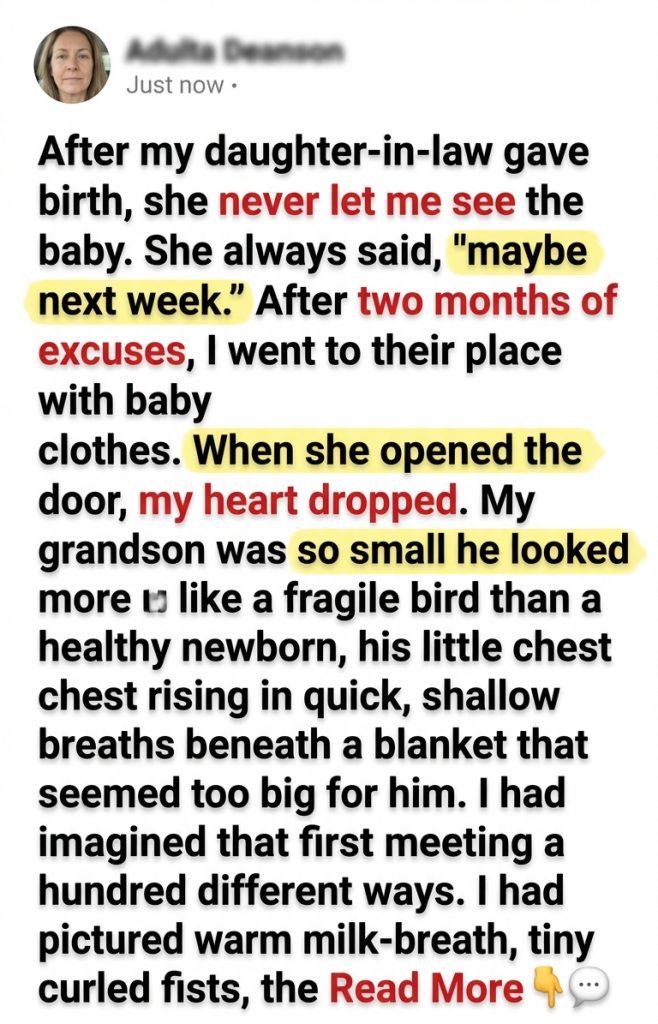
After my daughter-in-law gave birth, she never let me see the baby. She always said, “He’s still sensitive, maybe next week.” After two months of excuses, I went to their place with baby clothes. When she opened the door, my heart dropped. My grandson was so small he looked more like a fragile bird than a healthy newborn, his little chest rising in quick, shallow breaths beneath a blanket that seemed too big for him.
I had imagined that first meeting a hundred different ways.
I had pictured warm milk-breath, tiny curled fists, the soft weight of new life placed carefully into my arms. I had imagined crying the way grandmothers do, laughing through tears while promising to spoil him and protect him and love him in all the foolish, overflowing ways older women love the babies that come after their own children are grown. Instead, I stood frozen on that doorstep, the gift bag slipping in my hand, staring at a child who looked as if the world itself had been too harsh for him already.
My daughter-in-law, Elise, looked worse than I had ever seen her.
Her hair was tied back in a hurried knot, loose strands clinging to a pale face hollowed by exhaustion. The bright, polished woman my son had married—the one who always hosted dinners with candles lit and napkins folded just so—was gone. In her place stood someone worn thin by fear. Her eyes met mine for only a second before dropping toward the baby, as if even now she could not bear what another person might see.
For a moment, neither of us spoke.
There are silences that are ordinary and silences that expose truth. This was the second kind. All at once, every cheerful excuse she had offered over the phone cracked apart in my mind. “Maybe next week.” “He’s still sensitive.” “We’re just getting settled.” I had heard distance in those words and mistaken it for rejection. Standing there in the dim doorway, I realized it had been panic all along.
I stepped inside without waiting to be invited.
Not rudely. Not angrily. Just with the certainty of a mother who knows something is terribly wrong. The house smelled faintly of formula, antiseptic, and stale coffee. The curtains were half drawn though it was still daylight. Bottles crowded the coffee table beside a neat row of medicine syringes, appointment cards, and folded hospital papers. In one corner sat a diaper bag already packed as if they expected to run out the door at any moment.
My son, Daniel, came in from the kitchen when he heard my voice.
He looked up, saw me, and then saw that I had seen the baby. Something in his face collapsed. My son had always carried himself with calm competence, the kind of man who fixed leaking taps before anyone else noticed and held doors open without thinking. But now his shoulders were rounded, his beard overgrown, his eyes bruised by sleeplessness. He looked like a man standing on a ledge with no idea how much longer his legs would hold him.
“Mom,” he said, and his voice broke on the word.
That was enough.
I set the little bag of clothes on the floor and crossed the room. I did not ask permission before wrapping my arms around him. He held on to me like a boy again, not the grown husband and new father he had been trying so hard to remain. Over his shoulder, I saw Elise clutching the baby closer, tears already filling her eyes with the look of someone bracing for blame.
But blame was the farthest thing from my heart.
“What happened?” I whispered.
Elise answered before Daniel could. Her voice was so quiet I had to lean in to hear her.
“He was born early,” she said. “Very early. There were complications. His lungs… they said his lungs weren’t ready. Then there were infections, feeding problems, more tests. We brought him home, but he still isn’t really safe yet. They keep telling us to be careful. No crowds. No visitors with colds. Watch his breathing. Watch his temperature. Watch everything.” She swallowed and looked down at him. “I didn’t know how to let anyone see him like this.”
Her honesty struck me harder than any accusation could have.
After my daughter-in-law gave birth, she never let me see the baby. I had spent weeks letting that sentence grow teeth inside me. I had told myself she was selfish, possessive, maybe punishing me for old disagreements that now seemed embarrassingly small. I had replayed every postponed visit as an insult. And all the while, she had been sitting in this dim house with a premature infant in her arms, learning how to keep him alive one breath at a time.
Shame rose through me slowly and hot.
I looked again at my grandson. His skin had that delicate reddish translucence some preemies have, his eyelids so thin they seemed almost blue at the edges. A feeding tube had left faint marks on his cheeks. One hand escaped the blanket, no bigger than the petals of a flower, and flexed weakly in the air. He was alive, yes. But he was living at the fragile edge of things.
“Oh, sweetheart,” I said, though I wasn’t sure whether I meant the baby, Elise, or both.
That was when she started crying.
Not politely. Not the composed tears of a woman embarrassed to be overwhelmed. She cried the way people cry when they have been holding a wall in place with their bare hands and someone finally says they can stop pretending it isn’t crushing them. Daniel moved toward her, but she was already shaking so hard the baby startled and gave a thin, strained cry that turned us all to stone.
Instinct took over.
“Sit,” I said softly. “Both of you. Sit down.”
I took the diaper bag from the couch and set it aside. I pulled the blanket over Elise’s knees. I asked where the sterilized bottles were, where the burp cloths were, what the next feeding time was, whether the pediatrician had given a chart. They answered automatically, relief mixing with confusion. Fear had made them into soldiers, living from alarm to alarm. Sometimes the first mercy is simply being asked practical questions by someone calm.
As they spoke, the full story came out.
My grandson, Noah, had arrived nearly eight weeks early after a frightening labor that ended in an emergency delivery. He had gone straight to the neonatal intensive care unit. There were wires, incubators, whispered updates from doctors whose optimism changed by the hour. Elise had barely recovered from childbirth before she was shuffling down sterile hospital halls in slippers, pumping milk in bathroom stalls, learning to place a hand through plastic walls to soothe a child she could not properly hold.
Daniel had lived between home and hospital, sleeping in chairs, living on vending machine meals and adrenaline.
By the time Noah was discharged, they were already broken.
But coming home had not brought relief. It had brought a different kind of fear. In the hospital, there had been monitors, nurses, specialists. At home, there was only silence—and every silence felt dangerous. Every sneeze became a threat. Every missed ounce in a feeding became a crisis. Elise had started checking Noah’s breathing dozens of times a night, waking in terror if he slept too still. Daniel did his best to reassure her, but he was unraveling too.
“And people kept asking to visit,” Elise said, wiping her face with the back of her hand. “Everyone meant well, I know that. But every message felt like pressure. Every ‘when can I come hold him?’ felt like one more thing I had to manage. And then I thought if they saw him…” Her voice cracked. “If they saw how tiny he was, how sick he looked, they’d think I failed him.”
No sentence in that room broke me more than that one.
Because there it was, the secret guilt at the center of so many young mothers’ pain—the belief that if a child struggles, it must somehow reflect a failure of love. I moved closer to her and made sure she looked at me.
“You did not fail him,” I said firmly.
She tried to look away, but I caught her hand.
“You carried him. You fought for him. You are here. You are exhausted because you have been loving him with everything you have. That is not failure.”
Daniel bowed his head then, covering his eyes.
“I should have told you,” he murmured.
“Yes,” I said, because truth matters. “You should have.”
He nodded, accepting it.
“But you were scared,” I added more gently. “And sometimes scared people make small circles around themselves because it feels safer. I understand that too.”
For a while, we simply sat there, the four of us and all the fear in the room, while Noah drifted back into a shallow sleep against his mother’s chest. Outside, a car passed. Somewhere down the street a dog barked. Ordinary life kept moving, ignorant of the fact that inside this little house, survival had narrowed into ounces, breaths, temperatures, and prayers.
Then I rolled up my sleeves.
Because grief, fear, and shame are heavy things, but soup still needs making and bottles still need washing. I cleaned the kitchen first, not because a messy kitchen matters beside a fragile baby, but because order can feel like mercy when chaos has ruled too long. I threw out stale coffee, wiped counters, sterilized whatever needed sterilizing, and started a pot of chicken broth with the groceries I found in their freezer. The sounds of chopping and rinsing filled the house with something steadier than panic.
By evening, I had changed two loads of laundry, labeled medication times in clearer handwriting, and convinced Elise to shower while I sat beside the bassinet and watched Noah breathe.
That first hour alone with him, I did not try to hold him.
I only sat nearby and studied him in the fading light. He made tiny sounds, like a kitten dreaming. His eyelids fluttered. Once, his whole body jerked with the strange sudden movement newborns have, and my hand flew to my heart. He was so small. So unfinished in the most painful sense. But he was here. Alive. Fighting. Every breath he took seemed like both a miracle and a negotiation.
When Elise returned, her hair damp and her face scrubbed clean, she looked younger.
Not happier, exactly. No shower can wash fear away. But less haunted for the moment. I handed her a bowl of soup and waited until she had taken three real spoonfuls before speaking.
“You should have called me,” I said.
Tears gathered again in her eyes. “I know.”
“I’m not saying that to make you feel worse.”
“I thought you’d judge me.”
That stunned me into silence because the cruelest part was that she had not imagined that fear out of nowhere. I had not always made things easy between us. Before Noah, our disagreements had been ordinary but sharp—different opinions about holidays, routines, the thousand tiny power struggles families accumulate. I had often mistaken her reserve for coldness. She had likely mistaken my concern for criticism. And when disaster came, those old bruises became reasons not to reach.
So I told her the truth she deserved.
“Maybe I gave you reasons to think that,” I said. “I’m sorry for that. But never, ever believe you have to hide suffering from me to earn kindness.”
She cried again, quieter this time.
That night, I stayed.
Then I stayed the next night. And the next.
Soon a rhythm formed. I took the early morning shift so Daniel could sleep three straight hours without listening for every sound. I learned the exact way Noah liked to be swaddled, the way he relaxed if you cupped one hand gently around his feet. I went to pediatric follow-ups with Elise and took notes when doctors talked too fast. I listened when she confessed that sometimes she was terrified to love him fully because she feared losing him would destroy her. I told her that loving him halfway would not spare her; it would only cheat both of them.
Slowly, the house changed.
The curtains opened. Windows cracked for fresh air. Dirty mugs stopped multiplying by the sink. Daniel shaved. Elise started eating before noon. None of it was dramatic enough for movies, but real healing rarely is. It is built from stupidly humble things: half a sandwich finished while still warm, four hours of uninterrupted sleep, a laugh escaping before guilt can smother it.
And Noah began to change too.
Not all at once. Not with some magical leap that made the past seem exaggerated. It was slower, more precious than that. His cheeks filled out a little. His cry got louder. His little fingers gripped with surprising strength. One morning, while I was singing to him under my breath, his eyes opened wide and truly focused on my face for the first time. It felt like being chosen by a star.
At his next checkup, the doctor smiled before he even spoke.
Weight gain. Stronger lungs. Good progress.
Elise sat in the exam room clutching Noah so tightly I thought she might float away. Daniel laughed once, sharply, in pure relief. I looked at the ceiling because sometimes gratitude is so intense it hurts worse than grief.
Later, at home, Elise handed Noah to me without prompting.
That mattered.
Up until then, even when she accepted help, some part of her remained braced, as if the world might still snatch him away the instant she loosened her grip. But that afternoon, she placed him carefully into my arms and left the room to make tea. No panic. No hovering. Just trust. His whole body fit against me in a way that made my chest ache with love.
“My grandson was,” I whispered, thinking back to the doorway and the horror of that first sight.
But now I could finish the sentence differently.
My grandson was a fighter.
Weeks turned into months. Noah’s first true smile arrived on a rainy Tuesday while Daniel was making formula and Elise was trying to answer a message from the insurance company. I saw it first—a quick lift at the corners of his mouth, then a full tiny bloom of joy that transformed his whole face. We all gasped as if he had spoken. Elise burst into tears again, but this time they were the kind that leave light behind.
The strangest thing about surviving a crisis is how ordinary joy feels afterward.
A smile. A nap. A clean bill of health on a Tuesday afternoon. These things would have meant little to strangers. To us, they were fireworks. They were proof that the body can be weak and still move toward strength, that parents can be terrified and still do a beautiful job, that families can fracture through misunderstanding and still mend if someone is brave enough to walk through the door instead of away from it.
One evening, months later, Elise sat with me after Noah had finally fallen asleep.
The house was dim and peaceful, the kind of peace that had once seemed impossible there. She turned her tea mug slowly between her hands and said, “When you first showed up that day, I was sure you were going to be angry.”
“I was,” I admitted. “Before I opened the door.”
She gave a tired little smile. “I know.”
“I thought you were keeping him from me.”
“I was keeping everyone from what scared me.”
We let that sit between us.
Then she said, “Thank you for not saying ‘I told you so’ about anything.”
That made me laugh softly. “I’ve wanted to, once or twice.”
She laughed too, and there it was—the ease we had never quite found before Noah. Not perfection. Families are rarely that neat. But something honest. Something earned.
I think often now about how close I came to getting it all wrong.
If I had stayed offended instead of showing up, I would have missed the truth. I would have kept telling myself a story in which I was rejected, while inside that house my son and daughter-in-law were drowning quietly in fear. Pride is such a dangerous narrator. It can make abandonment out of someone’s panic and insult out of someone’s collapse. Love asks more of us than that. It asks us to knock anyway.
After my daughter-in-law gave birth, she never let me see the baby.
That is how the story begins.
But it is not how it ends.
It ends with my grandson asleep against my shoulder, warm and heavier than he used to be, his breath steady and sure. It ends with my son in the kitchen making coffee while humming again, a sound I thought fear had stolen from him. It ends with my daughter-in-law handing me a photo album and asking which picture we should frame for the hallway. It ends with all of us understanding that love is not always shown through perfect timing and easy words. Sometimes it arrives carrying baby clothes and old hurt, then stays to wash bottles and hold the line against the dark.
And if anyone ever asks me what I saw when that door opened, I will tell them the truth.
My grandson was fragile.
My children were frightened.
And our family was one honest moment away from either breaking apart completely or becoming something stronger than it had ever been before.
Thank God I stepped inside.