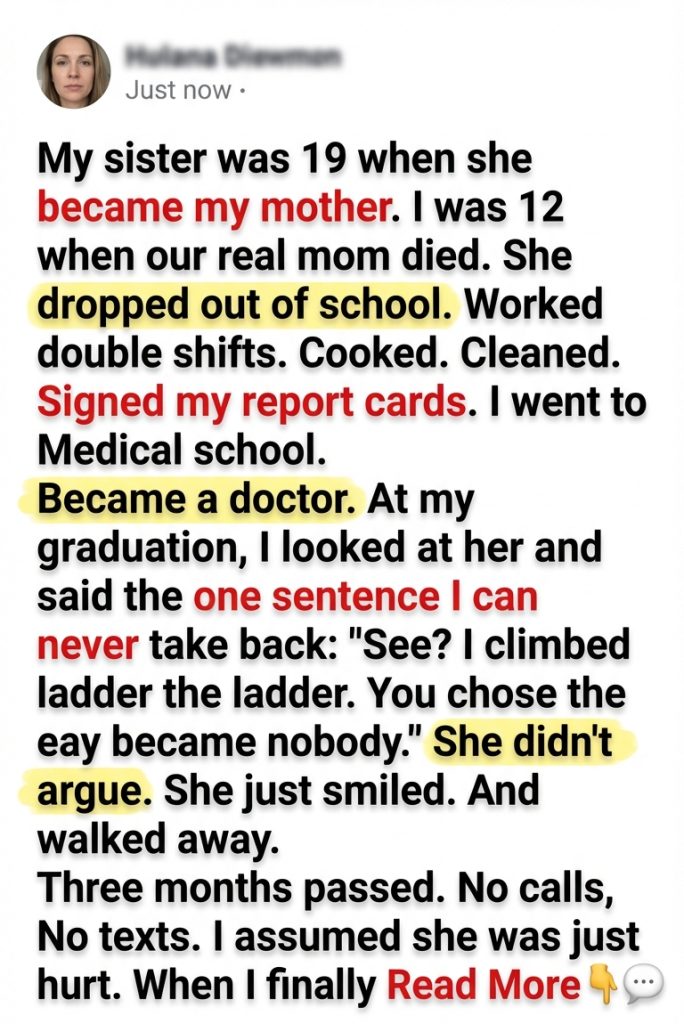
My sister was 19 when she became my mother. I was 12 when our real mom died. She dropped out of school. Worked double shifts. Cooked. Cleaned. Signed my report cards. I went to Medical school. Became a doctor. At my graduation, I looked at her and said the one sentence I can never take back: “See? I climbed ladder the ladder. You chose the easy road and became nobody.” She didn’t argue. She just smiled. And walked away. Three months passed. No calls, No texts. I assumed she was just hurt. When I finally went back home I opened the door.
The silence was wrong.
Not the peaceful kind, not the familiar hush of a house at rest, but the kind of silence that feels like something has been taken out of the air. The house I had grown up in had always carried some sound of her in it—pots clinking in the kitchen, a broom brushing across the floor, the low murmur of the television after midnight when she was too tired to sleep properly. But that day, there was nothing.
I stood in the doorway with my suitcase in one hand and my keys still in the other, waiting for her voice to call from the kitchen and ask whether I wanted tea. Waiting for the faint scolding in her tone, the one she used when she was pretending not to be happy I had come. Waiting for some sign that the last three months had been only distance, only hurt feelings, only pride.
But the living room was bare.
Not empty, exactly. The sofa was still there. The old curtains still hung at the windows. My school photos still lined the shelf in cheap silver frames she had probably bought one at a time because that was all she could afford. But there was no warmth left in the rooms. It was as if the house had already started forgetting us.
I called her name once, then again, louder this time.
No answer.
A strange cold spread through my chest. I moved from room to room, checking the kitchen, the narrow bathroom, her bedroom with the faded blue quilt she had kept since I was a boy. The bed was made. The closet door stood open. Half the hangers were gone. On the dresser, the small bottle of perfume she wore only on holidays had been taken too.
That was when I understood.
She had not gone out.
She had left.
I wish I could say my first feeling was heartbreak. It wasn’t. It was irritation, then disbelief, then a bruising kind of anger that only later revealed itself as fear. I had spent years becoming someone important, someone respected, someone whose white coat turned heads and opened doors. Somewhere inside me, I had started believing that no one who truly loved me could ever choose absence.
But she had.
And the reason was standing right there in my memory, wearing my face, speaking with my mouth.
At my graduation, I looked at her and said the one sentence I can never take back: “See? I climbed ladder the ladder. You chose the easy road and became nobody.”
Even now, I can still see the moment after I said it.
The crowd had been loud around us, proud families lifting bouquets, camera flashes, laughter ringing out beneath the bright banners of the medical auditorium. My classmates were hugging their parents. Professors were shaking hands. My name had just been called with distinction, and I was swollen with the kind of pride that feels almost holy when you have worked half your life for one moment.
She was standing there in the same navy dress she had worn to every important event of mine for years. It wasn’t new. I noticed that only later. At the time, I barely saw her at all. I only saw what I thought I had become—and what I had convinced myself she had not.
She didn’t argue. She just smiled. And walked away.
That smile has haunted me more than if she had slapped me.
If she had screamed, I could have defended myself. If she had cried, I could have blamed emotion. But she simply smiled the way people do when pain has gone too deep to be displayed in public. Then she stepped back into the crowd and let me remain in the glow of my own cruelty.
Three months passed. No calls, No texts.
At first I told myself she needed time. Then I told myself she was being dramatic. Then residency began swallowing my days with long shifts, emergency consults, charting that never ended, and the endless pressure of proving I deserved the title I had fought so hard to earn. I let those excuses become a shelter. It was easier to imagine her stubborn than to imagine myself monstrous.
Still, every now and then, some tiny thing would crack that illusion.
A patient’s daughter fixing her father’s blanket with the same gentle hands my sister used when I was sick. The smell of burnt onions from the hospital cafeteria reminding me of how she always overcooked them when she was rushing between jobs. A kid in the pediatrics wing clutching a science workbook, making me remember her standing at our kitchen table late at night, pretending she understood my homework so I would not feel alone.
My sister was 19 when she became my mother.
People say sentences like that too easily, as though sacrifice can be summarized neatly. But what does it really mean for a nineteen-year-old girl to become a mother overnight? It means taking grief and turning it into groceries. It means signing school forms while your own classmates are posting party photos. It means learning to stretch one chicken over three meals, learning how to lie to utility companies, learning how to smile when you are exhausted so the child watching you doesn’t get scared.
I was 12 when our real mom died.
She died so suddenly that the house never had time to prepare for her absence. One week there was soup on the stove and her humming in the mornings. The next week there were casseroles from neighbors and the bitter smell of funeral lilies that made everything feel wrong. I remember staring at the adults around me and thinking they all seemed to know how to move through the world without her. I didn’t.
Neither did my sister. But unlike me, she didn’t have the luxury of falling apart.
She dropped out of school. Worked double shifts. Cooked. Cleaned. Signed my report cards.
I did not understand the cost of those words when I was younger. To me, she was just there. Dinner appeared. Laundry got folded. Permission slips got signed. Birthday cakes, even if lopsided, still found their way to the table. She was the force that kept our life from sliding into chaos, and because she made it look ordinary, I mistook it for effortless.
I never saw the parts she hid.
I never saw her crying in the bathroom after the landlord pounded on the door. I never saw her count coins under the blanket at night because she didn’t want me to know the electricity might be cut off. I never saw how many invitations she turned down, how many dreams she folded away and tucked into drawers because my school shoes needed replacing or I had another exam fee to pay.
When I was fourteen, I told her I wanted to be a doctor.
She looked at me over the sink, her hands raw from detergent, and smiled like I had handed her a miracle. “Then be one,” she said. Not “if we can afford it.” Not “let’s see.” Just be one. As if faith itself could pay tuition. As if her belief in me was a currency strong enough to challenge reality.
Maybe it was.
Because from that day on, everything in the house bent quietly toward that goal. She took more shifts. She learned to sleep in fragments. She stopped buying herself new clothes altogether. When my science teacher suggested a summer enrichment program, she found the money. When I needed a better secondhand laptop, she found the money. When application season came and the fees stacked like threats, she found the money again.
I went to Medical school. Became a doctor.
I wore that achievement like armor.
There is a danger in climbing. The higher you go, the easier it becomes to confuse altitude with virtue. Somewhere between scholarships, white coats, anatomy labs, and the praise of people who finally pronounced my future with admiration, I began rewriting my own story. I told it as one of talent, discipline, grit. Those things were true. But they were not the whole truth.
The whole truth was standing in the shadows, wearing a grocery-store uniform, rubbing aching feet, pretending not to be tired on the phone so I could focus on exams.
At my graduation, all of that should have been visible to me.
Instead, I looked at her and saw only what she was not.
Not educated. Not accomplished, at least not in the way the world counts. Not polished enough for the people shaking my hand that day. She stood among the professors and affluent parents like someone from another life, and rather than feel humbled by the bridge she had built for me, I felt embarrassed that anyone could trace me back to her.
That is the ugliest truth I know about myself.
Back in the house, I stood in the center of the living room and finally noticed the envelope on the table.
It had my name on it. Just my name, written in the same neat, slightly slanted handwriting that had once signed school excuses and lunch money notes and birthday cards with five-dollar bills tucked inside. My fingers trembled before I even opened it, because some part of me already knew that whatever was inside would hurt more than silence.
The letter was only three pages long.
She began simply. No accusations. No dramatic declarations. Just facts, the same way she had always dealt with hard things.
She wrote that she had loved me enough to give me everything she had, but she did not know how to keep standing in a place where I had reduced her life to failure. She wrote that maybe she had made it look too easy all those years, and that was her mistake. She had protected me so well from the weight she carried that I had grown up thinking it weighed nothing.
Then came the line that made me sit down before my legs gave way.
“I did not choose the easy road. I chose you.”
I read that sentence once. Then again. Then aloud, as if hearing it in my own voice might make it less devastating. It did not.
The rest of the letter was worse in the quietest ways.
She told me she had enrolled in community college twice after Mom died and dropped out both times because my needs kept pulling her back home. She told me she had once been offered a promotion that would have changed our lives, but it required night travel and she couldn’t leave a fifteen-year-old alone with no one to make sure he came home safe. She told me she used to keep a brochure for nursing school in her dresser drawer and would sometimes look at it after I fell asleep.
There it was.
The life she might have had.
Not because she lacked ambition, not because she “became nobody,” but because she poured every possible version of herself into keeping me alive, stable, educated, and unbroken. I had thought I climbed by myself. In truth, she had been the ladder.
At the bottom of the letter was an address.
No explanation. Just an address in another town, two hours away, and a final line:
“If you ever understand what you said, do not come with excuses. Come with truth.”
I left that same evening.
The drive felt longer than any road I had taken in my life. Fields blurred past the window. Dusk fell slowly over gas stations and dark storefronts and little houses with porch lights blinking on one by one. I kept rehearsing what I would say, and every version sounded thin, defensive, shamefully incomplete.
Sorry felt too small.
Tired and desperate by the time I reached the address, I found a modest brick building with flower boxes under the windows and a small sign out front. It was not an apartment complex. It was not a friend’s house.
It was an adult education center.
For a long moment, I just stared.
Then I saw her through the glass.
She was standing in a classroom, writing on a whiteboard. Her hair was pinned up loosely. She wore reading glasses I had never seen before. Around her sat a handful of adults—some middle-aged, some elderly, one young mother rocking a stroller with her foot while taking notes. My sister turned, smiled at something a student said, and in that instant I saw a version of her I had never allowed myself to imagine.
Not broken. Not abandoned.
Becoming.
I did not go in right away.
I stood outside like a coward, watching the woman I had dismissed as “nobody” patiently explain algebra to people who had probably once believed their own lives were over too. There was confidence in her posture, humor in the way she tilted her head when someone got stuck, warmth in the room that seemed to radiate from her. She looked alive in a way I had not noticed in years.
When class ended, she saw me.
For one terrible second, nothing moved. The students filed past me with notebooks under their arms, and still she stood there in the doorway, looking at me with an expression I could not immediately read. Not anger. Not welcome. Something steadier than both.
I crossed the room like a man walking into judgment.
“I got your letter,” I said, because apparently even after everything, I was still clumsy with the truth.
She nodded.
“I was cruel.”
Another nod.
I swallowed hard. “No. More than cruel. I was arrogant. I was ashamed of the wrong things. I thought success meant I was better than the life I came from, and I used the ugliest words I could find against the person who gave me that success.”
She said nothing, and somehow that made honesty easier.
So I kept going.
I told her I remembered the nights she stayed up with me when I had pneumonia. The mornings she lied and said she had already eaten so I would take the last egg. The way she clapped the loudest at every school event, even when she came in smelling like fryer grease and laundry soap because she had rushed there straight from work. I told her I had spent years benefiting from her sacrifice while resenting the evidence of it.
Then my voice broke.
“You were never nobody,” I said. “You were everything.”
Her face changed then, just slightly. A crack in the calm. A shimmer in the eyes.
She looked down at her hands before speaking, and when she did, her voice was soft. “Do you know what hurt the most?”
I shook my head because I was afraid to guess.
“It wasn’t that you insulted me,” she said. “It was that for one moment, I realized I had protected you so much from suffering that you never learned to recognize it.”
I started crying before I could stop myself.
Not the dignified tears of apology. The ugly kind. The kind that pull your shoulders down and make you gasp like a child. All the years of pressure, ambition, pride, exhaustion, and denial seemed to collapse at once. And through it, she stood there, not rescuing me from it, not rushing to make it easier, but letting me feel the full weight of what I had done.
I deserved that weight.
After a long silence, she stepped closer.
“I’m studying now,” she said, almost shyly, as if she needed me to know this was not a fantasy or a punishment or a performance. “I got my GED first. Then I started taking classes here. Next year, if all goes well, I’ll transfer into a teaching program.”
I laughed through tears because the irony was almost too much to bear.
All those years, while I had been measuring worth in titles and salaries and prestige, she had quietly returned to the road she was never supposed to lose in the first place. And somehow, even after everything, she had found the courage to begin again.
“I’m proud of you,” I whispered.
She smiled a little at that, but there was sadness in it too. “You don’t get to be proud of me instead of being sorry.”
I nodded immediately. “I know.”
That was the beginning. Not the repair. Just the beginning.
Forgiveness, I learned, is not a scene. It is a practice. It is showing up again and again without demanding that the wound close on your schedule. I started visiting every week. Sometimes we talked. Sometimes we only drank tea at her tiny kitchen table while rain tapped against the glass. Sometimes she told stories from the years I thought I already knew, and each one revealed another invisible brick she had carried for me.
I helped where I could, though nothing I did felt equal.
I fixed her old car. Paid off a loan she had taken for textbooks, but only after asking and only after she agreed on the condition that it be called a gift, not a debt. I attended one of her presentations at the center and sat in the back while she taught a room full of adults how to write personal statements. Watching her there, guiding other people back toward their own futures, I understood something that medicine had never taught me.
Saving a life does not always happen in hospitals.
Sometimes it happens in kitchens, at bus stops, in laundromats, at midnight over homework, in the years someone hands away piece by piece so another person can become whole. My sister had saved mine long before I ever wore a stethoscope.
Months later, she invited me to dinner.
Nothing grand. Pasta, garlic bread, one of those supermarket cakes with too much frosting because she said celebrations should still look like celebrations. After we ate, she disappeared into the other room and returned with an old folder. Inside were my drawings from middle school, my spelling test certificates, acceptance letters, copies of essays, and one wrinkled paper with childish handwriting.
“What’s this?” I asked.
She smiled.
It was a school assignment from when I was thirteen: Write about your hero.
I had written about her.
In messy, uneven lines, I had described how my sister made pancakes shaped like stars when I was sad. How she worked all the time but still came to parent-teacher night. How she was “the bravest person I know because she does everything and never makes me scared.”
I could barely breathe by the end of it.
“You kept this?”
“I kept everything,” she said.
That was the moment I understood grace in its purest form.
Not that she forgot what I said. Not that she erased it. But that she allowed me to return and become answerable to the better truths I had once known before ambition hardened me. She had always seen both versions of me—the boy who loved her without shame and the man who wounded her with it. And somehow, she made room for me to choose which one I wanted to become.
I still think about that graduation day.
I still hear the sentence. Still feel its poison. There are words that can be apologized for and words that remain like scars no apology fully smooths. That one will stay with me for the rest of my life. Maybe it should. Maybe some shame deserves to be remembered so it can keep teaching you humility long after forgiveness begins.
My sister was 19 when she became my mother.
Now, when I say that, I no longer say it as tragedy alone. I say it with reverence. Because she did not simply raise me. She rebuilt a world from ashes and held it together with her own bare hands until I was strong enough to stand in it. And when I became too proud to remember who made that possible, she walked away not to punish me, but to save what remained of herself.
I was the doctor. She was the one who taught me what healing costs.
So yes, I went back home and opened the door. I thought I was returning to the woman I had hurt. Instead, I found the truth she had been carrying all along: she had never been nobody. She had been the author of every good thing in my life. The first home I knew after loss. The quiet miracle behind every success I wore so loudly.
And if I spend the rest of my life trying to deserve being called her brother again, that will still be a smaller task than the one she took on when she was nineteen and grieving and brave enough to choose me.