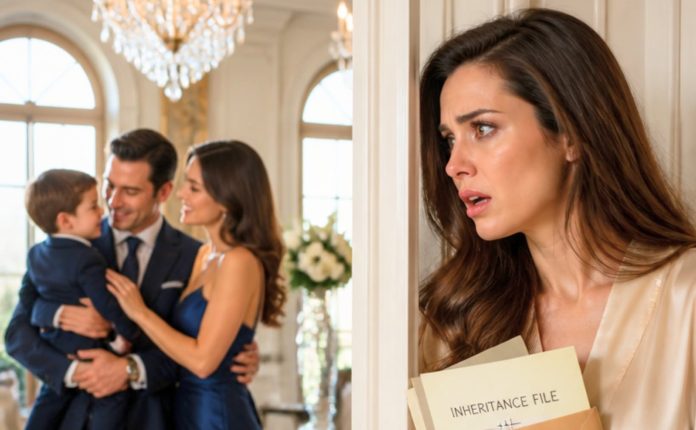
My son was only 33 when he became gravely ill. His wife looked at him once and said, “I won’t waste my life watching him turn into a vegetable,” – and walked away. I sold my house. Everything I owned. I became his nurse, his cook, his strength when the pain stole his sleep. I was the only one holding his hand when he took his last breath. Then after the funeral, the woman who abandoned him inherited everything and threw me out. While packing my final box, I found a shoebox hidden under his bed. When I opened it, my heart stopped. Because inside was something he had kept secret.
There are griefs so sharp they do not arrive all at once. They come in layers, like cold rain soaking deeper through cloth, until you realize you are trembling from something far greater than weather. Losing a child is one of those griefs. It is unnatural, unbearable, and wrong in a way language can never fully hold.
Even now, I struggle to say his name out loud without hearing the sound of his laughter layered over the silence that followed him. My son, Daniel, had always been the kind of man who made a room feel warmer just by entering it. At 33, he should have been building a future, making plans, chasing ordinary happiness. Instead, he was counting pills and measuring pain between sleepless nights.
The illness came quietly at first. A little fatigue. A pain in his back he dismissed as a pulled muscle. Then came the tests, the scans, the waiting, and the doctor’s face when he returned with the results. You do not forget a face like that. It is the face of someone about to divide your life into before and after.
Daniel tried to be brave for everyone. He laughed in the hospital room, joked with the nurses, told me not to make that worried look because it made him feel older than he was. But I saw what the illness was doing to him. I saw it in the way he gripped the side of the bed when the spasms came. I saw it in the way he stared at the ceiling after everyone else had left.
His wife, Vanessa, was there in the beginning. She wore expensive perfume and crisp coats and carried herself like inconvenience had personally insulted her. At first, she made a great show of concern. She posted dramatic messages online about love and hardship. She sat in waiting rooms just long enough to be seen. But genuine compassion has weight, and hers was all air.
The day she left is burned into me as clearly as the day he died. Daniel had just come home from another hospital stay. He was thinner than ever, exhausted, struggling to lift even a glass of water. She stood at the foot of the bed, arms crossed, looking at him as if he had become something offensive to her.
Then she said the words I will never forget: “I won’t waste my life watching him turn into a vegetable,” – and walked away.
Just like that. No tears. No hesitation. No backward glance. She took her handbag, her car keys, and every trace of warmth out of that room. Daniel didn’t cry immediately. That was the worst part. He only stared at the doorway for a long time, as if his mind refused to accept what his heart had already understood. Later that night, when I adjusted his blanket, I found tears drying near his temples.
I sold my house. Everything I owned.
People told me not to. They said I was being too emotional, too drastic, too willing to ruin my own future. But what future was I supposed to preserve, if my son was slipping away and I still had the power to make his days gentler? Walls, furniture, savings—none of it mattered more than giving him comfort. So I sold the place his father and I had built, the jewelry tucked away in drawers, the china no one used anymore, even the old piano Daniel learned on as a boy.
I became his nurse, his cook, his strength when the pain stole his sleep.
I learned how to change dressings with steady hands even when my stomach twisted. I learned the names of medications too long and too technical for a mother who had once only needed to know his favorite cereal. I blended soups when he could not chew, counted drops in the middle of the night, washed sheets before dawn, and sat by his bed when the hours stretched into something beyond exhaustion.
There is a kind of intimacy in caregiving that few people talk about. It strips life down to its truest elements. Hunger. Pain. Fear. Hope. A cool cloth on a fevered forehead. A spoonful of broth. A hand resting on a shoulder when words are too small to help. In those months, I was not heroic. I was simply his mother, loving him in the only ways still left to me.
Some nights Daniel apologized for being a burden, and every time it broke me anew. I would smooth his hair back and tell him the truth: that he had never been a burden, not when I carried him beneath my heart, not when I held him through childhood fevers, not now. Love does not become less sacred when it becomes difficult. If anything, difficulty reveals how real it is.
When pain medication dulled him into a restless half-sleep, he would murmur strange fragments from the edges of dreams. Sometimes he called for me as if he were a child again. Sometimes he said things that made no sense at all. But other times he spoke with heartbreaking clarity. “I’m sorry, Mom,” he whispered once. “You shouldn’t have to watch this.” I pressed my forehead to his hand and told him I would watch anything, endure anything, if it meant he did not face it alone.
Friends faded. That is another cruelty illness teaches you. People come with flowers in the beginning. They send messages. They say, “Let me know if you need anything.” Then the weeks stretch on, and your sorrow becomes too inconvenient, too repetitive, too real. One by one, they return to their lives. The world continues spinning with almost obscene normalcy while yours narrows to the sound of labored breathing behind a half-closed bedroom door.
Vanessa never came back. Not once.
But she did send papers.
Legal papers. Insurance forms. Estate documents Daniel was too weak to read. She claimed she was “taking care of practical matters.” Even then, something about it made my skin crawl. The illness had stripped my son of so much, yet somehow she still seemed to hover at the edges of his life like a vulture waiting for the final stillness. I wanted to scream at her, to tell her she had forfeited every right the moment she walked out. But Daniel always asked me not to fight.
He still loved her, at least for a while. Or maybe he loved the version of her he had married, the version he kept trying to believe in. Illness does not only attack the body. It also humiliates the heart, making it cling to people who do not deserve its loyalty. I watched that truth wound him almost as deeply as the disease itself.
As the months passed, Daniel grew weaker. The man who once carried grocery bags two at a time could barely lift his own arms. His voice thinned to a whisper. His skin turned pale and delicate, almost translucent in the morning light. Yet somehow, in flashes, I still saw the little boy who ran barefoot through sprinklers, the teenager who came home muddy from football, the young man who danced with me in the kitchen just to make me laugh.
I was the only one holding his hand when he took his last breath.
That night was quiet. Too quiet. The kind of silence that warns you something is changing forever. Rain tapped softly against the windows, and the lamp on his bedside table cast a weak golden circle over the blanket. Daniel had been drifting in and out all evening. Near midnight, his eyes opened fully, and for one clear, luminous moment, he looked like himself again.
He squeezed my fingers and whispered, “Mom.”
I leaned close. “I’m here, sweetheart.”
His breathing shuddered. His lips moved. I had to bend until my ear nearly touched them. “Thank you,” he said. Just that. Two words carrying the weight of a whole lifetime between us. Then his chest rose once more, slowly, and when it fell, it did not rise again.
No mother should have to learn the exact shape of the moment her child leaves the world. But I did. I learned it in the stillness after his final breath. In the unbearable absence of motion. In the way his hand, still warm in mine, no longer held on. Something inside me broke so deeply that I do not think it ever fully healed.
The funeral came and went in a blur of black clothes, casseroles, wilted flowers, and phrases people say because they do not know what else to offer. “He’s in a better place.” “At least he’s no longer suffering.” I nodded because that is what the grieving are expected to do. But inside, I wanted to ask why a better place always had to be so far from a mother’s reach.
Then after the funeral, the woman who abandoned him inherited everything and threw me out.
Vanessa arrived not in mourning, but in control. Crisp heels. Sunglasses. A handbag that probably cost more than the car I drove for fifteen years. She informed me, in a voice polished smooth by entitlement, that as Daniel’s legal wife, his assets transferred to her. The house, the accounts, the contents—everything. She gave me three days to leave.
I looked at her and felt something colder than rage. Rage burns hot. This was ice. This was the understanding that some people move through tragedy not changed by it, but sharpened into even clearer versions of their worst selves. She had not earned a single inch of the life Daniel built, yet she arrived ready to claim all of it as if grief were merely paperwork to process.
I wanted to fight then. I wanted to overturn tables, tear documents, drag every shameful truth into the daylight. But I was tired in a way that went beyond physical exhaustion. I had poured every ounce of myself into helping my son die with dignity. I had nothing left for war. So I packed.
While packing my final box, I found a shoebox hidden under his bed.
At first I thought it held ordinary things. Old letters. Socks. Something tucked away and forgotten in the chaos of illness. The cardboard was worn at the corners, sealed with a faded strip of tape. My hands almost passed it by. Almost. But something about the careful way it had been pushed far back into the shadows made me stop.
When I opened it, my heart stopped.
Because inside was something he had kept secret.
On top lay a bundle of envelopes, all addressed in Daniel’s handwriting. Beneath them sat a flash drive, a small leather notebook, and a sealed folder marked in thick black ink: FOR MOM. ONLY IF SHE LEAVES ME WITH NOTHING. My hands began to shake so hard I had to sit down on the floor beside the bed he died in.
I opened the folder first.
Inside were copies of legal documents I had never seen. Bank records. Property transfers. Insurance beneficiary changes. There was also a letter from Daniel, written when his handwriting had already begun to weaken, the lines uneven but unmistakably his. In it, he explained that after Vanessa left, he started noticing unusual withdrawals, forged signatures, and strange phone calls from creditors. At first he thought stress was confusing him. Then he found proof.
Vanessa had been moving money quietly for months before she walked out.
Not just spending it—draining it. Opening credit lines in his name. Transferring funds through shell accounts. Positioning herself so that when he died, she would inherit what remained while the hidden debt would bury anyone else who tried to challenge her. Daniel wrote that he had confronted her by phone once, and she laughed. She told him no one would believe a dying man over a healthy, grieving widow.
But Daniel had not been as helpless as she thought.
The flash drive contained recordings. Phone conversations. Copies of emails. A video message he had made late one night, his face gaunt but his eyes painfully alert. In that video, he said if I was watching, it meant Vanessa had done exactly what he feared. He apologized for keeping it from me. He said he wanted to protect me from one more burden while he was alive, but he needed me to have the truth once he was gone.
Then came the part that made me cry so hard I could barely see.
He had changed what he could.
Months before his death, with the help of an old college friend who was now an attorney, Daniel had created a separate trust using funds Vanessa did not know existed—money from an investment his grandfather left him years earlier. He had placed it beyond her reach. Not for himself. For me. For the woman who sold everything to keep him safe, who stayed when everyone else fled, who held the line between suffering and mercy with nothing but love and worn-out hands.
The leather notebook held one final blow against Vanessa. Dates. Times. Details. Every cruel visit. Every threatening message. Every financial irregularity. Even notes about her affair with a man Daniel suspected she was seeing before she left. It was not just a grieving husband’s anger. It was evidence. Meticulous, careful, devastating evidence.
For the first time since Daniel died, I felt something besides grief.
Purpose.
The next morning, I took the shoebox to the attorney whose name Daniel had written in the letter. He listened without interrupting, read every page, viewed every file, and then sat back in his chair with a long, measured breath. “Your son,” he said quietly, “was very sick. But he was also very smart.” I think that was the first moment I smiled through tears.
The weeks that followed were not easy, but they were righteous. Vanessa’s polished confidence began to crack the moment she realized Daniel had prepared for her betrayal. The recordings were authentic. The transfers were traceable. The affair gave motive, the documents gave structure, and the trust placed a protected part of his estate safely beyond her reach. What she thought would be a clean inheritance became a legal nightmare with fraud at its center.
She tried to play the widow. Tried to cry. Tried to say I was a vindictive mother refusing to let her grieve. But facts do not wilt under performance. Bit by bit, her lies came apart. Accounts were frozen. Claims were challenged. Investigators started asking questions she could not answer smoothly. Even people who once avoided my eyes in the grocery store began whispering a different story now.
In the end, Vanessa did not keep everything. She lost far more than she expected. The hidden fraud opened doors she could not close. The courts unraveled transactions she assumed no one would examine. And the trust Daniel created ensured that I was not left homeless, broken, and erased. My son, even from the edge of death, had found a way to protect me.
I moved into a small cottage not far from the churchyard where Daniel is buried. It is not grand. It does not need to be. There are flowers by the fence in spring and a kitchen window where morning light lands warmly across the table. On the shelf above the fireplace sits the shoebox, not because I cannot move on, but because it reminds me that truth sometimes waits in silence until the exact moment it is needed most.
I still miss him every day.
I miss his voice. I miss the way he called me “Ma” when he was tired. I miss the impossible hope I carried even when doctors had none left to give. But alongside the grief now lives something steadier: pride. Daniel saw betrayal clearly when his body was failing. He faced cruelty without letting it poison him. And even then, he was still thinking of me.
People sometimes speak of the dead as if they are gone in a simple, clean way. But love leaves fingerprints everywhere. In handwriting on old envelopes. In recipes scribbled on torn paper. In a hidden shoebox beneath a bed. In the plans a son made so his mother would not be destroyed by the woman who abandoned him. Death took Daniel’s breath, but it did not erase his courage.
If there is one thing I have learned, it is this: the cruel often mistake kindness for weakness. Vanessa thought I was just an exhausted old woman too broken by loss to fight back. She thought Daniel was too sick to notice, too dying to defend himself. She was wrong on both counts. Love had made us tired, yes. But it had also made us fierce.
So when I stand by Daniel’s grave now, I do not only bring sorrow. I bring gratitude. For the years I had him. For the privilege of holding him through the hardest ending. For the secret he left behind not as revenge, but as protection. The shoebox under his bed did stop my heart for a moment. Then, slowly, it helped teach it how to beat again.
And if the world ever wonders who truly loved my son, the answer is not in the widow who came back for money. It is in the mother who stayed for the pain, the breath, the goodbye—and in the son who, even while dying, made sure she would not be left with nothing but grief.