At 36, I chose a path no one in my village could understand — I married a woman they all whispered about, the one they called a beggar. Years later, she gave me two beautiful children. Then, one day, three gleaming luxury cars rolled into our quiet village — and the truth they revealed stunned everyone.
By the time I reached 36, the gossip had become unbearable. “Still unmarried? He’ll be alone forever,” the neighbors muttered behind their doors. They didn’t know the quiet truth: I had loved before, but life had always intervened. So, I embraced the simple rhythm of my days — tending my garden, feeding my chickens and ducks, finding comfort in a peaceful routine.
It was a bitter winter afternoon when I first saw her. She was small and thin, wearing threadbare clothes, sitting by the roadside with her hand outstretched. But it wasn’t her appearance that drew me in — it was her eyes. Calm, gentle, yet weighed down by a sorrow that seemed far too heavy for one person. On impulse, I offered her some rice cakes and a bottle of water. She accepted quietly, head bowed, her voice soft and trembling with gratitude.
That evening, I couldn’t get her out of my mind. Her presence lingered like a quiet song I didn’t know I’d been missing. Days later, I found her again in another corner of the market. I sat beside her this time, and we spoke for hours. Her name was Claire Dawson. She told me she had no family, no home, no one to rely on but the kindness of strangers. She had survived, she said, by begging for as long as she could remember.
There was something about the way Claire spoke that did not match the life she claimed to have lived. Her words were careful, measured, almost elegant. Even in rags, she carried herself with a quiet dignity that no hardship had managed to crush. She never begged from me directly. She only answered what I asked, and when silence came, she wore it gently.
I began looking for her every market day without admitting to myself that I was doing it. I would bring an extra bun, an orange, sometimes a warm scarf if the air turned cruel. She always thanked me with the same shy smile, the kind that seemed surprised by kindness. In time, our conversations became the part of the week I looked forward to most.
The village noticed, of course. Villages always notice. Women filling baskets at the well lowered their voices when I passed. Men at the tea stall smirked into their cups. Some called me foolish. Others said loneliness had finally made me lose my senses. A few laughed openly, as if caring for someone poor was a joke fit for entertainment.
But the more they mocked her, the more I wanted to understand her. Claire never answered cruelty with bitterness. When children pointed at her torn sleeves, she only smiled sadly and moved on. When shopkeepers waved her away from their doors, she bowed her head and stepped aside. It was not weakness. It was the patience of someone who had already survived worse.
One spring morning, I found her sitting beneath the acacia tree at the edge of the village. The rains had washed the air clean, and the earth smelled rich and alive. She looked exhausted, as if sleep had abandoned her for many nights. I asked if she had eaten. She said yes, but her voice was faint, and I knew it was not true.
I brought her home that day, though not without hesitation. My house was modest — two rooms, a low roof, old wooden shutters that creaked in the wind — but it was clean, and it was mine. I told her she could rest, wash, and leave whenever she wished. She stood in my doorway with tears trembling in her eyes, as if stepping inside was more frightening than sleeping outside.
For the first two days, Claire moved through my house like a guest afraid to touch anything. She folded blankets twice, washed her own cup, and apologized every time she spoke above a whisper. I noticed how carefully she avoided waste, how instinctively she saved crumbs, how she startled at sudden sounds. Poverty had shaped her, yes, but fear had shaped her even more.
Little by little, the walls around her began to soften. She helped me in the garden, kneeling in the soil with her hair tied back, sunlight warming her face. She fed the ducks and laughed the first time one nipped at her skirt. In the evenings, we shared simple meals while the lantern flickered between us, and for the first time in years, my home no longer felt hollow.
Then the whispers grew sharper. “He let that beggar live with him,” people said. “Desperate men make desperate choices.” Some warned me she would steal from me. Others said she would disappear once she found something better. Even my cousin pulled me aside one evening and told me I was ruining my reputation for a woman no one knew.
I listened, but only because silence was easier than arguing. In truth, my reputation had never kept me warm at night. It had never sat beside me while the rain hit the roof. It had never looked at me the way Claire did when I handed her a cup of tea — as if I had given her far more than tea, as if I had handed her proof that the world could still be gentle.
I asked Claire one night if she wanted to stay. The crickets were singing outside, and moonlight lay across the floor like pale cloth. She stared at me for a long time, her hands trembling in her lap. Then she whispered that no one had ever asked what she wanted before. I told her I was asking now.
She cried then, not loudly, but with the quiet grief of someone who had been strong for too long. She told me she was afraid to belong anywhere because everything she had ever loved had been taken from her. I did not press her for details. I only took her hand and told her that some things did not need to be explained before they were accepted.
A month later, I married her.
The village reacted exactly as I knew it would. Some came only to witness the absurdity of it. Some refused to attend at all. A few stood far off, watching with faces pinched in judgment. Claire wore a simple cream dress sewn by the widow next door, and I swear I had never seen anything more beautiful. She walked toward me with tears in her eyes and courage in every step.
Marriage did not erase hardship. We were not suddenly blessed with riches or spared from cruelty. There were seasons when crops failed and money ran thin. There were market days when people still called her names under their breath. Yet there was also laughter in our home, warmth in our bed, and peace in waking beside someone who understood the sacredness of small things.
When our first child was born, a daughter with Claire’s steady eyes, something shifted inside me. I held that tiny body and felt my life divide into before and after. Claire wept when she placed the baby in my arms. She said she had never believed she would live long enough to be called mother. I kissed her forehead and told her the world had owed her tenderness for a very long time.
Two years later, our son arrived with a cry loud enough to startle the birds from the roof. He had my stubborn chin and Claire’s delicate hands. By then, our little house was noisier, messier, and more alive than I had ever imagined possible. The village still talked, but I cared less with every passing year. Let them talk. My life had become too full to leave room for their scorn.
Still, I knew Claire carried shadows she had never named. Sometimes she would freeze at the sound of engines on the road. Sometimes letters arrived with no return address, and she would burn them unread. Once, I woke in the middle of the night to find her sitting outside under the stars, arms wrapped around herself, staring into the darkness as if listening for footsteps from another life.
I asked her, more than once, if she wanted to tell me the truth of her past. Each time, she would smile sadly and say, “One day.” I learned not to force doors that pain was still holding shut. Love, I discovered, is not only in the asking. Often, it is in the waiting. So I waited, trusting that whatever haunted her would speak when it was ready.
Years passed quietly after that, until the morning everything changed.
It was harvest season, and the village roads were dusty and bright beneath the sun. I was repairing a fence while our children played nearby with sticks and stones, turning the yard into a kingdom only they understood. Then a deep mechanical hum rose from the far end of the road. It was not the sound of a tractor or motorbike. It was smoother, heavier, expensive.
One by one, three gleaming luxury cars rolled into our village.
The entire place seemed to stop breathing. Children ran after the vehicles. Women stepped out from courtyards, wiping their hands on aprons. Men abandoned the tea stall and shaded their eyes. Those cars looked like they had come from another world entirely, all polished metal and dark glass, moving through our dusty lane like royalty passing through a forgotten kingdom.
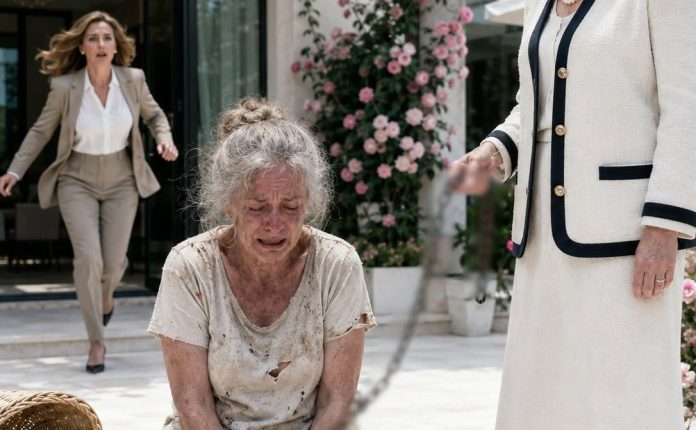
The first car stopped in front of my gate. Then the second. Then the third. Doors opened in perfect sequence. Men in dark suits stepped out, followed by an older silver-haired woman wearing pearls and a coat too fine for our village dust. Another man emerged behind her, tall, stern, carrying a leather folder. Nobody spoke. Even the chickens seemed to go quiet.
I looked at Claire.
She had gone pale.
Her hands shook so hard that the cup she was holding slipped and shattered on the ground. Our daughter clung to her skirt. Our son ran to my side. For a long second, fear crossed Claire’s face so nakedly that I thought she might collapse. Then something else rose in its place — not fear this time, but resolve. A woman who had been hiding suddenly stood up straight.
The silver-haired woman walked toward us with tears already falling. When she reached Claire, her voice broke on a single word.
“Cecilia.”
The name hit the air like thunder.
The villagers murmured around us. I felt my mind stumble, trying to fit that elegant name over the woman I knew as Claire Dawson. Claire closed her eyes, and when she opened them again, they were full of a pain so old it looked carved there. The older woman reached for her, but Claire stepped back first, breathing hard, fighting for control.
Then, in a voice barely above a whisper, my wife said, “You found me.”
What followed spilled out in fragments, then in whole truths. Claire Dawson was not her real name. She had once been Cecilia Laurent, the only daughter of a wealthy family from the city. Years ago, after her father’s death, her relatives had fought viciously over money, property, and control of the family business. When Claire refused to marry the man chosen to strengthen a partnership, everything turned dark.
She had fallen in love with someone her family considered beneath them — a musician, kind and poor. They had tried to separate them. When she resisted, she was threatened, watched, and finally forced into isolation under the excuse of protecting the family name. She escaped with the help of a housemaid, but before she could flee far, the man she loved was killed in what the police called a robbery. She had always believed it was no robbery at all.
After that, she disappeared.
She changed her name, cut ties with everyone, and drifted from place to place, terrified that money and power would drag her back into the prison she had escaped. She had trusted no one. Accepted nothing. Built no roots. By the time I found her by the roadside, she had been running for so long that survival was the only shape her life knew. Begging had not been her beginning. It had been her hiding place.
The silver-haired woman was her mother.
With trembling hands and a grief-stricken voice, she explained that she had spent years searching in secret. Claire’s uncles had controlled everything after her husband’s death, including the story told to the world. They claimed Claire was unstable, ungrateful, lost. But her mother had never believed it. Recently, after legal battles and the exposure of financial crimes within the family, she finally gained access to private records that led her here.
The man with the folder opened it and produced documents. Properties. Court orders. Bank statements. Proof that Claire’s father had left everything to her in a trust that had been concealed and manipulated by the very relatives who had hunted her. The scandal, he said, had begun unraveling months ago. Several people were under investigation. Others had already fled. The empire built on lies was collapsing.
Around us, the villagers stared as if the earth itself had split open.
These were the same people who had called my wife worthless, dirty, cursed. The same mouths that had whispered “beggar” now hung open in shock. Some lowered their heads. Others kept staring, hungry for every detail, desperate to reshape yesterday’s mockery into today’s admiration. But I felt no triumph in that moment. Only sorrow for what Claire had lost before she ever found us.
Claire’s mother fell to her knees then, right there in the dust, and begged forgiveness. Not for losing her daughter, she said, but for failing to protect her when it mattered most. Claire stood frozen, tears spilling silently down her face. Our children clung to her on either side, confused but instinctively protective, as if they understood that their mother’s heart was standing at the edge of an old wound.
When Claire finally spoke, her voice was stronger than I had ever heard it. She said she could not undo the years. She could not erase the hunger, the fear, the nights spent alone, or the humiliation of being treated as less than human. But neither could she deny that some part of her had never stopped longing for a mother’s love. So she stepped forward, and the two women held each other and wept.
The village watched the reunion in complete silence.
In the weeks that followed, everything changed — and yet, strangely, the most important things did not. Claire, or Cecilia, inherited wealth beyond anything I had ever imagined. There were offers to move to the city, to live in mansions, to send our children to elite schools, to begin a new life among polished people and guarded gates. But when she looked at me, I already knew her answer.
She chose to stay.
Not because she feared the past, but because she finally knew where home was. We repaired the village school roof. We funded medicine for the clinic. We made sure no widow went hungry through winter and no child had to leave class because of unpaid fees. Claire said wealth had nearly destroyed her once; now she would use it to restore what cruelty had broken.
As for the villagers, their behavior turned sweeter overnight, which told me all I needed to know about their character. Some apologized sincerely. Others praised Claire with suspicious enthusiasm, as if admiration could erase years of contempt. Claire accepted the honest apologies and ignored the rest. She had no interest in revenge. Life had already taught her that dignity is sometimes the most powerful answer of all.
One evening, long after the cars had gone and the village had returned to its ordinary sounds, Claire and I sat outside our home while the children chased fireflies in the yard. The sunset burned gold across the fields. She leaned her head on my shoulder and told me she used to think love had to be grand to be real — full of dramatic promises, wealth, rescue. But the truest love, she said, had found her in rice cakes, duck feed, muddy boots, and a man who asked nothing but honesty when she was ready.
I laughed softly and told her I had simply followed my heart.
She took my hand and answered, “No. You saw me when no one else wanted to.”
There are moments in life when the world reveals what it values. My village valued appearances, status, and rumor. It looked at a wounded woman and saw only torn clothes. It looked at an unmarried man and saw failure. But love has always been wiser than pride. It looks beyond what is visible. It listens beneath the noise. It recognizes the human soul even when the world has covered it in dust.
So yes, three luxury cars came to our village and stunned everyone with the truth. But the greatest truth had arrived years earlier, quietly, on a winter afternoon, when I handed a hungry woman a few rice cakes and a bottle of water. The village thought the miracle was that she turned out to be rich. They were wrong. The miracle was that she was always precious, even when no one knew.
And if I had to choose again — against the gossip, the laughter, the warnings, the judgment — I would still choose her every single time.