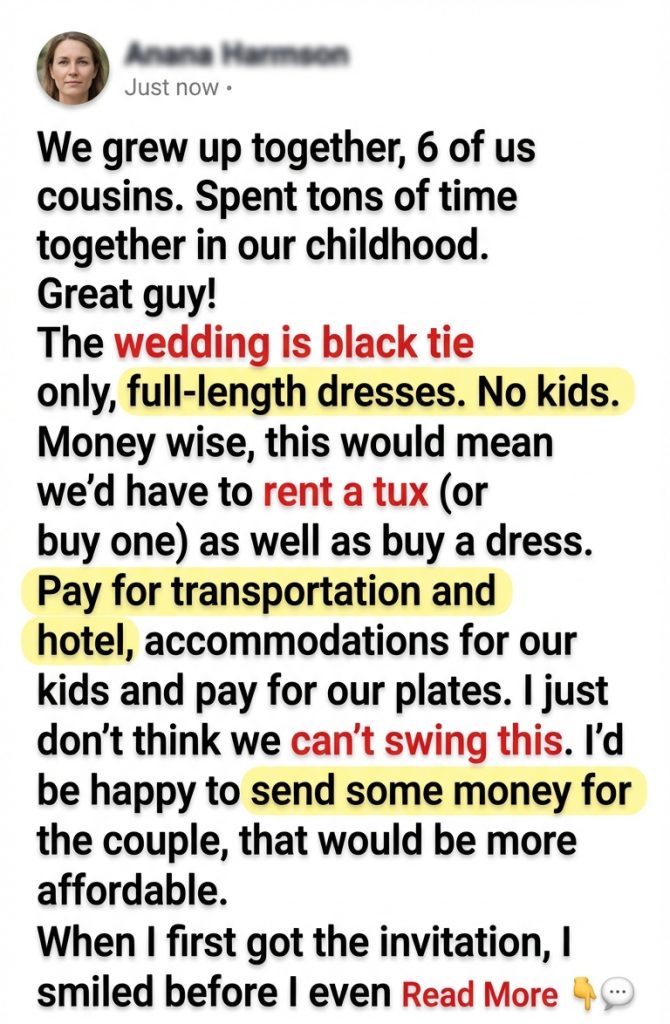
We grew up together, 6 of us cousins. Spent tons of time together in our childhood. Great guy!
The wedding is black tie only, full-length dresses. No kids.
Money wise, this would mean we’d have to rent a tux (or buy one) as well as buy a dress. Pay for transportation and hotel, accommodations for our kids and pay for our plates.
I just don’t think we can swing this. I’d be happy to send some money for the couple, that would be more affordable.
When I first got the invitation, I smiled before I even opened it all the way.
Some names carry warmth before your eyes have time to focus, and his was one of them.
My cousin had always been one of those people stitched into the best part of my childhood.
We were six cousins growing up together, and for a long time it felt like we were our own little tribe.
Summer afternoons blurred into bike rides, scraped knees, inside jokes, and the kind of laughter that made adults shake their heads from porches.
We were loud, inseparable, and convinced those years would somehow last forever.
He was a great guy even back then.
Easygoing, funny, the kind of cousin who made everyone feel included, whether we were building forts or getting scolded for tracking mud through somebody’s kitchen.
Some people grow older and become strangers. He never quite did in my mind.
So when I heard he was getting married, I was genuinely happy for him.
Not performatively happy, not politely happy, but the kind of happy that makes you pause for a second and picture someone’s whole future opening up in front of them.
I wanted good things for him. I still do.
At first, the invitation felt exciting.
Elegant paper, formal wording, all the little details that announce a wedding is not just an event but a production.
It had the kind of polished seriousness that tells you this day has been imagined for a long time.
Then I kept reading.
Black tie only.
Full-length dresses.
No kids.
None of those things are wrong on their own.
People are allowed to have the wedding they want, and I truly believe that.
If someone has dreamed of chandeliers, tuxedos, long gowns, and a child-free evening, that is their right.
But rights and realities are not always close friends.
Because the moment I finished reading, my mind stopped being sentimental and started doing math.
And math has a brutal way of stripping glamour down to what it actually costs.
A tux is not something my husband has hanging in the closet waiting for formal invitations to arrive.
That means renting, or worse, buying.
And either option becomes expensive very quickly once you add shoes, shirt, and all the little pieces that somehow never seem included.
Then there is my dress.
A full-length gown is not the kind of thing I can improvise from something already in my wardrobe.
Maybe someone with endless events and endless money can treat black tie like a casual inconvenience, but that is not our life.
Then came transportation.
Then hotel.
Then accommodations for our kids, because “no kids” does not magically mean children disappear into a cloud of affordable childcare.
And underneath all of that sat one more quiet truth: the gift.
Because even if nobody says it out loud, most people do not show up to a wedding empty-handed.
So the cost isn’t only attending—it is attending properly, dressing properly, traveling properly, gifting properly, existing properly inside someone else’s big beautiful day.
By the time I finished adding everything up in my head, the joy had a knot tied around it.
Not because I resented him.
Not because I thought he was wrong.
But because I realized that loving someone and being able to afford celebrating them are not always the same thing.
That is such an uncomfortable truth, especially with family.
People love to talk about showing up, making memories, being there no matter what.
What they mention less often is that “being there” can come with a price tag heavy enough to tip an entire month off balance.
We are not struggling in some dramatic, desperate way.
But we are not floating above money either, untouched by bills and timing and practical decisions.
We live in the real world, where one formal weekend can quietly swallow money meant for groceries, savings, school needs, or emergencies.
And that is what made this feel so hard.
If this were a random acquaintance, the answer would be easier.
But this was one of the six. One of ours.
One of the boys from childhood summers and family chaos and holiday tables crowded with laughter.
One of the people who belonged to that chapter of life when everything felt close and uncomplicated.
Saying no to him did not feel like declining a party. It felt like disappointing history.
For a few days, I kept trying to solve it in my head.
Maybe we could cut corners.
Maybe I could find a dress on sale, maybe borrow something, maybe shorten the hotel stay, maybe juggle the childcare, maybe make it all work if I bent every part of the budget until it squealed.
But every version of “maybe” still ended in the same place.
Too much.
Too tight.
Too irresponsible for one weekend, no matter how meaningful the occasion was.
That was the hardest part to admit.
Not that we couldn’t go in some technical sense, but that going would come at the expense of other things we actually need.
And adulthood is full of painful moments exactly like that—choosing the responsible answer even when it feels emotionally ugly.
I started imagining the conversation before I ever had it.
Would he be hurt?
Would other relatives think we were cheap, unsupportive, selfish, dramatic?
Families can be strangely unforgiving about money when it comes wrapped in celebration.
People understand financial limits when someone skips a luxury vacation.
But let it be a wedding, and suddenly practicality can get painted as disloyalty.
Still, I kept returning to the same belief.
A wedding invitation is an invitation, not a summons.
It is not a test of love measured in tux rentals and hotel receipts.
If I have to choose between protecting my family’s budget and proving devotion through expensive attendance, I have to choose my family.
That should not make me cold.
That should make me an adult.
I would be happy to send money for the couple, that would be more affordable.
And more honest, too.
Because it would be a gesture we could actually make with joy instead of forcing ourselves into a financially stressful performance.
There is dignity in giving what you truly can.
People act as though smaller participation is somehow lesser, but sometimes it is the only kind that comes from sincerity rather than panic.
I would rather send a thoughtful gift and genuine love than arrive polished and anxious, silently calculating every dollar the whole night.
What I kept circling back to was this: if he really is the great guy I’ve always known, then he will understand.
Maybe he will be disappointed.
Maybe he will wish we could come.
I wish that too.
I wish weddings happened in a world where joy was free.
I wish love did not need hotel blocks and dress codes and childcare logistics and formalwear invoices.
I wish family milestones could always remain emotionally simple instead of financially layered.
But wishing does not change numbers on a page.
And numbers are stubborn little things.
They sit there unmoved by nostalgia, reminding you that sentiment does not pay for a tux.
So I imagined writing to him with honesty.
Not a long dramatic explanation, not a guilty essay begging to be understood.
Just the truth, spoken kindly and clearly.
Something like: we love you, we are happy for you, and we are honored to be included.
But we cannot make the costs work without putting pressure on our household that we are not comfortable with.
We would love to celebrate you in a way we can manage.
There is grace in that kind of honesty.
At least, there should be.
The people who love you should not require you to go broke in formalwear to prove it.
And maybe that is the hidden ache underneath all of this.
When someone you love creates a celebration that is financially unreachable, it can make you feel as though your presence matters less than the aesthetic.
Not because they intended that, necessarily, but because money has a way of turning distance into something personal.
Still, I try not to take it that way.
His wedding is not about excluding me.
It is about creating the day he and his partner want.
That matters.
But what also matters is this: the people who love them are allowed to have limits.
Allowed to have budgets.
Allowed to say, with affection and regret, that reality will not bend just because the invitation is beautiful.
I think that is what adulthood really is, more often than not.
Not grand declarations or dramatic sacrifices, but the quiet courage to tell the truth when pretending would cost too much.
Not only financially, but emotionally too.
Because there is a cost to forcing yourself into something unsustainable.
You carry it before the event, during it, and after it.
The stress lingers longer than the music, longer than the cake, longer than the photos.
And I do not want to attach stress to his wedding in my memory.
I want to think of him with warmth, the same warmth that lives in all those childhood summers.
Not with resentment because we drained ourselves dry trying to keep up.
So no, I do not think we can swing this.
That sentence may sound plain, but inside it is a hundred calculations, compromises, and quiet disappointments.
It is not indifference. It is realism.
I can love him deeply and still decline.
I can mean it when I say I wish them happiness.
I can send a generous amount within our means and still be a caring cousin.
Those things can all be true at the same time.
If someone chooses black tie, no kids, travel, hotel, and all the rest, they are choosing a certain kind of wedding.
And with that choice comes an unspoken reality: some people will not be able to make it.
Not because they do not care enough, but because care is not currency.
Love does not magically become liquid assets.
Family affection does not turn into free babysitting, discounted rooms, and formal outfits appearing from thin air.
Sometimes love looks like a card, a gift, and sincere regret.
And maybe that is enough.
Maybe being grown means learning that “enough” does not always look glamorous.
It does not photograph as well as tuxedos and candlelit ballrooms.
But it is honest, and honesty matters more than appearances ever will.
So I will wish him joy.
I will hope the day is beautiful, the vows are meaningful, and the life he is building is full of peace.
And from where I stand, with love and with limits, I will give what I can without pretending it is less than real.
Because it is real.
Just not black tie.