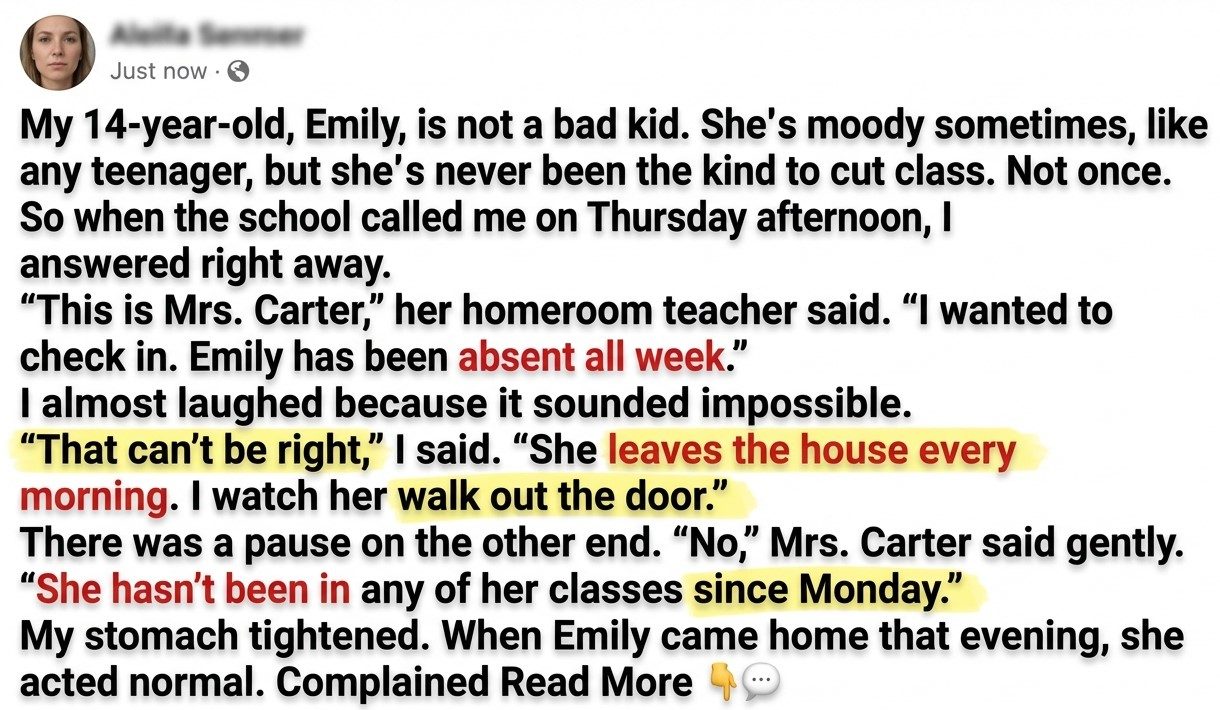
My 14-year-old, Emily, is not a bad kid. She’s moody sometimes, like any teenager, but she’s never been the kind to cut class. Not once.
So when the school called me on Thursday afternoon, I answered right away.
“This is Mrs. Carter,” her homeroom teacher said. “I wanted to check in. Emily has been absent all week.”
I almost laughed because it sounded impossible.
“That can’t be right,” I said. “She leaves the house every morning. I watch her walk out the door.”
There was a pause on the other end.
“No,” Mrs. Carter said gently. “She hasn’t been in any of her classes since Monday.”
My stomach tightened.
When Emily came home that evening, she acted normal. Complained about homework. Asked what was for dinner. Rolled her eyes at my questions.
The next morning, I didn’t confront her. I didn’t call the school again.
Instead, I stood by the kitchen window with my coffee growing cold in my hand and watched her pull on her backpack like always. Her hair was half-brushed, her hoodie sleeves swallowed her hands, and she gave me the same distracted little wave she had given me a hundred times before. Then she stepped out the front door and headed down the street as if it were any ordinary Friday.
I waited ten seconds before grabbing my keys.
My heart was pounding so hard that I could hear it over the engine when I backed out of the driveway. I felt ridiculous and terrified at the same time, like some suspicious stranger following her own child. But something inside me, something old and instinctive and sharp, kept whispering that if I let her disappear around the corner without knowing the truth, I might regret it for the rest of my life.
Emily did not turn toward the school.
She walked three blocks past the crossing guard, past the bakery where I sometimes bought her cinnamon rolls on Fridays, and slipped down a narrow side street lined with old apartment buildings and overgrown hedges. I kept far enough behind not to spook her, stopping whenever she glanced over her shoulder. She looked nervous, but not guilty. That unsettled me even more.
At the end of the block, she stopped in front of a faded blue house I had never noticed before.
It was small, tucked between two larger homes, with peeling paint on the porch railing and flowerpots full of dry soil. Emily climbed the steps, knocked twice, and then let herself in like she had done it before. My fingers tightened around the steering wheel until my knuckles blanched white. A dozen ugly possibilities rushed through my mind all at once.
I parked half a street away and sat frozen for nearly a minute.
I told myself to breathe. Told myself not to jump to the worst conclusion. But I was already there in my head: drugs, older men, danger, secrets too heavy for a 14-year-old to carry. By the time I stepped out of the car, my legs were trembling so badly I had to steady myself on the door before walking up the cracked sidewalk.
I knocked once, then harder.
For a moment, there was only silence. Then the door opened, and Emily stood there, her face draining of color so quickly it scared me. Behind her, the house smelled faintly of soup and bleach. Somewhere deeper inside, I heard the creak of floorboards and the low murmur of a television playing too softly to make out.
“Mom?” she whispered.
I had rehearsed anger on the drive over, but it vanished the second I saw her expression.
That wasn’t the face of a rebellious teenager caught in a lie. It was the face of a child who had been carrying something alone for far too long. Her eyes looked exhausted. Not guilty. Not defiant. Just tired in a way no 14-year-old should ever look.
“Emily,” I said, trying to keep my voice steady, “what is this? Why aren’t you at school?”
She opened her mouth, then closed it again. Her chin trembled. Before she could answer, an elderly voice called weakly from somewhere in the back of the house, “Emily, is that you, sweetheart?” The sound sliced through the moment like a blade, and Emily flinched.
Then she stepped aside.
I walked into a dim living room where the curtains were half-drawn against the morning light. A portable fan rattled in the corner. On the couch sat an old woman under a blanket, her frame so thin it looked as though the cushions were swallowing her. Beside her were pill bottles, a glass of water, and a bowl of untouched broth.
Emily stared at the floor.
“This is Mrs. Bennett,” she said quietly. “She used to live next door to Jenna. Remember Jenna from my old soccer team?” I nodded faintly, though I barely remembered. My mind was still trying to catch up. “Her granddaughter moved away last month,” Emily continued, “and there wasn’t anyone left checking on her.”
I looked at the old woman, then back at my daughter.
Emily swallowed hard. “I found her on Monday morning when I cut through here. She had fallen trying to get to the kitchen. She was crying, and she couldn’t stand up by herself. She said she’d been there for hours.” Emily’s voice broke. “I didn’t know what to do.”
I should have spoken then. I should have asked why she didn’t call me, or 911, or anyone. But all I could do was stand there while shame slowly spread through me, hot and heavy. Because in all the terrible scenarios I had imagined, not one of them involved my daughter spending her days caring for someone everyone else had forgotten.
“I helped her up,” Emily said. “Then I made her tea. Then I saw there wasn’t much food here, and she kept saying she didn’t want to be sent away.”
Mrs. Bennett looked over with watery blue eyes and a smile that trembled at the edges. “Your girl is an angel,” she said. “She comes every day. Makes sure I eat. Reads to me when the pain gets bad. Sweeps the kitchen, too, though I don’t ask her.”
Emily winced at the word angel as if she didn’t deserve it.
“I know I should’ve told you,” she said quickly, turning to me at last. “I know I should’ve told somebody. But she begged me not to. She said if officials came, they’d put her in a home, and she’d die there. She was scared. And I…” Her voice dropped to almost nothing. “I didn’t want to leave her alone.”
The anger I had come with dissolved completely.
In its place came something more complicated—fear, yes, because what Emily had done was risky and secretive and far too much for a teenager to shoulder. But beneath that was a crushing ache. Because my daughter had seen suffering, real suffering, and instead of turning away, she had quietly rearranged her entire week to meet it.
I sat down on the arm of a chair because my knees felt weak.
“Emily,” I said softly, “you cannot disappear every day and let me think you’re safe at school.” Tears rushed into her eyes. I reached for her hand. “But sweetheart… why didn’t you trust me enough to tell me? I would have helped.”
That was when she finally broke.
She covered her face with both hands and started crying in those deep, ugly sobs teenagers try so desperately to hide. “Because everyone always says they’re too busy,” she choked out. “At school, when kids talk about old people living alone, everyone just shrugs. And you work so much, and I thought you’d tell me to stop coming here. I thought if I told an adult, they’d make it official and cold and awful.”
Her words hit harder than I expected.
I do work too much. Single parenting had turned my life into a system of alarms, bills, grocery lists, and exhausted promises that things would calm down next month. I had thought I was keeping us afloat. I had not realized that somewhere along the way, Emily had started believing compassion needed to be hidden because adults were too overwhelmed to carry it.
I looked around the room more carefully then.
There were signs everywhere that things had been unraveling long before Emily walked in—dust along the baseboards, unpaid envelopes stacked on a side table, dishes in the sink, a wheelchair parked beside the hallway. Mrs. Bennett hadn’t needed a secret visit from a teenager. She had needed a community. She had needed family. She had needed help before things got this bad.
“How long has this been going on?” I asked gently.
Mrs. Bennett answered this time. “Longer than I’d like to admit.” She gave a weak laugh. “Arthur died three years ago. My daughter passed before him. My granddaughter did what she could, but life pulls young people away. I stopped asking for help because it was easier than hearing pity in everyone’s voice.”
Emily wiped her face and spoke again.
“She fell again on Tuesday night. Not hard, just near the chair. So on Wednesday I brought the heating pad from home.” I stared at her. “The blue one from the linen closet,” she added, almost apologetically. “I washed it before I put it back yesterday.”
Even then, even caught, she was worried about being considerate.
I pressed my lips together, trying not to cry myself. My daughter had been living a second life all week—one where she packed crackers in her backpack, checked medication labels, and sat beside a lonely woman while the rest of the world rushed past. A child should not have had to do all that alone. But what kind of heart did it take to do it anyway?
That morning turned into hours.
I called the school and told them there had been a family emergency and that I would explain everything later. Then I called my office and took the day off. After that, I made a pot of fresh soup in Mrs. Bennett’s kitchen while Emily changed the bedsheets and opened the windows for air. Together, we did in a few hours what shame and pride had prevented anyone from doing in months.
By noon, the house felt different.
Not fixed, not healed, but less abandoned. I phoned a local senior support service and asked questions carefully, making sure I understood what help could be arranged without immediately forcing Mrs. Bennett out of her home. A nurse was able to come by that afternoon for an evaluation. Meals could be delivered. A social worker could coordinate in-home assistance. There were options. Real ones.
Mrs. Bennett cried when I explained them.
“I thought help only came in the form of losing everything,” she whispered. Emily moved to her side and squeezed her hand. I watched them together and felt something inside me shift. So much of parenting is spent correcting behavior, watching for danger, preparing children for the cruelty of the world. But sometimes they are the ones showing us where our world has gone cruel.
The nurse arrived just after three.
She was kind and practical, exactly the sort of person I wished had appeared sooner. She checked Mrs. Bennett’s blood pressure, looked over her medications, and gently but firmly explained that surviving alone was no longer the same thing as living well. To my relief, she didn’t treat Emily like a foolish child. She treated her like what she was: a brave girl who had stepped into a gap no adult should have left open.
When we finally drove home that evening, the car was quiet.
Emily stared out the window, wrung out and red-eyed. I let the silence sit for a while. The sun was dropping low, painting the road in streaks of orange and gold. It should have felt like the end of a long day. Instead, it felt like the end of something older—the invisible distance that had been growing between us without either of us naming it.
“I’m sorry I lied,” she said at last.
I tightened my hands on the wheel. “I’m sorry you felt like you had to.”
She looked at me then, really looked at me, and I saw that she had been afraid of more than punishment. She had been afraid of becoming one more person who saw pain and filed it away for later. One more person who said, Somebody should do something, while meaning somebody else.
That night, we talked for hours at the kitchen table.
Not just about rules and school attendance, though there was plenty of that too. We talked about responsibility. About how helping someone does not mean disappearing yourself. About how emergencies belong in the light, not in secrets. I told her she had done a beautiful thing in a dangerous way. She nodded, tears slipping down her face again.
Then she asked the question that shattered me most.
“If I had told you on Monday,” she said carefully, “would you really have come right away?”
I wanted to say yes instantly. I wanted to be the kind of mother who never hesitated. But honesty mattered in that room. “I don’t know,” I admitted. “I would like to think so. But maybe I would’ve said I had meetings, or asked why nobody else could do it, or promised to deal with it later. And that hurts to admit.”
Emily stared at her folded hands.
“That’s why I didn’t tell you,” she whispered.
Children always know more than we think.
They notice where our attention goes. They notice when we’re too tired to ask a second question, when we say maybe later enough times that later begins to sound like never. Emily had not stopped trusting my love. She had stopped trusting my availability. There is a difference, and realizing it felt like standing barefoot on broken glass.
The next week, things began to change.
Emily went back to school on Monday with an excused absence and a stern warning from both me and the administration that this could never happen again without an adult being involved. But something else happened too: Mrs. Carter, the same teacher who had called me, helped arrange a small student volunteer effort for local seniors. Quietly, respectfully, without turning Mrs. Bennett into a project or a spectacle.
Help started arriving at the blue house.
A meal service. A home aide three mornings a week. A church group that repaired the porch step. One man from the neighborhood mowed the yard after realizing how long he had walked past it without truly seeing it. It turned out compassion was not as rare as Emily had feared. It had simply been waiting for someone brave enough to point directly at the need.
Mrs. Bennett improved.
Not miraculously, not in some movie-perfect way, but enough to smile more easily, enough to sit on the porch in the afternoons with a blanket over her knees and wave when Emily and I stopped by after school. Sometimes Emily still read to her, but now it was after homework, with my knowledge, with the world reopened around them. Care no longer had to hide.
And Emily changed too.
She still rolled her eyes. Still forgot to rinse cereal bowls. Still acted as if my questions were invasive acts of war. But there was a steadiness in her after that week, something older in the way she moved through the world. She had crossed a threshold most adults avoid all their lives. She had seen what abandonment looks like, and she had refused to participate in it.
As for me, I began paying closer attention.
Not just to where Emily was going, but to what she was carrying. To the pauses in her answers. To the things she shrugged off too fast. I stopped mistaking routine for connection. Watching your child leave the house each morning is not the same as knowing where their heart goes when they walk out the door.
Months later, Mrs. Bennett told me something I will never forget.
We were sitting in her living room while Emily helped organize old photo albums. Mrs. Bennett looked at me over the rim of her teacup and said, “Most people think the miracle is that your daughter found me. But that’s not the miracle. The miracle is that she stayed.” Then she smiled toward Emily. “Most people notice suffering. Very few rearrange their lives because of it.”
She was right.
What my daughter did that week scared me. It upended trust, bent rules, and could have ended badly in a hundred ways. But buried inside that fear was something fierce and luminous: a heart so unwilling to let another human being suffer alone that it created its own secret mission of mercy. That is not rebellion. That is conscience, raw and untrained.
I still think about that Thursday call sometimes.
About how close I came to brushing it off for another day. About how easy it would have been to keep believing what I saw from the kitchen window instead of asking where the path really led. Parenthood is full of moments like that, I think—moments when the truth is standing just outside the frame of what looks normal.
My daughter had been absent all week.
But she had not been lost. She had been exactly where her heart told her someone needed her most. And while I will always wish she had asked for help sooner, I will never forget what she taught me in the process: that character is revealed when no one is watching, compassion is costly when it is real, and sometimes the child you are trying to protect is already becoming the kind of person this world desperately needs.