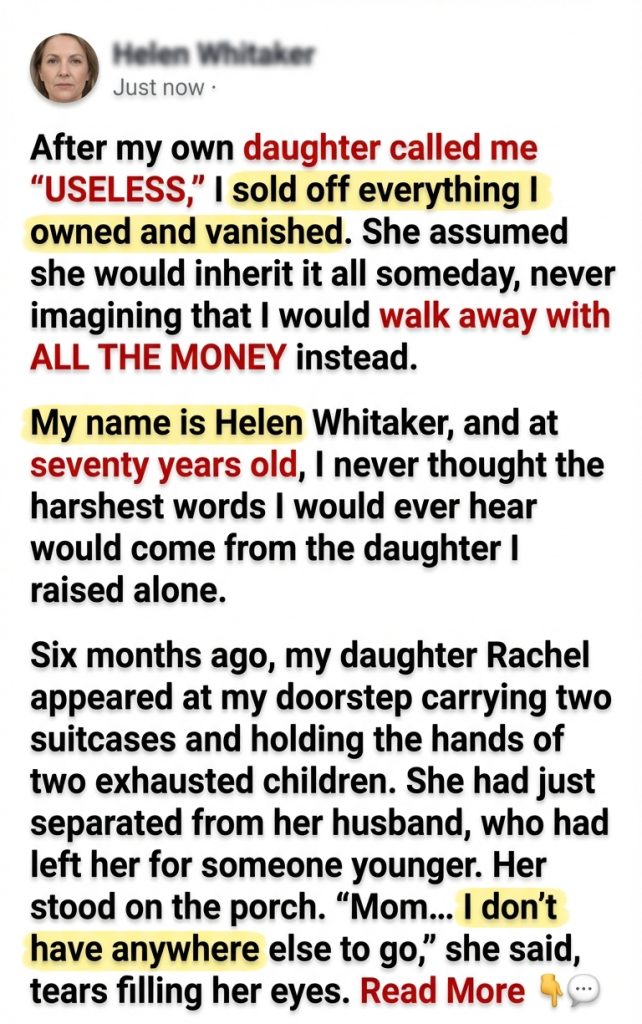
After my own daughter called me “USELESS,” I sold off everything I owned and vanished. She assumed she would inherit it all someday, never imagining that I would walk away with ALL THE MONEY instead.
My name is Helen Whitaker, and at seventy years old, I never thought the harshest words I would ever hear would come from the daughter I raised alone. Some insults from strangers can be brushed aside. Some betrayals can be forgiven with time. But when cruelty comes from your own child, it lands in a place so deep that even silence cannot soften it.
Six months ago, my daughter Rachel appeared at my doorstep carrying two suitcases and holding the hands of two exhausted children. She looked nothing like the confident woman who had once stormed out of this same house insisting she didn’t need anyone. Her mascara had run, her shoulders sagged, and for the first time in years, she looked small.
She had just separated from her husband, who had left her for someone younger. Her voice shook as she stood on the porch. The wind that evening was cold, and the little ones clung to her coat as if afraid even the air might abandon them too. I remember thinking that heartbreak had aged her more in a week than motherhood had in years.
“Mom… I don’t have anywhere else to go,” she said, tears filling her eyes. “Just until I can get back on my feet.” She didn’t sound proud when she said it. She sounded frightened, ashamed, and desperate in a way no mother can ignore, no matter how complicated the history between them may be.
Ever since my husband died, I had been living alone in our quiet five-bedroom house in a calm neighborhood outside the city. Most days the place felt too large and painfully silent. The rooms had become museums of old laughter, old holidays, old arguments, and old love. I had grown used to the hush, but not to the loneliness that settled in every evening like dust.
So I opened the door.
I let Rachel and the children in without asking for details, without conditions, and without reminding her of all the times she hadn’t called, hadn’t visited, hadn’t remembered my birthday until days later. A mother’s heart does not keep score as neatly as people think it should. Sometimes it simply opens, even when it has already been cracked before.
The first few weeks felt almost tender. The grandchildren filled the house with movement, cartoons, spilled cereal, and the kind of little chaos that makes a place feel alive again. I cooked their favorite meals, found extra blankets, rearranged furniture, and turned my sewing room into a second bedroom for the little ones. At night, I told myself perhaps this was life giving me a second chance at family.
Rachel thanked me at first. She kissed my cheek when she left for job interviews and promised she would contribute once she found work. She said this arrangement was temporary, that she just needed time to breathe, to recover, to rebuild. And because I wanted to believe her, I did.
But gratitude has a way of fading quickly when comfort becomes expectation.
It started with small things. She complained that my house rules were “old-fashioned” when I asked the children not to leave toys on the staircase. She rolled her eyes when I reminded them to say please and thank you. When I suggested limiting screen time, she laughed and said, “Mom, the world has changed. Try to keep up.”
Then came the money. Grocery bills doubled. The electricity climbed. Water, internet, school snacks, shoes, medicine, field trips—I quietly paid for all of it. Rachel always had an explanation. Her paycheck was delayed. Her ex had missed child support. The kids needed this, needed that, and surely I understood. After all, I was “just sitting on a paid-off house.”
I began dipping into savings I had carefully protected for years. My husband and I had built those savings one cautious decision at a time. He had worked long hours. I had clipped coupons, mended clothes, and turned down luxuries. That money was never meant to fund entitlement. It was meant to protect me in old age, when health grows fragile and options grow few.
Still, I said nothing.
I watched Rachel settle in as though she were the owner of the place. She redecorated the guest bathroom without asking. She criticized my furniture, my curtains, even the china cabinet my husband had built by hand. One afternoon I came home from a doctor’s appointment and found her giving away a box of my things to a neighbor because, as she put it, “No one uses this junk anymore.”
That was the first time anger rose hot in my chest.
I told her those were my belongings and that she had no right. She shrugged, crossed her arms, and said I was being dramatic. The children were in the next room, so I lowered my voice, but inside I was shaking. There is a particular kind of pain in realizing someone feels entitled not only to your space, but to erasing pieces of your life while you are still alive to witness it.
After that, respect disappeared completely.
Rachel began introducing the house to others as “basically mine one day anyway.” She said it casually over the phone, laughing with friends in the kitchen while I stood unseen in the hallway. Once, I heard her telling someone that I should just move into a senior apartment because “one old woman doesn’t need five bedrooms.” She didn’t know I heard. Or maybe she didn’t care.
I started noticing how often she used the word “eventually.” Eventually the house would be hers. Eventually the money would be hers. Eventually she could renovate, sell, relocate. In her mind, I was no longer a person with a future. I was an obstacle standing between her and an inheritance she had already spent in her imagination.
Then came the morning that changed everything.
I had asked her, gently, if she could start contributing something—anything—to the household. Not much. Just enough to show good faith. I explained that my pension was limited and that property taxes had gone up. I even said I understood she was under pressure. But before I could finish, she slammed her coffee cup down so hard it splashed across the counter.
Her face twisted with a rage that didn’t even seem connected to me. Maybe it was about her failed marriage. Maybe it was about her life not turning out the way she thought it would. But I was the one standing in front of her when it burst.
“Useless,” she snapped. “That’s what you are, Mom. Useless. All you do is sit in this house judging me like you’ve ever done anything important.” The room went still after that. Even the children looked up.
I cannot fully describe what that word did to me.
I had spent decades being useful. Useful when my husband got sick and I became his caregiver. Useful when Rachel was a baby and I worked nights hemming dresses to keep food on the table. Useful when the washing machine broke, when tuition bills came, when heartbreaks came, when babysitters canceled, when life fell apart. My entire life had been built around being useful to everyone else.
And suddenly, in my own kitchen, all of that was reduced to nothing.
Rachel stormed out after the argument, muttering that she needed air. I stayed where I was, one hand gripping the edge of the sink so tightly my knuckles turned white. The children sat quietly in the living room. I smiled at them when they looked my way, because children should never have to carry the ugliness adults create. But the moment I was alone, I cried harder than I had cried even at my husband’s funeral.
Not because of the insult alone.
Because of the truth hiding inside it.
I had let myself become invisible. I had mistaken sacrifice for love, silence for peace, and endurance for dignity. I had kept giving because I thought family deserved endless chances. But standing there that morning, I realized something with startling clarity: if I remained, Rachel would continue taking until there was nothing left of me but a body in a chair and a name on a will.
That night, I did not sleep.
I walked through the house room by room, touching old photographs, polished banisters, faded wallpaper, and the doorframe where pencil marks still measured Rachel’s height as a child. Memory pleaded with me to stay. Habit pleaded with me to wait. But something deeper, something fiercer, told me that leaving was not running away. Leaving was the first brave thing I had done for myself in years.
The next morning, I called a realtor.
Then I called an estate liquidator.
Then I called a lawyer.
I did not announce my plans. I did not threaten. I did not argue. I simply began. The realtor moved quickly—faster than I expected. The market was strong, and the house, despite its age, sat on desirable land. Buyers came through within days. I made sure Rachel and the children were out when they toured it. I protected the children from the details, but I did not protect Rachel from consequences.
When she found out, she laughed at first.
“You’re not selling this house,” she said. “Don’t be ridiculous.”
“I already am,” I told her.
The color drained from her face. She demanded to know where she and the children were supposed to go. I answered honestly: that was something she should have thought about before treating refuge like ownership. She accused me of being cruel, unstable, vindictive. For a moment, I almost wavered—because mothers are trained to mistake guilt for responsibility.
But this time, I held firm.
I gave her legal notice and enough money for a short-term rental, more than she deserved and less than she wanted. I did it for the grandchildren, not for her. She cried, shouted, begged, and finally sneered that I was destroying the family. Yet the family she spoke of had apparently required my house, my savings, my silence, and my self-respect to function. That is not family. That is dependency dressed as love.
The sale closed three weeks later.
I sold furniture, dishes, antiques, silverware, paintings, even the upright piano no one had played in twenty years. I kept only what fit into a few suitcases and one small storage unit: photographs, my husband’s watch, my sewing basket, a handful of letters, and the blue wool coat I wore the winter Rachel was born. The rest became numbers in an account bearing only my name.
Rachel assumed, I think, that I was reorganizing assets for her future. She still didn’t understand.
She understood the day I left.
I did not leave a dramatic note. I did not explain myself in paragraphs soaked with pain. I wrote only this: “I was useful for everyone for a very long time. Now I will be useful to myself. Take care of your children. The rest is your responsibility.” Then I turned off my phone, handed my keys to the attorney, and got into a car headed toward the coast.
For the first time in decades, no one knew where I was.
I rented a small furnished cottage in a town where nobody recognized my name. It had two rooms, a garden full of rosemary, and windows that faced the sea. In the mornings, I drank coffee on the porch and listened to gulls instead of complaints. In the evenings, I walked along the shoreline and let the wind strip away layers of grief I had worn for years like a second skin.
Silence felt different there.
It was no longer the silence of abandonment.
It was the silence of peace.
Rachel called for weeks, then months. At first the voicemails were furious. Then accusing. Then tearful. Then transactional. She asked where I was, what I had done with the money, how I could do this to her and the children. She never once asked the more important question: what had she done to make her own mother disappear?
I did not answer.
Eventually, a message came that was quieter than the rest. She said the children missed me. That part pierced me, because I missed them too. They had loved me in the uncomplicated way children do, and none of this was their fault. So I arranged, through my lawyer, a safe way to remain in their lives without reopening the same door Rachel had kicked through with entitlement. Boundaries, I learned, are not punishments. They are protections.
Months passed, and I began to return to myself.
I joined a small book club. I learned the names of flowers in the garden. I bought fresh bread from a local bakery and spoke to strangers who knew nothing about my history. I laughed without bracing for criticism. I rested without feeling guilty. I discovered that old age is not the closing of a life, but the final chance to live it honestly.
I thought often about the word Rachel used.
Useless.
At first it echoed as a wound. Then, slowly, it became a kind of fire. It forced me to ask who had defined my worth for all these years. A husband who needed care? A daughter who needed rescuing? A household that consumed my labor as if it were love? I had measured myself by what I gave away. I had never measured myself by what I deserved.
Now I do.
I deserved respect in my own home. I deserved gratitude instead of contempt. I deserved to grow old without being treated like a waiting room for someone else’s inheritance. Most of all, I deserved not to vanish inside the needs of people who only noticed me when I stopped providing.
That is why I left.
Not because I stopped loving my daughter. Some heartbreaks do not erase love; they simply expose where love has been abused. I still pray Rachel becomes the kind of woman her children can trust. I still hope life teaches her what I no longer had the strength to keep explaining. But hope no longer requires proximity. Love no longer requires surrender.
People may judge me for taking the money and disappearing.
Let them.
They did not hear the contempt in my daughter’s voice. They did not watch my life being treated like an unopened inheritance. They did not feel the humiliation of standing in a kitchen built from sacrifice while being told I had done nothing important. They did not see how close I came to spending the rest of my years apologizing for taking up space in my own home.
I will not apologize anymore.
If my story sounds harsh, remember this: I did not leave when she forgot me. I did not leave when she used me. I did not leave when she took my money, my peace, my labor, and my kindness for granted. I left when I realized that staying would teach everyone around me—including myself—that I was worth exactly as little as they had decided.
They were wrong.
At seventy, I sold the house, packed the memories, took the money, and chose myself. Not because I was bitter. Not because I was cruel. But because after a lifetime of being useful to others, I finally understood that my life still belonged to me. And sometimes the strongest thing a mother can do is stop rescuing the child who only learned to love her when she was giving things away.
So yes, I vanished.
But the truth is, I did not disappear at all.
For the first time in years, I finally appeared in my own life.