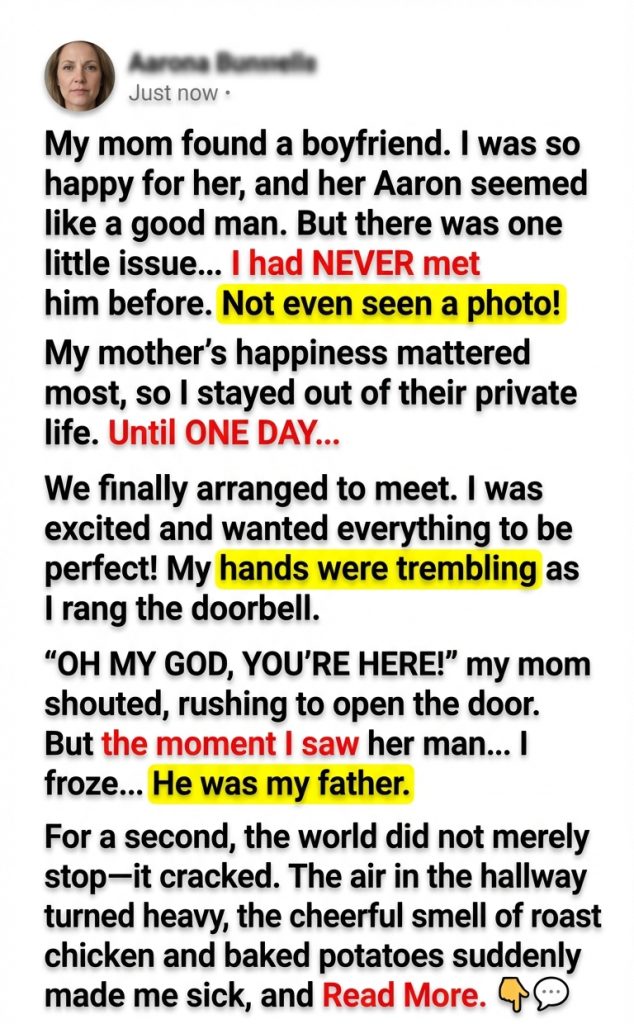
My mom found a boyfriend.
I was so happy for her, and her Aaron seemed like a good man.
But there was one little issue…
I had NEVER met him before.
Not even seen a photo!
My mother’s happiness mattered most, so I stayed out of their private life.
Until ONE DAY…
We finally arranged to meet. I was excited and wanted everything to be perfect! My hands were trembling as I rang the doorbell.
“OH MY GOD, YOU’RE HERE!” my mom shouted, rushing to open the door.
But the moment I saw her man… I froze… He was my father.
For a second, the world did not merely stop—it cracked. The air in the hallway turned heavy, the cheerful smell of roast chicken and baked potatoes suddenly made me sick, and the blood in my body seemed to reverse direction. I stood there with one hand still half-raised from knocking, staring past my mother’s shoulder at the man behind her, and all I could hear was the roaring silence of twenty years of absence collapsing into one unbearable moment.
He had changed, and yet he hadn’t. His hair was thinner, silver now at the temples. His shoulders had slumped the way guilt or age can do to a man. But his eyes were the same. That quiet brown, careful and watchful, as if he had spent his whole life standing just outside the doorway of other people’s love. I knew that face. I had carried its ghost in old childhood memories, in a crumpled photograph hidden inside a drawer, in every birthday that came and went without a card.
My mother kept smiling at first, not realizing why I had gone pale. She looked from me to him and back again, expecting laughter, surprise, maybe happy tears. She thought she had arranged some wonderful, cinematic reveal. Instead, I felt my stomach twist so hard I thought I might collapse right there on her welcome mat.
“You two look like you’ve seen a ghost,” she said, still trying to laugh.
He did not laugh. His face had drained of all color. One hand gripped the back of a dining chair so tightly his knuckles turned white. When he opened his mouth, no sound came out. And in that terrible, stretched second, I knew with absolute certainty that he recognized me too.
My mother’s smile slowly faded. “Wait,” she said, frowning. “What is this? Do you two know each other?”
I wanted to answer. I wanted to scream. I wanted to ask a thousand questions all at once: Where were you? Why did you leave? Why didn’t you ever come back for me? Why did you let Mom build a life with you again without telling her who you were? But none of those words reached my lips. The only thing that came out was a raw whisper, broken and small.
“Mom,” I said, “this is Dad.”
The room went dead still.
My mother blinked as though she had not heard me correctly. The color in her face disappeared so fast it frightened me. She turned to him with a confusion so sharp it looked like pain. “What did she just say?”
He shut his eyes. Just for a moment. Like a man bracing for impact. Then he exhaled slowly and looked at her with the wrecked expression of someone who had been outrun by his own secrets. “She’s right,” he said. “I’m her father.”
My mother stepped back as if the floor beneath her had shifted. “No,” she said immediately. “No. That’s impossible.” But it was not impossible. It was just buried, sealed, and waiting to detonate. She turned to me, searching my face for some sign this was a misunderstanding, a joke in horrible taste, some insane coincidence. “Your father’s name was Daniel.”
He swallowed hard. “Aaron Daniel Reeves,” he said.
My mother actually grabbed the edge of the table to steady herself. I watched her mind race backward through decades, trying to fit the man she loved now into the shape of the man who vanished before I was old enough to remember clearly. She had known him by Aaron. I had known him, from the scraps of our family history, as Daniel. He had split himself into names the same way he had split himself away from us.
“Why?” she asked him, and her voice cracked on that single word. It was not loud, but it was devastating.
He looked at me first, and I hated that. I hated that after all these years, after all that emptiness, he still thought he could reach me before answering her. “Because I was ashamed,” he said quietly. “And because by the time I found you again, I didn’t know how to tell the truth without losing everything.”
I laughed then, but it came out cold and ugly. “Everything?” I said. “You mean the woman you abandoned and the daughter you forgot?”
His jaw tightened as though my words had physically struck him. Good. Let them. I had carried the bruise of his absence my whole life. He could survive a sentence.
He motioned weakly toward the chairs at the table, but I stayed standing. My mother remained motionless too, one hand pressed to her chest as if her own heart had become unfamiliar to her. The candles on the table flickered beside a bottle of wine she had probably bought for this special evening. She had set the table with her good dishes. She had believed tonight marked the beautiful merging of two chapters in her life. Instead, she had unknowingly invited her own unfinished past to dinner.
“What happened?” I asked. “No lies. No softened version. No excuses about timing. What happened?”
He nodded slowly. For the first time, he seemed to understand that he no longer had the right to hide behind silence. “When you were little,” he began, “I was drowning in debt. I had made stupid choices, desperate choices. I got involved with people I never should have known. One night I tried to leave that world, and they made it clear that if I stayed in town, you and your mother wouldn’t be safe.”
I wanted to reject it immediately. It sounded too cinematic, too convenient, the kind of story a man invents when he wants his cowardice mistaken for sacrifice. But his voice did not hold self-pity. It held ruin. “So you disappeared?” I said. “Without a word?”
“I thought distance would protect you,” he replied. “I told myself I would come back when it was safe. Then weeks became months. Months became years. Shame made me a worse man than fear ever did.”
My mother stared at him with tears shining in her eyes, but they were not soft tears. They were furious ones. “You let me think you were dead,” she said. “Do you understand that? Dead. I spent years wondering whether you were in a ditch somewhere, whether I had missed some clue, whether I had failed you somehow. I blamed myself. And all that time, you were alive.”
He lowered his head. “Yes.”
That small word hurt more than any elaborate defense could have. Yes. He was alive. Alive while my mother worked two jobs and still came home exhausted, trying to make childhood feel normal for me. Alive while I made Father’s Day cards in school and pretended not to care when I had no one to give them to. Alive while every unanswered question hardened inside me.
“I found your mother again by accident,” he said after a long silence. “A year ago. At a charity event downtown. I saw her across the room, and I nearly walked out. But she smiled at me. She didn’t recognize me at first. Time had changed enough. I used Aaron because that’s what everyone calls me now. I thought maybe… maybe I could know her again. Maybe I could do one thing right before I died. Then the truth got harder to tell every single day.”
“Do one thing right?” I repeated. “By lying to her again?”
My mother sank into a chair. She looked smaller suddenly, as if betrayal had weight and it had dropped directly onto her shoulders. She was not just processing that her boyfriend was my father. She was reliving being abandoned, only now from the cruel angle of hindsight. She had fallen in love with the same man twice—and both times, he had hidden the truth.
I should have walked out. Maybe that would have been the smart thing, the dignified thing. But pain has a way of chaining you to the very place you should flee. I needed answers the way a person lost in the cold needs fire, even if it burns. So I stayed, and we sat there in that broken little dining room while the food cooled on the stove and the night outside pressed itself against the windows.
He told us everything then, or at least everything he claimed was true. The gambling. The threats. The panic. The years of drifting from one state to another under a shortened name, taking jobs no one would notice him in. The bottle that nearly finished him. The rehab center that finally forced him to look at the wreckage of his life. The way he had searched for us online more than once and then closed the screen because seeing our names made his guilt unbearable.
When he said he had kept a photo of me in his wallet the entire time, I nearly told him to stop. It felt insulting, like preserving evidence of love he had never actually shown. But then he pulled out the worn leather wallet, opened it with shaking hands, and there it was—a tiny picture of me at five years old, missing front teeth, grinning in a yellow raincoat. The edges were softened with age. The image had been folded and unfolded until it nearly split.
I looked at it and felt something far more dangerous than anger. I felt grief. Not just for what had happened, but for what could have been. There is a special cruelty in realizing a person may have loved you and still failed you completely. Hatred is simpler. Love tangled with abandonment is a knot that tightens every time you breathe.
My mother wiped her eyes and stood up. For a moment I thought she might tell him to leave. Instead, she walked to the sink, braced both hands on the counter, and stared out the window. “All this time,” she said softly, “I thought I had survived the worst of it. I thought I had healed. And now I find out I built my future on the same lie that destroyed my past.”
No one spoke after that. The silence was no longer explosive. It was exhausted. The kind of silence that comes after an emotional storm when all the furniture in your heart has been overturned and you no longer know where anything belongs.
Finally, she turned around and looked at me—not him, me. “Are you okay?”
That almost broke me more than everything else. Because even then, in the middle of her own devastation, she was still being my mother. I shook my head. “No,” I admitted. “But I will be.”
Then I looked at him. Really looked at him. Not as a myth, not as a ghost, not as the empty chair in every childhood memory—but as a man. Flawed, aging, frightened, remorseful. Human. That did not erase what he had done. It did not redeem him. But it stripped away the fantasy. He was not some giant mystery anymore. He was simply the person who had made a series of unforgivable choices and then spent the rest of his life limping behind them.
“You don’t get to step into our lives because you feel guilty now,” I said. “Guilt is yours. We already paid for it.”
He nodded, tears gathering in his eyes. “I know.”
“You don’t get to call this fate or a second chance or some miracle reunion. You lied to Mom. Again. You looked me in the face and said nothing. Whatever happens after tonight is not something you’re owed. It’s something we decide.”
My mother turned to him then, and the quiet in her voice was colder than shouting. “She’s right,” she said. “You took choice from us once. You will not do it again.”
He stood there like a man waiting for a sentence. Maybe part of him had expected forgiveness to arrive just because truth finally had. But truth is not a reward. Sometimes it is simply the blade that cleanly names the wound.
She asked him to leave. Not dramatically. Not with thrown plates or sobbing accusations. Just three words, spoken with terrifying steadiness: “You need to go.” He opened his mouth, perhaps to apologize once more, perhaps to beg. But something in her face stopped him. He set the wallet on the table instead, next to the untouched bread basket, as though surrendering the last proof that he had carried us with him. Then he walked to the door and left.
After it closed, my mother and I remained in the kitchen for a long time. The food had gone cold. The candles had burned low. The whole evening looked like the set of a play that had ended badly. I expected her to apologize, but she didn’t, and I was grateful. This was not her shame to carry. She came to me slowly, like someone approaching a fragile thing, and wrapped her arms around me.
I had not cried yet, but the moment she held me, the tears came violently. Years of them. I cried for the child who waited at windows. For the teenager who pretended not to care. For the woman who had rehearsed every possible reunion and never imagined this one. I cried for my mother, who had loved with an open heart only to find an old knife hidden inside it. I cried because some losses do not end when the person returns; sometimes they begin all over again.
That night, I stayed with her. We talked until dawn, not only about him, but about everything around him—the years we survived, the birthdays, the bills, the scraped-together joy, the pain we never fully named. We discovered that what he had broken long ago had not destroyed us. Bent us, yes. Marked us, absolutely. But not destroyed us.
In the weeks that followed, he wrote letters. Long ones. Honest ones, maybe. Regret-soaked ones, certainly. My mother did not answer. I did not answer either. Healing is not the same as reopening the door. Closure is not the same as reconciliation. Sometimes the strongest ending is not letting the person back in, but finally letting yourself step out from under their shadow.
And that was the truth I carried forward. The biggest shock of that night was not that my mother’s boyfriend was my father. It was realizing that I no longer needed him to become whole. As a child, I thought his return would explain everything. As an adult, I learned that explanations are not the same as repair. Some apologies arrive too late to rebuild what they broke.
Still, I do not think that night was meaningless. It gave me something I had been missing even more than answers: clarity. He had not vanished because I was unlovable. He had not stayed gone because I was easy to forget. He disappeared because he was weak, and he stayed away because he was ashamed. Those truths hurt, but they freed me from the old poison children carry when they are left behind—the belief that abandonment must somehow be their fault.
So when people ask me now what happened to the man who came back as my mother’s boyfriend, I tell them this: he finally told the truth. And sometimes truth does not reunite a family. Sometimes it simply allows the people who were wounded to stop blaming themselves and begin living without the weight of someone else’s choices.
My mother found a boyfriend and thought she had found late-life happiness. I went to dinner expecting to celebrate her joy. Instead, we opened the door to the one ghost that had haunted both of us for years. But ghosts lose power when the lights come on. And that night, however painful it was, the lights finally did.