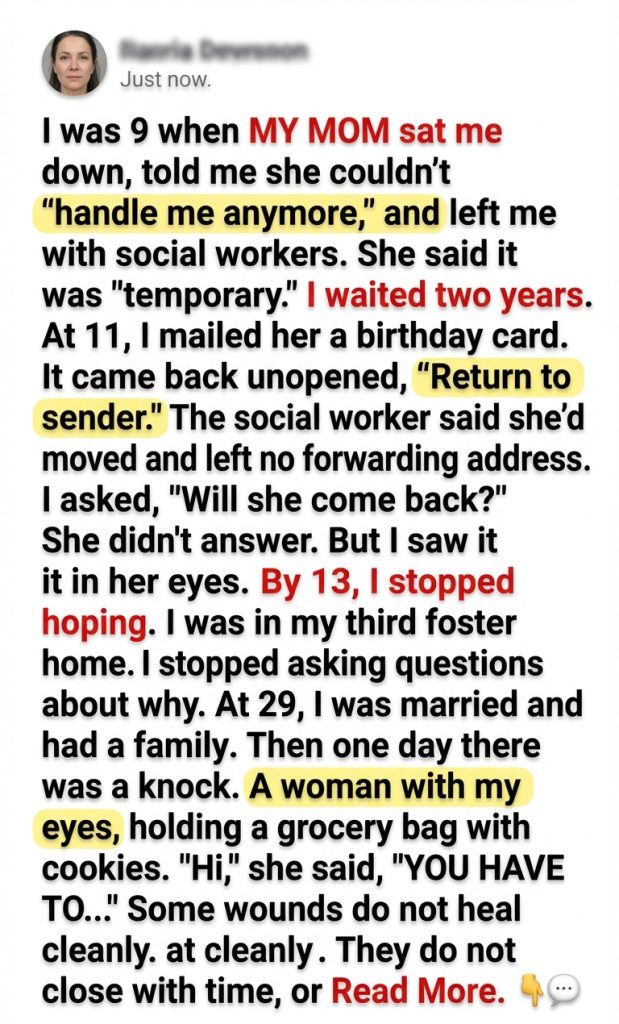
I was 9 when MY MOM sat me down, told me she couldn’t “handle me anymore,” and left me with social workers. She said it was “temporary.” I waited two years. At 11, I mailed her a birthday card. It came back unopened, “Return to sender.” The social worker said she’d moved and left no forwarding address. I asked, “Will she come back?” She didn’t answer. But I saw it in her eyes.
By 13, I stopped hoping. I was in my third foster home. I stopped asking questions about why.
At 29, I was married and had a family. Then one day there was a knock. A woman with my eyes, holding a grocery bag with cookies. “Hi,” she said, “YOU HAVE TO…”
Some wounds do not heal cleanly. They do not close with time, or fade into neat little scars you can trace without feeling anything. Some wounds stay alive under the skin, quiet but waiting, and all it takes is one familiar face, one certain voice, one impossible knock at the door to make them split open all over again.
That afternoon had begun like any other. My son was on the living room rug building a crooked tower out of bright plastic blocks, and my daughter was at the kitchen table coloring on the back of an old grocery list. My husband was still at work, and I was standing at the sink rinsing strawberries for dessert, thinking about nothing bigger than dinner, bath time, and whether I had enough milk for the morning. It was an ordinary day, and maybe that was why the knock felt so strange. Ordinary days are never supposed to become the days that change everything.
I wiped my hands on a dish towel and went to the door without looking through the peephole. If I had, maybe I would have had half a second more to prepare. Maybe I would have opened it differently. Maybe I would have told the kids to stay back. But I opened it the way people open doors on normal afternoons—casual, unguarded, unafraid.
She stood there wearing a beige coat too thin for the wind, her hair pinned back carelessly, as if she had arranged herself in a hurry. In one hand she held a grocery bag. In the other, she clutched the strap of an oversized purse so tightly that her knuckles looked pale. For one suspended second I did not know who she was. My mind saw the eyes first—my eyes, reflected back at me from an older, more exhausted face—and then something deep inside me recognized what my brain had not yet allowed. My stomach turned cold.
“Hi,” she said softly, with a smile so tentative it looked borrowed. “You have to let me explain.”
I could not move. I could not even breathe properly. Behind me, I heard my daughter laugh at something only a four-year-old would find hilarious, and the sound made the moment feel even more surreal. My mother—my vanished mother, my returned-to-sender mother, my ghost—was standing on my porch holding cookies like she was a neighbor dropping by to borrow sugar.
She lifted the bag a little. “I made these. Chocolate chip. You used to love them.”
The words hit me harder than if she had slapped me. You used to love them. As if the missing years were a skipped chapter. As if my childhood had been paused in a drawer somewhere, waiting for her to pull it back out and continue. As if abandonment could be softened with melted butter and brown sugar.
I should have slammed the door. Part of me wanted to. Another part of me wanted to scream until every buried thing finally came out. But the strangest part—the child-part, the one I thought had died at thirteen—just stared at her, still trying to answer the oldest question in my body: Why?
My son appeared beside me and tugged at my sleeve. “Mom, who is it?”
I didn’t answer right away. I couldn’t. My mother’s eyes dropped to him, and something flashed across her face so quickly I almost missed it. Longing, maybe. Or regret. Or calculation. I had grown up enough to know those things can look almost identical.
“It’s no one,” I said, too sharply. My son startled and stepped back.
Her expression folded inward. “I’m sorry,” she whispered. “I know I don’t deserve this, but I had to come. There’s something you need to hear.”
Need. The word ignited something hot and bitter in me. She needed to hear herself, perhaps. She needed forgiveness. She needed absolution. But I had needed a mother when I was nine. I had needed one at eleven with a birthday card in my hands. I had needed one at thirteen in strangers’ houses, learning how to keep my shoes on at night in case I was moved again. Need had always flowed one way.
“How did you find me?” I asked.
She hesitated, and in that hesitation I felt the old instability return—the sense that truth around her was always thin ice. “I asked around. I looked at records. It took time.”
Twenty years, I thought. It took twenty years.
I stepped outside and pulled the door nearly closed behind me. I did not want my children hearing this. I did not want her voice crossing the threshold into the home I had built with such care. My house was not large, and nothing in it matched perfectly, but it was steady. It was warm. It was the first place I had ever lived where love did not feel temporary.
The wind moved through the porch railings, carrying the smell of damp leaves and distant rain. Up close, I could see that she looked older than her years. There were deep shadows under her eyes and a tremor in her hands she was trying hard to hide. For a second, despite everything, I felt a flicker of pity. Then I remembered the unopened card.
“What do you want?” I asked.
Her mouth shook before the words came. “I’m sick.”
There it was. Not I missed you. Not I never stopped loving you. Not I was wrong. Just the arrival of consequences wearing the costume of reunion.
She must have seen the change in my face, because she rushed forward with her explanation. The doctors had found something. Treatments were expensive. She had nowhere stable to stay. The people who used to help her were gone. She had thought about me for years, she said. She had wanted to come sooner, but shame had held her back. Now she was out of time. She needed a place to stay for a little while. Just until she got on her feet. Just until things settled.
I looked at the grocery bag in her hand and almost laughed. Cookies. She had brought cookies as an offering, as though motherhood could be bought back with nostalgia and sugar. I wondered if she had practiced the speech in the car. I wondered if she had rehearsed looking frail, looking sorry, looking small enough to trigger mercy. Maybe some of it was even real. That was the problem. The most dangerous lies are often wrapped around pieces of truth.
“My kids are inside,” I said carefully. “Do you understand that?”
She nodded too fast. “I’m not here to cause trouble. I just thought… I thought maybe you of all people would understand what it means to have nowhere to go.”
The cruelty of that sentence was almost elegant. She had taken the worst thing she ever did to me and polished it into an argument for her own rescue. Something inside me hardened with such force that I could feel it like stone setting.
At that exact moment, my husband’s truck pulled into the driveway.
I had never been more grateful for the sound of tires on gravel. He stepped out, took one look at my face, then at the woman on the porch, and all the easy warmth left his expression. He walked up calmly, but I knew that calm. It was the kind he wore when something mattered so much he could not afford to react too quickly.
“Everything okay?” he asked.
My voice felt strange. “This is my mother.”
He had heard the stories, of course. Or what little I was able to tell without unraveling. He knew about the social workers, the foster homes, the birthday card that came back unopened. He knew there were nights I still woke from dreams in which I was running after someone whose face I never quite saw. He also knew I had stopped saying the word mother years ago unless absolutely necessary.
He turned to her with a politeness so controlled it was nearly frightening. “This isn’t a good time.”
She blinked as if she had expected softness from him too. “Please. I just need a chance to talk to her.”
“She’s heard you,” he said.
That should have been the end of it. But abandonment leaves strange wreckage. Even when you know someone has no right to ask anything of you, some part of you still aches to prove you are not as cruel as they were. I hated that part of myself. I hated that it existed at all.
So I told him to take the kids inside, and I sat down on the porch swing across from her. I listened.
She told me about jobs lost, apartments surrendered, relationships that collapsed, promises others had made and failed to keep. She cried at the right places. She used phrases like “I was young” and “I didn’t know what I was doing” and “I thought you’d be better off.” She said she had watched me from a distance once or twice over the years but could never gather the courage to come closer. She said she had always loved me.
That was when I stopped her.
“No,” I said.
She stared at me.
“You do not get to say that like it cancels the rest.” My voice was quiet, but every word came out clean. “Love is not leaving a nine-year-old with strangers and disappearing. Love is not moving without a forwarding address. Love is not sending a child the message that she is too much to keep.”
Tears spilled down her face, but I did not stop.
“I spent years thinking there was something wrong with me. Do you know that? Every foster home, every packed bag, every birthday, every school form where I had to leave things blank—I thought maybe if I had been easier, quieter, prettier, smarter, you would have stayed. I built my whole life fighting a lie you planted in me.”
She whispered my name the way people do when they want pain to excuse them.
But I had pain too. Mine had just never been allowed to become permission.
She reached into her purse and pulled out a worn photograph. It was me at maybe six years old, missing my front teeth, smiling into sunlight. “I kept this all these years,” she said. “Doesn’t that tell you something?”
“Yes,” I said. “It tells me you were capable of remembering me while still choosing not to come back.”
That landed. I could see it.
She looked suddenly smaller then, less like a ghost from my past and more like a woman who had spent her whole life outrunning the damage she caused until she finally ran out of road. For one fleeting moment, I saw what I had wanted for so long: not a monster, not a mystery, just a weak person who made a monstrous choice. Oddly, that hurt even more.
My husband opened the door and stood just inside, giving me space without leaving me alone. My daughter peered around his leg. “Mommy?” she called.
I turned and saw her—the little face, the unquestioning trust, the certainty that I would be there when she woke up tomorrow and the day after that and every day after that. In that instant, everything became simple.
I stood.
“You need to leave,” I said.
My mother stood too, panic rising in her expression. “Please. Just for a few days. I’m your mother.”
And there it was again, the title she had forfeited trying to function like a key.
I stepped toward the door and held it open behind me, but not for her. For myself. For the life I was choosing again.
“No,” I said. “You were the woman who gave birth to me. A mother is someone who stays.”
She flinched like the sentence had weight. Maybe it did. Maybe some truths arrive too late to save anything but still matter because they finally put the blame where it belongs.
She tried once more. She said she was sorry. She said she had nowhere else. She said people deserve second chances. I told her that second chances are not something you seize from the person you broke. They are something you earn, and some doors stay closed not out of cruelty, but because someone on the other side finally learned what safety costs.
Then I took the grocery bag from her trembling hand and set it gently on the porch floor between us.
“You can keep the cookies,” I said.
I went inside and closed the door.
Through the window, I watched her stand there for a long moment, caught between leaving and hoping I would come back out. She looked old. Smaller than I remembered. Human, painfully so. But being human had never erased what she did. Eventually she picked up the bag, walked down the steps, and disappeared past the hedges and out of view.
I did not chase her.
That night, after the kids were asleep, I sat at the kitchen table with all the lights off except the one over the stove. My husband made tea I forgot to drink. He didn’t try to fill the silence or offer perfect words. He just sat beside me while I let twenty years of grief rearrange itself into something new.
Because the truth was, her return did not reopen the wound. The wound had always been there. What changed was that for the first time, I stopped standing inside it like it was my home.
I went upstairs and checked on the children before bed. My son had kicked off his blanket. My daughter was asleep with one fist curled under her cheek, breathing in soft little sighs. I tucked them in, touched their hair, and felt something powerful settle inside me—not rage, not sorrow, but certainty.
She had left me with social workers and called it temporary.
I stayed with my children and called it forever.
The next morning, I found the old returned birthday card in the fireproof box where I keep the documents that matter. I had saved it all these years without quite knowing why. Maybe because it was proof. Maybe because part of me needed evidence that the abandonment was real and not something I had exaggerated in lonely moments. I held it in my hands, looked at the faded ink and the harsh stamp across the front, and realized I did not need it anymore to remember.
I put it back anyway—not as a relic of rejection, but as a record of survival.
Some stories end with reconciliation. Some people want that, need that, reach for it with both hands because forgiveness feels holy and reunion feels like justice. But not every ending is built that way. Sometimes the bravest thing a person can do is refuse to reopen the door to the one who taught them what abandonment feels like. Sometimes healing is not hugging the past. Sometimes healing is recognizing it, naming it, and denying it access to your future.
She came back when I was 29, carrying cookies and a plea, expecting that blood would outweigh history.
She was wrong.
Because the little girl who waited by windows and asked social workers impossible questions grew up. She built a life. She learned that family is not defined by who left fingerprints on your DNA, but by who shows up, who stays, who protects the fragile things entrusted to them.
And when the knock finally came, I answered it not as the abandoned child she remembered, but as the woman that child fought to become.