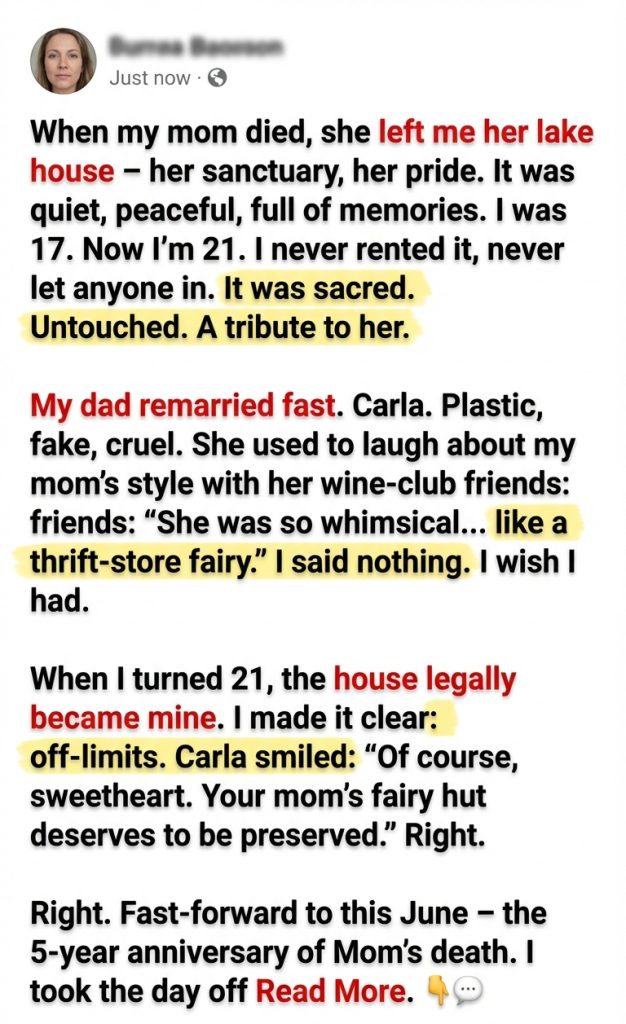
When my mom died, she left me her lake house – her sanctuary, her pride.
It was quiet, peaceful, full of memories. I was 17. Now I’m 21. I never rented it, never let anyone in. It was sacred. Untouched. A tribute to her.
My dad remarried fast. Carla. Plastic, fake, cruel. She used to laugh about my mom’s style with her wine-club friends:
“She was so whimsical… like a thrift-store fairy.” I said nothing. I wish I had.
When I turned 21, the house legally became mine. I made it clear: off-limits.
Carla smiled: “Of course, sweetheart. Your mom’s fairy hut deserves to be preserved.” Right.
Fast-forward to this June – the 5-year anniversary of Mom’s death. I took the day off work, like I always do, to be at the lake house. Alone. Quiet. But when I pulled up…
At first, I thought I had driven to the wrong place. Cars lined the gravel driveway in a row so long they nearly spilled onto the narrow road. Expensive SUVs, polished sedans, and one ridiculous white convertible sat under the trees where my mother used to hang bird feeders. I actually stopped breathing for a second. My hands froze on the steering wheel, and all I could do was stare.
Then I heard it.
Music. Loud music. Not soft background music or some mellow acoustic playlist. Bass-heavy, laughing, shrieking, party music. The kind of sound that rattled windows and swallowed peace whole. My mother’s porch—the one where she used to sip tea in old cardigans and write in little spiral notebooks—was wrapped in balloons, fake flower garlands, and a giant gold banner that read: FAIRY QUEEN FAREWELL BRUNCH.
My stomach dropped so hard I thought I might be sick right there in the car.
For a moment, I just sat there, gripping the keys so tightly they cut into my palm. I could see women in pastel dresses wandering across the lawn with champagne glasses. One of them had propped her feet up on my mother’s vintage outdoor table. Another was taking selfies in front of the old willow tree, making pouty faces while standing beside the wind chime my mom had bought at an art fair the summer before she got sick.
I got out of the car without even closing the door behind me. Gravel crunched under my shoes as I walked toward the house, and every step made the scene more surreal. There were rented linens on the deck. A catered brunch spread inside. Someone had tied silk ribbons around the porch railings. My mother’s handmade quilt—the one she kept folded over the reading chair in the sunroom—had been spread across the grass like a picnic blanket.
I felt grief and rage slam into each other so violently inside me that I nearly couldn’t speak.
Then Carla appeared in the doorway.
She was wearing white linen, oversized sunglasses, and the kind of smile people wear when they think they have already won. One hand held a mimosa. The other rested on her hip like she belonged there. Like this was hers. Like five years of my mother being dead had erased the truth of who built that place, loved that place, and trusted it to me.
“Oh,” she said, as if I had surprised her. “You’re early.”
Early.
I looked at the banner. At the guests. At the open doors. At strangers walking through my mother’s kitchen with plates in their hands. “What is this?” I asked, but my voice came out so cold and low it barely sounded like mine.
Carla gave an airy little laugh and descended one porch step. “A remembrance brunch,” she said. “I thought it would be healing. Your mother did love whimsical things. We wanted to celebrate her spirit.”
“We?”
“My friends. Some of your dad’s colleagues’ wives. A few neighbors from the club. It’s tasteful, actually.”
Tasteful.
That word nearly broke something in me. Because nothing about it was tasteful. Not the champagne flutes on the dock where my mother used to sit barefoot at sunrise. Not the women using her bedroom mirror for lipstick touch-ups. Not the laughter echoing through the walls that had once held my mother’s last Christmas, her last birthday, her last everything.
“You were told this house is off-limits,” I said.
Carla tilted her head. “Don’t be dramatic. It’s just a gathering.”
“No,” I said, louder now. “It’s trespassing.”
That got a few heads turning. One of her friends lowered her glass. Another pretended not to listen while very obviously listening. Carla’s smile shifted—not gone, just sharper. “Your father approved it.”
“My father does not own this house.”
Her jaw tightened for half a second. There it was. The truth beneath the sweet voice and polished manners. She had never forgotten that this place was mine, and she had never forgiven it.
“He’s family,” she said.
“So was my mother.”
Silence spread outward from us like a crack through ice.
I walked past Carla and straight into the house. My pulse was pounding so hard I could hear it in my ears. Every room was wrong. The scent of lilies and expensive perfume had smothered the cedar-and-lavender smell I associated with my mother. Decorative signs had been placed on tables like they were at some theme event. One of them, leaning against a lamp in the living room, read: Whimsy Never Dies.
I picked it up and stared at it for a long second.
Then I set it down carefully and took out my phone.
Carla followed me in. “What are you doing?”
“What I should have done the first time you mocked her,” I said.
I called the police.
The reaction around me was instant. Murmurs. Gasps. One woman actually said, “Oh my God,” like I was the one ruining the mood. Carla rushed forward, voice lowered now, angry and urgent. “Don’t you dare embarrass this family over a brunch.”
I turned to face her. “You embarrassed yourself the second you turned my mother’s death anniversary into a costume party.”
She looked stunned—not because I had spoken, but because I had spoken in front of witnesses. People like Carla count on your silence. They build their power on it. They mistake restraint for weakness. They mistake grief for passivity. For years, I had let her little comments slide because I was trying to survive losing my mother without starting wars I didn’t have the strength to fight.
But grief changes shape.
At 17, mine was numb and quiet. At 21, it had a voice.
My father arrived twenty minutes later, red-faced and furious, probably called by Carla the moment she realized I wasn’t bluffing. He came charging through the front door demanding to know what kind of stunt I thought I was pulling. And for the first time in my life, I didn’t shrink when he raised his voice.
I stood in the center of the living room, surrounded by wilted brunch flowers and horrified guests, and said, “The legal owner of this property asked people to stay out. You ignored me. She ignored me. And now the police are on their way.”
He stopped.
Maybe it was the way I said legal owner. Maybe it was because some of Carla’s precious friends were now backing toward the exit, suddenly desperate not to be involved. Maybe it was because deep down, he knew exactly what he had done. Not just that day, but for years. He had let Carla belittle my mother to make his own life easier. He had traded memory for convenience. He had let the woman who replaced my mother behave as if love could be redecorated.
“She was trying to do something nice,” he said at last, but his voice had lost its force.
“No,” I said. “She was trying to make herself the hostess of a place she never had any right to enter.”
The officers arrived while no one was speaking.
I showed them the deed on my phone, the messages where I had explicitly said the property was off-limits, and the recent text from Carla—sent three days earlier—asking if I still “never let anyone use the cute cabin,” followed by a smiley face. I had replied with one word: No. Clear. Direct. Impossible to misunderstand.
One officer stepped aside to talk to Carla and my father. Another asked whether I wanted everyone formally removed from the property.
I looked around the room.
At the half-eaten pastries on my mother’s counter. At the lipstick marks on borrowed glasses. At the muddy shoes on the rug she had woven by hand during one winter she said she was “learning patience.” At strangers standing in the middle of my loss, suddenly awkward, suddenly silent, suddenly aware that they had walked into something far uglier than gossip over brunch.
“Yes,” I said. “Everyone.”
What followed was chaos, but the satisfying kind.
Guests grabbed purses and shoes and abandoned plates mid-bite. One woman muttered that she had “no idea” the house belonged to me. Another refused to make eye contact as she hurried down the porch steps. Carla kept trying to speak in that tight, controlled voice of hers, insisting it was all a misunderstanding, insisting I was emotional, insisting we should handle this privately. The officers did not care. Facts are wonderfully indifferent to manipulative tone.
And the facts were simple.
It was my house.
She had been warned.
They had entered anyway.
Before leaving, Carla turned to me with a face so stripped of sweetness it was almost unrecognizable. “You’ve been waiting for a reason to do this,” she hissed.
I met her stare. “No. I’ve been waiting for a reason to stop protecting people who never protected me.”
That one landed.
My father looked older in that moment than I had ever seen him. Not wiser. Just older. Like the cost of cowardice had finally shown up all at once. He started to say my name, maybe to plead, maybe to lecture, maybe to ask me not to do this in front of everyone. But there was nothing left to say that should have taken five years to say.
They left.
Every single one of them.
When the driveway finally emptied and the last trace of music died away, the silence returned in pieces. The lake shimmered beyond the trees. A paper napkin skittered across the deck in the breeze. One champagne flute had been forgotten near the dock, glittering in the sunlight like a joke too cruel to be funny.
I spent the rest of the afternoon cleaning.
Not because Carla deserved tidiness. Not because the guests had been respectful enough to warrant it. I cleaned because that house had always been my mother’s sanctuary, and I needed to restore it with my own hands. I folded the quilt and brought it back inside. I stripped the ribbons off the porch. I threw away the signs, the balloons, the flowers, the ridiculous gold-lettered banner. I opened every window and let the lake air carry the perfume out.
By evening, the house felt like itself again.
Exhausted, I sat on the porch steps wrapped in my mother’s old knit blanket and watched the sun slide down over the water. The sky turned pink, then amber, then that deep bruised blue that always made her say the world looked painted. I could almost hear her voice. Not in some magical way. Just in the way memory lives in your bones when you’ve loved someone enough.
And for the first time in years, I didn’t feel like I had failed her by staying silent.
A week later, I had the locks changed. I installed security cameras. I posted private property signs at the edge of the drive, even though I hated the look of them. I also mailed my father a copy of a formal notice making it clear that neither he nor Carla had permission to enter the property again without my written consent. He called three times. I didn’t answer.
Carla, of course, sent a text.
It was exactly the kind of message people send when they want forgiveness without accountability. She said she was “sorry I was hurt by her attempt to honor my mother.” She said grief “makes people territorial.” She said families should extend grace. I read it once, took a screenshot for my records, and blocked her number.
Because some people do not apologize to repair. They apologize to regain access.
That house taught me that.
My mother had built that sanctuary to escape noise, cruelty, and performance. She filled it with chipped mugs, secondhand books, handmade curtains, and wildflowers in old jam jars. Carla mocked all of that because she could not understand a life that wasn’t curated for status. But the joke was always on her. My mother had something Carla never would: a place made beautiful by sincerity.
And that is what Carla tried to invade.
Not just land. Not just a building. Meaning.
But meaning is harder to steal than furniture. Love leaves a mark deeper than ownership papers, though I’m grateful I had those too. In the end, Carla didn’t just get kicked out of a lake house. She exposed herself in front of everyone she most wanted to impress. All her charm, all her polished cruelty, all her little jokes about whimsy and fairy huts—they collapsed the second truth walked through the door.
Mine.
So now, every June, I still take the day off work. I still go to the lake house alone. I still sit on the porch in the quiet my mother loved. I bring flowers from the farmers market, the kind she used to buy for no reason at all. I make tea in her favorite mug. I read for a while. Sometimes I cry. Sometimes I laugh at things she would have said. Sometimes I just listen to the water and let grief be whatever it is that day.
But one thing is different now.
I do not confuse silence with strength anymore.
My mother left me that house, yes. But what she really left me was a final lesson in dignity: if something sacred is placed in your care, you protect it. Even when your voice shakes. Even when the people violating it call you difficult. Even when family expects you to swallow your pain to keep the peace.
Especially then.
Because peace built on your humiliation is not peace at all.
And the day Carla turned my mother’s death anniversary into a brunch theme, she learned something she should have understood from the start: I may have been quiet at 17. I may have been grieving. I may have let too much slide.
But I was never weak.