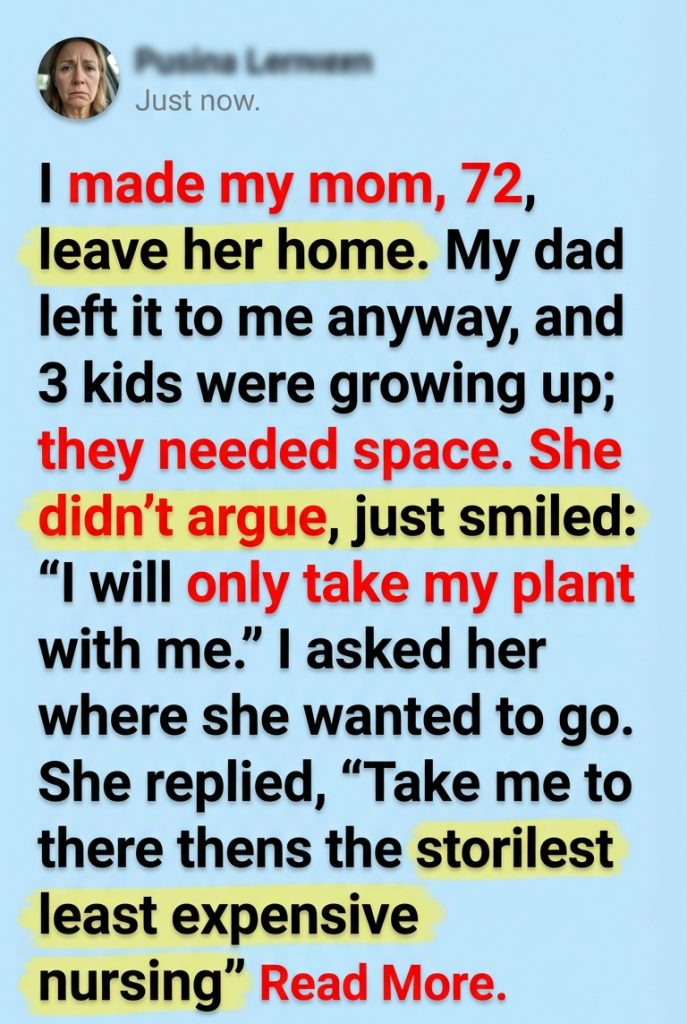
I made my mom, 72, leave her home. The sentence sounds brutal now, but at the time, I dressed it in logic so neatly that I almost believed it was kindness. I told myself I was not throwing her out. I was making a practical decision. I was choosing what any responsible father of three would choose when walls started closing in, when bedrooms felt too small, when every corner of the house carried the noise and clutter of a growing family. I used reason like a shield, and behind it, I hid something uglier: impatience.
My dad had left it to me anyway, and my 3 kids were growing up; they needed space.
That was what I repeated to anyone who looked at me too long after hearing what I had done. I said it to my wife. I said it to my sister over the phone. I even said it to myself at night when the silence in the house felt too heavy to ignore. The deed was in my name. The law was clear. My children were older now, louder now, taller now, and every passing month seemed to demand another closet, another bed, another place to breathe. It sounded reasonable. It sounded justified. That was the worst part.
She didn’t argue, just smiled: “I will only take my plant with me.”
I still see that smile in my sleep. It wasn’t bitter. It wasn’t wounded in the way I expected. That would have been easier to live with. It was calm, almost tender, as if she were the one comforting me. On the kitchen windowsill beside her sat that little plant in its faded ceramic pot, a thing so ordinary I had stopped noticing it years ago. Green leaves, a thin stem, soil packed down from age and careful watering. Out of everything in the house—forty years of marriage, grief, birthdays, winters, prayers, photographs—she asked for only that.
I asked her where she wanted to go.
Even then, some small part of me hoped she would save me from myself. I hoped she would name a friend, a cousin, a church member, some place that would shift the decision away from my hands. Instead, she stood by the doorway in her pale cardigan, one hand around the little pot, and looked at me with the same tired softness she had worn when I was a child with a fever or a scraped knee.
She replied, “Take me to the least expensive nursing home… I know you don’t earn much, and I don’t want you to spend all your money on your sick mother…”
There are words that do not strike you immediately. They enter quietly, then begin to echo years later with a force strong enough to split you open. At the time, I nodded too quickly. I accepted her mercy the way selfish people do—with relief. I let her make my cruelty easier. I let her speak as though she were the burden and I was the struggling son doing his best. The truth was more shameful: I was not poor enough to do this. I was only selfish enough.
I agreed.
The day I drove her there, rain clung to the windshield in trembling streaks. The nursing home sat on the edge of town beside a fenced patch of dead grass and a row of tired hedges that looked as though even nature had given up there. The building smelled of bleach, canned soup, and old loneliness. A television blared somewhere in the background. A nurse with a rushed smile handed me forms before she looked properly at my mother’s face. My mom stood beside me holding her plant the whole time, not complaining once, not asking me to reconsider, not saying, “Please don’t leave me here.”
Forty days later, I got a call: she had passed away.
I remember exactly where I was when the phone rang. I was in the hardware aisle of a department store, comparing paint colors for what had once been her room. My youngest son wanted blue walls. My daughter wanted shelves. My wife thought we could knock out one side and make the room brighter. My mother was not even gone six weeks, and already her space had become a project. When the call came, the cheerful voice on the recording system told me to hold for the facility administrator. I felt irritation before I felt fear.
She—
The administrator’s voice was professional, careful, practiced. My mother had been found unresponsive shortly after dawn. They had done everything according to protocol. They were sorry for my loss. There were items to collect. Papers to sign. A death certificate would be available soon. I heard every word, but none of them landed at first. What landed instead was a memory of her climbing into my car with that plant in her lap, making sure the leaves didn’t brush the door.
I drove to the nursing home in a fog so thick it felt physical. The roads were familiar, but I barely recognized them. At red lights, I kept seeing small things I had ignored: her folding my school uniforms when I was too old to need help, her waiting for me after late shifts with reheated dinner, her lying to collectors after my first business failed so I would not hear the humiliation in their voices. My mother had spent her life making my hardships lighter. And when she had grown old and ill, I had calculated square footage.
The receptionist recognized me immediately, and that alone made my stomach turn. There are places where the staff remember the children who never visit. I realized with shame that I had become one of them. I had not returned in forty days. Not once. I had sent money. I had called twice. I had convinced myself that practical support counted as love. It does not. Not when presence is what is needed most.
A nurse led me to a small office where my mother’s belongings had been placed in a cardboard box. A sweater. A Bible with a cracked spine. Reading glasses wrapped in tissue. A hairbrush. Two neatly folded dresses. Her medications in plastic packets. And the plant. The same little ceramic pot, now sitting on top like some final witness. I stared at it longer than I stared at anything else.
“She kept talking about you,” the nurse said gently.
I could not answer.
“She said you were a good son,” the nurse continued. “She said you had your hands full and didn’t need more guilt in your life. She asked us not to call and pressure you to visit. She defended you every time.”
There are kinds of mercy that feel like punishment because they reveal what you are. If my mother had cursed me, I might have hidden inside my anger. If she had told the staff I abandoned her, I might have fought the accusation. But she had done what mothers like her do even from a narrow bed in a cheap room under fluorescent lights: she protected me from the truth of myself.
I asked whether she had suffered. The nurse hesitated, then said my mother had been very weak the last week. She had trouble eating. She tired easily. But on the final evening, she had insisted on sitting by the window with her plant in her lap. She had watched the sunset. She had smiled. Later that night, she asked one of the aides for paper and wrote something before going to sleep.
The note was inside the Bible.
My hands shook so hard I nearly tore the page opening it. The handwriting was hers, wavering but unmistakable, each letter shaped with old-fashioned care.
“My dear son, if you are reading this, don’t cry too long. I have already lived more love than many people ever know. Your father loved me. I loved you. I still do. Take care of the children. And please water my plant. There is something there for you when your heart is ready.”
I read it three times before the last sentence made sense.
I looked up at the nurse, but she only shrugged. She said my mother never mentioned anything else. I took the box and carried it to the car like it weighed a hundred pounds. The drive home was quieter than any road I had ever traveled. On the passenger seat, the plant shifted lightly with every turn, leaves trembling in the gray afternoon. I kept glancing at it as though it might speak.
When I got home, the house felt wrong. Too bright. Too alive. My children were arguing over snacks in the kitchen. My wife was holding fabric samples for curtains. The ordinary rhythm of life, which had seemed so urgent weeks earlier, now sounded hollow. I took the box to the garage and set the plant on the workbench. For a long time, I only stood there.
Then I knelt and examined the pot.
The ceramic container was heavier than it should have been. I tipped it gently and loosened the packed soil with my fingers. Beneath the roots, wrapped in wax paper and protected inside a plastic sleeve, was a small brass key and an envelope with my name on it. My breath stopped. The envelope had been buried there carefully, deliberately, like something planted for a season she knew she would never see.
Inside was another note.
“This key opens the safe deposit box your father and I kept. We never told you because we wanted it to be used only in need, not in comfort. I think now you need it in a way money can’t fix. Inside are the papers to the house. It was never yours alone, no matter what the deed said first. Your father changed his will before he died. The home was to remain mine for as long as I lived. After that, it would pass to you only if I chose. I chose not anger. I chose grace. There is also a letter from your father. Read it after you are ready to be honest.”
I sat on the cold garage floor and felt something inside me collapse.
I had forced my own mother out of a house that, by my father’s final wish, I had no right to take from her. She had known. All along, she had known. She could have fought me. She could have humiliated me with one call to a lawyer, one reading of a document, one public truth. Instead, she had gone quietly, protecting my pride even as I stripped her of dignity. The magnitude of it made me nauseous.
The next morning, I went to the bank.
The safe deposit box contained property papers, insurance documents, some old jewelry, and a sealed letter in my father’s handwriting. I opened that one last. My father had always been a plainspoken man, not soft with emotions, not careless with words. Even on paper, he sounded like himself.
“If you are reading this after your mother’s death, then I pray you treated her better than the world usually treats old people. A son’s character is tested not when he is hungry, but when he is full; not when he needs his mother, but when she needs him. I left protections in place because love sometimes requires guarding the gentle from the entitled. If you failed her, then do not waste time defending yourself. Change.”
That last word burned.
I did not go to work that day. I did not paint the room. I did not discuss renovations. I sat at the dining table and told my wife everything. At first, she looked stunned. Then she cried—not loudly, but with the quiet disappointment that is harder to endure than fury. My oldest son, who had overheard enough to understand, asked the question no adult had dared ask me directly.
“Dad… why didn’t Grandma stay with us?”
There is no answer a child deserves less than a lie. So for the first time in weeks, maybe for the first time in years, I told the truth plainly. I told him I had been selfish. I told him I had cared more about comfort than gratitude. I told him I had hurt someone who loved me. He looked at me in a way children sometimes look at adults when they realize goodness is not automatic just because someone is grown.
My mother’s funeral was three days later.
It was small. Smaller than she deserved. A few church friends came. So did two aides from the nursing home. One of them brought a folded paper flower my mother had made during an activity hour. On the back, in shaky handwriting, my mom had written each of my children’s names. Even in that place, even in those final days, she had still been thinking forward, still making tiny gifts, still being a grandmother from a narrow chair under poor lighting.
When it was my turn to speak, my prepared words vanished. What came out instead was the raw thing.
I told everyone that my mother had been kinder than I was. I said she had been stronger in silence than I had been in authority. I confessed that she had been sent away not because there was no room in the house, but because there had been too little room in my heart. I said that if love could be measured, then hers had been ocean-deep and mine had been a locked door. By the end, I could hardly stand.
After the funeral, I drove back to the house and went straight to her old room.
Nothing had been changed yet. Her curtains still hung slightly uneven. A faint scent of lavender remained in the closet. On the dresser sat the framed photo of my parents from their fortieth anniversary, my father looking proud and my mother smiling the same smile she had worn when I forced her out: patient, forgiving, unbearably gentle. I sat on the edge of her bed and understood, too late, that space had never been the problem. Love was.
We turned the room into something else after that, but not a bedroom.
We made it into a quiet room with her chair by the window, her books on the shelf, family photographs on the wall, and the plant—her plant—resting where the sunlight touched it every morning. My children call it Grandma’s Room. Sometimes they sit there to read. Sometimes my wife prays there. Sometimes I go in alone and say things no one hears. Apologies. Memories. Promises I should have made while she was alive.
I also began volunteering at the nursing home.
At first, I thought I was doing it for redemption, but redemption is not a thing you earn with enough visible regret. It is not payment. It is practice. Week after week, I sat with people whose children were too busy, too distant, too uncomfortable, or too selfish to come. I listened to stories told three times in one hour. I watered plants. I fixed a broken lamp in one room and read old letters aloud in another. And every time someone looked toward the door at visiting hour, I saw my mother waiting without complaint.
The cruelest truth is not that I lost her.
It is that I lost the chance to become the son she deserved while she was still here to know it. Grief would be easier if it were only sorrow. But guilt is grief with teeth. It chews through sleep, through pride, through every defense you once trusted. It returns in small moments—at the grocery store when I pass her favorite tea, in spring when I see potted plants outside garden shops, in the sound of my daughter laughing the way my mother used to laugh before illness made her quieter.
I keep her notes in my desk now.
Sometimes I read them when I feel myself getting impatient with age, weakness, need, or inconvenience in others. Her words do not flatter me. They steady me. They remind me that love is not proved by inheritance papers, declarations, or occasional gestures. It is proved in the daily willingness to make room. Real room. Not just in a house, but in your schedule, your patience, your pride, your life.
If I could go back, I would open the front door before she ever had to touch her suitcase. I would tell my children that their grandmother staying with us was not a problem to solve but a privilege to protect. I would carry her medicines, warm her blanket, make her tea, sit beside her bed, and listen to stories I thought I had heard too many times. I would make room. God, I would make room.
But life does not return what pride destroys.
It only leaves you with what mercy preserved. My mother could have left me with court papers, accusations, and bitterness. Instead, she left me a plant, a key, and the truth. One living thing. One way to unlock what had been hidden. One final chance to understand that grace is sometimes more devastating than punishment because it asks you to become better without ever forcing you.
So I water her plant.
Every Sunday morning, before the house fully wakes, I carry a glass of water to Grandma’s Room and pour slowly until the soil darkens. Then I stand there in the quiet and look at the leaves reaching toward the light. It is such a small act. Too small for all I owe. Too late for all I ruined. But it is what I have. And every time I do it, I hear her voice again—soft, undemanding, still protecting me from the full weight of myself.
“I will only take my plant with me.”
She did.
And in the end, she left the rest of my life inside it.