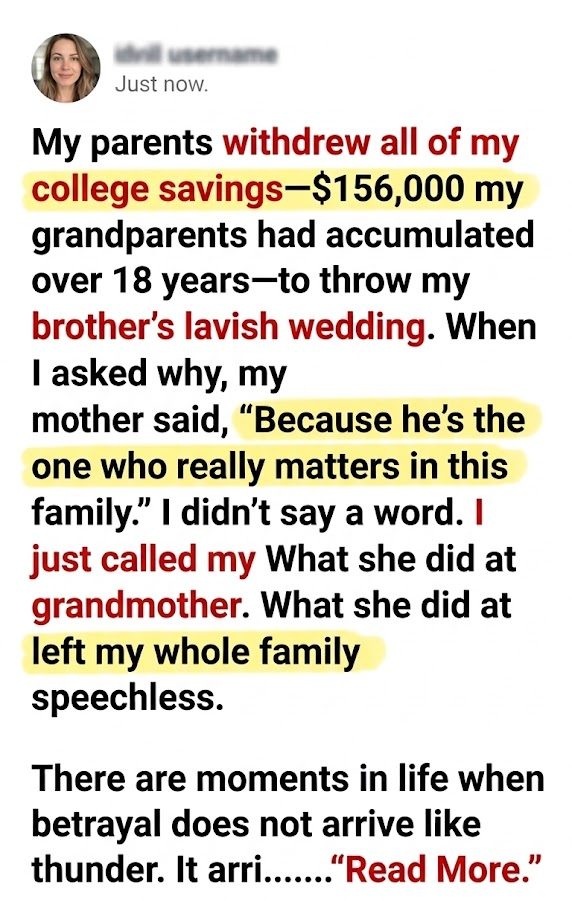
My parents withdrew all of my college savings—$156,000 my grandparents had accumulated over 18 years—to throw my brother’s lavish wedding. When I asked why, my mother said, “Because he’s the one who really matters in this family.” I didn’t say a word. I just called my grandmother. What she did at my brother’s wedding left my whole family speechless.
There are moments in life when betrayal does not arrive like thunder. It arrives quietly, with a glowing screen, a number that makes no sense, and a silence so sharp it feels louder than screaming. For me, that moment happened under the dim, institutional lights of the campus library, surrounded by students whispering over laptops and half-empty coffee cups, while the future I thought I had been promised vanished with the refresh of a page.
I found out on a Tuesday morning in the campus library. I refreshed my tuition portal and watched the status flip from “paid” to “past due.” I assumed it was a glitch—until my bank app loaded and the account labeled COLLEGE—EMILY read $0.00.
At first, I genuinely believed there had been some clerical mistake. Universities made errors. Banks made errors. Systems glitched. I refreshed the screen again, then again, my thumb trembling more each time, as if repetition alone could force reality to correct itself. But the balance stayed there, flat and merciless: zero dollars and zero cents. I felt the blood drain from my face so quickly that the edges of my vision blurred. Around me, the library carried on as usual—pages turning, keyboards clicking, someone laughing softly two tables away. It was almost insulting, how normal everything looked while my world came apart.
I drove home and asked my parents what happened. My mom, Linda, didn’t pretend to be surprised. “We reallocated it,” she said. My dad, Mark, kept his eyes on the TV like silence could erase the conversation.
The drive from campus to home usually took thirty-five minutes. That day it felt like I crossed an entire lifetime. Every traffic light seemed cruelly slow, every red light another second for denial to battle the truth. By the time I pulled into the driveway, my hands were clamped so hard around the steering wheel that my knuckles ached. Our house looked exactly the same as it always had—freshly trimmed hedges, blue shutters, the wreath my mother insisted looked “classy” even in the wrong season. But when I stepped inside, the air felt unfamiliar, like I was walking into a stranger’s home wearing my own memories.
“Reallocated to what?” I asked, though I already knew. For months, our house had been consumed by my brother Jason’s wedding: the waterfront venue, the live band, the guest list packed with people my parents wanted to impress.
Jason’s wedding had been less of a celebration and more of a family coronation. Everywhere I turned, there were fabric swatches, tasting menus, florist calls, seating charts, and conversations about image. My mother used words like elegant and unforgettable with the kind of reverence most people save for prayer. She wanted chandeliers in a tented reception space, imported flowers flown in two days before the ceremony, a signature cocktail named after the bride and groom, and gold-edged invitations thick enough to feel like tiny pieces of furniture. Every detail shimmered with money, and every shimmering detail now looked different to me.
Linda’s voice turned crisp. “To Jason’s wedding. It’s important for our family image.”
That was my mother’s religion: appearances. Not truth, not kindness, not fairness—appearances. She believed there was nothing a polished smile and expensive centerpiece could not disguise. In her mind, people did not need to be good; they only needed to look enviable from a distance. And Jason, handsome and charming and effortlessly adored, had always been the perfect centerpiece for the version of our family she wanted the world to see.
“That money was for my tuition,” I said. “Grandma and Grandpa saved it.”
My grandparents had started that account when I was a baby. Eighteen years of birthday checks, careful deposits, canceled luxuries, and quiet discipline had gone into it. My grandfather used to joke that every dollar had a job to do, and mine was to build a future no one could take away. When he died, Grandma Ruth kept contributing anyway, small amounts when she could, larger ones when she insisted on skipping something for herself. That money was never just money. It was proof that someone had seen me, planned for me, believed in me.
My mom leaned forward, not even trying to soften the blow. “Because he’s the one who really matters in this family.”
The words landed with a strange kind of finality. Not because I had never felt them before, but because this was the first time she had said them plainly. No euphemism. No excuse. No pretending the favoritism was accidental or misunderstood. It was all there, stripped bare and ugly. Jason mattered. I did not. The family had always known it. I had simply been the last one foolish enough to hope otherwise.
I didn’t scream. I didn’t cry. I just looked at my dad—one last chance for him to say it was wrong—and he stared at the screen. In that moment, I understood the rules: Jason was the headline; I was the fine print.
That was the part that hurt in a different way. My mother was predictable in her cruelty. My father was not cruel in loud ways. He was cruel in quiet ones—in his willingness to let wrong happen as long as it kept the peace for him. He had spent my whole life mistaking passivity for neutrality, as if refusing to interfere somehow absolved him of what he allowed. The television flickered blue across his face while my future burned to the ground, and he would not even look me in the eye.
I walked out, sat in my car, and called the only person who had never treated me like an afterthought—my grandmother, Ruth.
The moment she answered, something inside me nearly broke. Her voice had always had that effect—firm, warm, impossible to fake. She was the kind of woman who folded grief into action, who believed panic could wait until after the facts were gathered. Growing up, she was the one who remembered my science fair dates, my favorite pie, the names of my professors, the exact week finals usually started. Where my parents saw me as background, Ruth saw me in full color.
“Grandma,” I said, voice shaking, “they took it. All of it. One hundred fifty-six thousand.”
Ruth went quiet for a beat. Then she said, steady as stone, “Tell me everything.”
I told her the transfer date, the account name, and my mother’s exact words. Ruth didn’t gasp or curse. She asked for Jason’s wedding schedule and venue address. When I finished, she said, “I’m going to handle this. You don’t need to argue with them.”
There was something in her tone that made me stop crying almost immediately. It was not comfort, exactly. It was certainty. Ruth had lived through enough disappointment to know when talking was useless and when action was required. She did not waste time asking whether my parents had gone too far. She already knew. She did not tell me to be patient or calm down or avoid making a scene. She simply told me to send the details, and in that moment, I trusted her more than I had ever trusted anyone.
The days leading up to the wedding passed in a blur of dread. My phone lit up with family group messages full of photos of centerpieces, last-minute menu changes, and cheerful reminders about dress code and arrival times. I ignored them all. Each notification felt like a tiny insult. Somewhere between the cocktail hour planning and the custom dance floor decals, no one—not one person—had paused to consider what had been stolen to pay for all of it. Or maybe they had considered it, and simply decided Jason’s happiness was worth the cost.
The wedding Saturday arrived with perfect weather and a knot in my stomach. I sat in the back row as Jason and his fiancée, Madison, promised forever under an arch of white roses my tuition had paid for. At the reception, champagne flowed, my parents beamed, and Jason worked the room like a celebrity.
It was a gorgeous event, the kind people call tasteful when what they really mean is expensive. Sunlight danced on the waterfront behind the ceremony chairs. The band played softly between speeches. Waiters glided across the lawn balancing trays of sparkling drinks. Madison’s gown shimmered every time she turned, and Jason looked exactly the way my mother always wanted him to look: admired. Important. Untouchable. I sat near the back and watched strangers compliment my parents on what a beautiful family they had raised. Every smile made my jaw tighten. Every toast felt funded by a theft no one intended to mention.
Then the DJ announced a “special family toast.” My grandmother rose from her table, pearls catching the light, and walked straight to the microphone with a thick folder tucked under her arm.
The room softened into polite attention. People smiled, expecting something sentimental—perhaps a story from Jason’s childhood, a blessing for the newlyweds, a tender memory about family legacy. My mother even dabbed at the corner of one eye as if preparing to be publicly adored for raising such a son. But I knew Ruth better than that. She did not carry thick folders to give sentimental speeches.
She adjusted the microphone once, laid the folder on the podium, and surveyed the room with the cool calm of a judge who already knows the verdict. “Good evening,” she said. “I had intended to offer a toast. Instead, I am here to correct a lie.”
You could feel the air change. It moved through the reception like a draft, subtle at first, then impossible to ignore. Forks paused halfway to mouths. Laughter vanished. At the head table, my brother’s smile faltered. My mother straightened in her chair so abruptly that her champagne glass tipped and nearly spilled.
Ruth opened the folder and removed several sheets of paper. “Many of you have admired this beautiful wedding tonight,” she said. “And yes, it is beautiful. But beauty paid for with betrayal has an ugly foundation. The money used to help fund this event was taken from my granddaughter Emily’s college account—a fund her grandfather and I spent eighteen years building for her education.”
A murmur rippled across the room. It started at the nearest tables, then spread outward in widening circles. Some guests turned to each other in disbelief. Others looked directly at my parents. The band members stared at their instruments, frozen. I saw Madison’s maid of honor mouth, What? while Madison herself went pale beneath her bridal makeup.
My mother stood so quickly her chair scraped the floor. “Ruth, this is not the time,” she snapped, her voice thin with panic. “Sit down.”
Ruth did not even look at her. “I have transfer records,” she continued, lifting a page. “Bank statements. Dates. Amounts. The account title. I also have the exact words spoken when Emily asked why her education fund had been emptied.” Her eyes finally shifted to Linda. “Would you like me to repeat them, or shall we trust your memory?”
My father’s face had gone gray. Jason stared at the tablecloth as if studying the stitching might save him. Madison slowly turned toward him, confusion hardening into horror. This was not a misunderstanding about budgets or a harmless family reshuffle. This was theft, deliberate and personal, performed in broad daylight and now exposed in front of everyone my parents had invited to impress.
Ruth’s voice never rose, which somehow made every word hit harder. “The answer Emily was given was this: ‘Because he’s the one who really matters in this family.’” Gasps cracked through the reception like snapped wires. Someone at a back table actually whispered, “Oh my God,” without bothering to keep it down.
Madison pushed back her chair and stood. “Jason,” she said, too clearly for the microphone to be necessary, “did you know about this?” The question hung there, sharp and glittering. Jason opened his mouth, closed it, then tried again. Whatever answer he had prepared for life had clearly never included this moment. His silence told her enough. I watched her expression change in real time—from confusion to humiliation to fury.
Then Ruth delivered the final blow. “Since my son and daughter-in-law believed my husband’s and my savings were theirs to redirect, I have spent the last three days correcting several legal oversights.” She reached back into the folder and removed another document. “Every discretionary gift, transfer, and future family distribution under my control has now been revised. Effective immediately, Emily is the sole beneficiary of my estate.”
The room did not just go quiet. It collapsed inward. Even the waterfront breeze seemed to stop. My mother’s face drained of color. Jason looked up for the first time, stunned. A cousin near the dance floor actually dropped her glass, and it shattered against the tile with a crack that made several guests jump.
Ruth set the paper down and continued with devastating composure. “Furthermore, my attorney has already prepared a civil action demanding the return of every dollar removed from Emily’s account. Since tonight’s celebration appears to have benefited from those funds, I trust the responsible parties will find a way to repay what they took.” Then, finally, she smiled—but only at me. “Education, unlike vanity, is an investment worth defending.”
Madison removed her wedding ring before the room had even recovered. She placed it on the head table with a tiny metallic click that somehow echoed louder than the microphone. “You let me marry into this?” she asked Jason. Her voice trembled, but not from weakness. “You let me stand there and smile while your family stole your sister’s future?” Jason reached for her wrist. She stepped back as if his touch burned.
My mother tried to salvage the evening. Of course she did. She laughed—a brittle, frantic little sound—and said there had been a misunderstanding, that family finances were complicated, that everything would be sorted privately. But the spell had broken. People were no longer seeing elegant centerpieces and curated charm. They were seeing exactly what Ruth had dragged into the light: greed dressed in formalwear.
Some guests quietly gathered their purses and coats. Others stayed only long enough to stare. A few relatives looked at me with sudden, awkward sympathy, as if kindness after the fact could erase years of complicity. My father finally stood, but not to defend me. He tried to usher Ruth away from the microphone. She looked at him once, and whatever he saw in her face made him stop cold.
I did not say a word during any of it. I simply sat there, hands folded in my lap, feeling something unfamiliar move through me. It was not triumph. It was not revenge. It was relief. For the first time in my life, the truth had entered the room before I was forced to swallow it and smile.
The wedding dissolved soon after. The band packed up early. The cake remained mostly untouched. Staff moved through clusters of stunned guests collecting half-full glasses and abandoned napkins. Jason disappeared with my parents into a side corridor, where their muffled argument could still be heard through the venue doors. Madison left with her sister before the final dance was ever announced.
Outside, evening settled over the water in streaks of gold and blue. I found Ruth standing alone near the railing, her folder tucked under one arm, the wind lifting a few silver strands of hair from her careful bun. She looked tired, but steady. When I walked up beside her, she took my hand without looking at me, the way people do when words are not quite enough.
“I’m sorry it came to this,” I whispered.
She squeezed my fingers. “No,” she said. “You have nothing to be sorry for. Let people be ashamed of what they chose. That burden is theirs.”
I leaned against her shoulder like I had when I was little, when scraped knees and hurt feelings still felt repairable in a single afternoon. “I didn’t want to ruin the wedding,” I admitted.
Ruth turned then, her eyes clear and fierce. “Emily, they ruined it the moment they decided your future was expendable. All I did was remove the decorations from the truth.”
In the weeks that followed, the story traveled through the family faster than any holiday gossip ever had. Calls came. Messages came. Some apologetic, some defensive, some shamelessly curious. My mother left me three voicemails filled with tears that sounded more embarrassed than remorseful. My father sent a single text: We should talk. Jason never called at all. His silence, for once, was his own to carry.
The money was eventually returned through a legal settlement Ruth had clearly anticipated from the beginning. Tuition was paid. My classes resumed. The account was restored, though I understood now that money, even when recovered, does not return untouched. It carries fingerprints. It carries memory. Still, each semester I stayed in school felt like a quiet refusal to let their choices define my life.
What lasted most was not the humiliation they suffered, or the inheritance announcement, or the gasps at the reception. It was the moment my grandmother stood in a room full of people determined to admire the wrong things and made them look directly at what mattered. Not image. Not favoritism. Not the child who had always been handed the spotlight. Me. My future. My worth.
Families like mine survive on silence. They need one child to be exalted, another to absorb the cost, and everyone else to call it normal. But silence stops working the moment someone brave enough names the truth out loud. That night, under expensive lights and white roses bought with stolen dreams, my grandmother did exactly that.
And if my whole family was left speechless, it was only because for the first time, no one could pretend they had not heard.