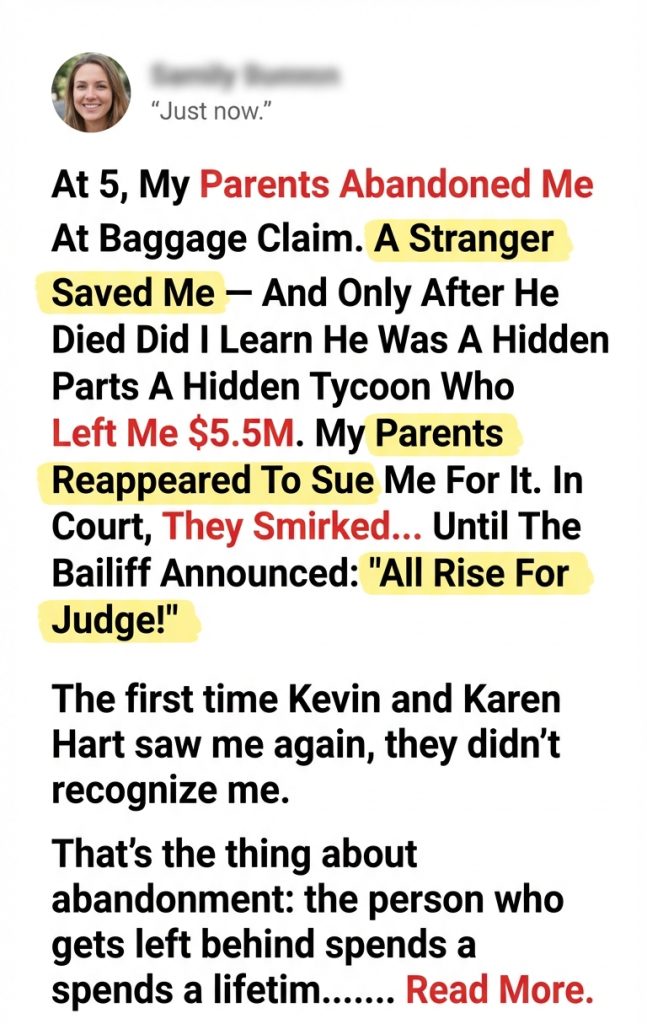
At 5, My Parents Abandoned Me At Baggage Claim. A Stranger Saved Me — And Only After He Died Did I Learn He Was A Hidden Tycoon Who Left Me $5.5M. My Parents Reappeared To Sue Me For It. In Court, They Smirked… Until The Bailiff Announced: “All Rise For Judge!”
The first time Kevin and Karen Hart saw me again, they didn’t recognize me.
That’s the thing about abandonment: the person who gets left behind spends a lifetime carrying the moment like a stone in their pocket, while the people who did the leaving treat it like a receipt they threw away years ago.
I was thirty-four, sitting at counsel table in Courtroom 23B, a red wool scarf folded in my lap even though the building’s heat was blasting like it always did in winter. Across the aisle, Kevin and Karen were laughing with their attorney as if they were already dividing up the money they were sure they’d win.
They didn’t look haunted. They looked excited.
Karen’s hair was carefully curled, the kind of effort you make when you want to appear respectable. Kevin wore a suit that tried to look expensive and failed, the shoulders slightly wrong, the tie too shiny. Their lawyer kept smirking, tapping a pen against a legal pad with the confidence of someone who believed he’d brought a knife to a gunfight without realizing the gun was the courthouse itself.
Courtroom 23B had been mine for six years. I knew every scuff in the wood, every crack in the tile. It smelled like old paper and floor polish and the faint metallic tang of elevators. It was where I’d sentenced burglars and drunk drivers and men who’d hurt people and tried to hide behind excuses. It was where I’d learned that silence could be more powerful than shouting if you knew how to hold it.
Kevin and Karen thought the silence belonged to them today. They thought their story would fill it.
They were wrong.
The bailiff stepped forward, voice loud enough to slice through the chatter. “All rise. Court is now in session for the Honorable Judge Samantha Hart.”
Kevin and Karen stood automatically, still smiling, still expecting a stranger in black robes to appear from some side door.
I stood too.
Karen’s smile faltered first. Her eyes flicked to me like a camera struggling to focus. Kevin’s laugh died mid-breath. Their attorney’s pen froze above the paper.
I didn’t rush. I didn’t dramatize it. I simply walked past the bar, up the steps, and took my seat behind the bench, the way I’d done a thousand mornings before.
For one long, clean second, the courtroom forgot how to breathe.
The lawyer’s smirk collapsed. Kevin’s face drained. Karen’s mouth opened slightly as if she’d been slapped by air.
I looked down at the file in front of me, though I didn’t need to. I already knew what it contained. A complaint thick with lies. A demand for five and a half million dollars. Claims that my adoptive father had kidnapped me. Claims that Kevin and Karen had searched tirelessly for decades.
That part almost made me laugh, not because it was funny, but because it was so aggressively fictional it belonged in a paperback thriller.
I set my hands on the bench and met their eyes.
The scarf in my lap wasn’t a comfort blanket anymore. It wasn’t a shield. It was just a scarf. But it had been there when I was five years old, and it had been there through every year I fought my way back to myself.
“My clerk has flagged a potential conflict,” I said, voice level. “Before we proceed, I need to address it on the record.”
Kevin’s lawyer tried to recover first, because lawyers are trained to keep moving even when the floor drops. “Your Honor—”
I raised a hand, not aggressively, just enough to remind the room who controlled the pace. “State your appearances.”
He did, voice strained. My own attorney—because yes, I had one, and yes, I’d hired the best—stated hers calmly.
Then I looked at Kevin and Karen.
“Mr. and Mrs. Hart,” I said. “Do you recognize me?”
Karen swallowed hard. “You’re… you’re the judge.”
“Yes,” I said. “And I am also the person you’ve named as defendant in this action.”
The room turned colder without the thermostat changing.
I could feel their confusion turning into panic, and I let it sit there for a moment, because some truths need a beat of silence before they land; then I did what I have done for thousands of frightened defendants and grieving families—I made the next step clear, steady, and unavoidable.
“This matter cannot proceed before me,” I continued, eyes on the record, not on their faces. “I will recuse myself and request immediate reassignment to the presiding judge.”
Kevin’s lawyer exhaled like he’d been thrown a rope, but the relief was premature, because ropes can also be used to pull someone closer to consequences.
“However,” I added, “I am also obligated to address what appears to be a knowingly false filing.”
My clerk slid a note to me—dates, docket numbers, the adoption decree, the sealed airport incident report—items that had been waiting in the wings like stage lights.
Karen’s hands began to tremble on the counsel table.
Kevin’s chin lifted, stubborn and stupid. “You can’t do this,” he muttered, as if the courthouse ran on his permission.
I looked at him the way I look at men who think volume is evidence. “I can,” I said, “and I am.”
The bailiff escorted me from the bench to chambers while the courtroom buzzed with a hunger that wasn’t quite gossip and wasn’t quite justice—more like the human need to see a lie finally trip over its own feet.
In my office, my attorney, Marisol Vega, was already standing by the window, calm as a metronome.
“They filed in your courtroom on purpose,” she said. “They thought the optics would force a settlement before anyone looked too closely.”
I nodded, because I had suspected that the moment the complaint hit my desk, thick with invented heroism and stolen grief.
What Kevin and Karen did not know—what they could not have known, because they had never been curious enough to learn anything real about me—was that the man they called a kidnapper had spent his life preparing for people like them.
Henry Ashford did not look like a tycoon. He looked like a tired traveler the day he found me at baggage claim: a man in a weathered coat, hair silver at the temples, eyes sharp but gentle, the kind of stranger your mother warns you about and your soul recognizes anyway.
I remember the airport like a nightmare you can still smell—the rubbery tang of the carousel belt, the cold blast of automatic doors, the way announcements echoed without meaning, the way my small fingers clutched a red scarf because it was the only thing Kevin and Karen had pressed into my hands before they vanished into the crowd.
At five, you don’t have vocabulary for betrayal; you just have the sudden, animal understanding that the world has become too big and you have become too alone inside it.
I sat on the floor by the suitcases that weren’t ours, watching adults stride past with rolling bags and impatient faces, waiting for my parents to return the way children wait for magic.
Hours later, when my throat was raw from crying and my stomach hurt from fear, Henry crouched beside me, not touching, just lowering himself to my level as if I mattered.
“Hey, kiddo,” he said softly. “Who are you traveling with?”
I told him, and he listened like my words were valuable, like my name was something worth protecting.
He asked airport security to call for Kevin and Karen over the loudspeaker.
He stayed when no one came.
He bought me water, then a sandwich I couldn’t swallow.
He wrapped his own coat around my shoulders when the terminal air-conditioning turned my skin to gooseflesh.
And when the police arrived, he didn’t hover like a hero; he handed them his ID, answered every question, and kept his voice steady so mine could stop shaking.
The report said “unattended minor,” “parents unlocated,” “stranger remained on scene.”
The part the report didn’t capture was the moment I finally fell asleep against his arm on a hard plastic chair, and his hand—big, warm, careful—rested on my red scarf like a promise.
Kevin and Karen never filed a missing-person report.
That came out years later, after Henry hired private investigators not to protect himself, but to locate them, to be certain I hadn’t been taken from a family that would come searching.
The investigators found a new apartment lease, a new phone number, a bank account drained and closed.
They found the truth: my parents hadn’t “lost” me; they had unburdened themselves of me.
Henry could have walked away once the state took over, but he didn’t.
He called every day to check where I’d been placed.
He paid for a guardian ad litem.
He showed up at hearings in the back row, quiet, respectful, present.
When the judge asked why a man with no relation kept appearing, Henry answered simply, “Because she shouldn’t have to do this alone.”
Months later, when my adoption was finalized, I took his last name, not because he demanded it—Henry never demanded anything from me—but because it felt like stepping into shelter.
He raised me in a brownstone that looked ordinary from the street and held warmth on the inside: books everywhere, soup simmering on Sundays, piano music drifting from rooms that smelled like cedar.
He taught me how to tie my shoes and how to read people.
He taught me that money can solve problems but not meaning, so if you have it, you use it like a tool, not like an identity.
He never once told me he was wealthy.
He drove an old sedan.
He wore coats until they were shiny at the elbows.
If a charity dinner invitation came, he declined.
“Private good is still good,” he’d say, and then he’d write checks in his neat handwriting without letting anyone photograph him.
I didn’t learn about Ashford Capital until high school, when a classmate’s father spoke about a “genius” investor who built a quiet empire and never appeared on TV.
I went home and Googled the name and felt the floor tilt the way it does when your brain catches up to your life.
Henry watched me read the screen, then sighed like a man finally setting down a heavy bag.
“I didn’t want you to think you owed me,” he said.
“You don’t,” I told him, and I meant it.
But he still looked relieved, because Henry Ashford’s greatest fear was always that love could be mistaken for purchase.
When he died, it was sudden—an aneurysm, the doctors said, the kind that steals a person between one heartbeat and the next.
I stood by his hospital bed with my red scarf in my hands, the same one I’d carried through foster meetings and first days of school, through college finals and bar exams, through every moment when my childhood tried to pull me backward.
In his desk, after the funeral, I found the letter he’d written years earlier and updated every December like a ritual: a plain envelope labeled “For Sam—When I’m Gone.”
Inside were two things: a trust document naming me as beneficiary of five and a half million dollars, and a second letter, longer, in which Henry finally told me everything he had learned about Kevin and Karen.
He attached copies of the investigator’s reports, the airport log, the unanswered announcements, the closed bank account, the move-out date—proof stacked like bricks.
“I can’t give you a childhood back,” his letter said, “but I can make sure the world cannot rewrite what happened to you.”
The trust had conditions, too, written with the precision of a man who understood predators: the money would transfer to me outright when I turned thirty-four, and if Kevin and Karen attempted any legal action to claim it, the trust would immediately fund a separate endowment for abandoned children in the state where the incident occurred, in their names, making their greed public and permanent.
They either got nothing, or they got to become the faces of the very cruelty they denied.
I sat on the floor with those pages in my lap and cried until my chest hurt—not because of the money, but because Henry had loved me so thoroughly he had planned for my worst day without ever stealing my agency.
When Kevin and Karen found out, they didn’t call to apologize.
They didn’t ask if I was okay after losing the man who raised me.
They hired a lawyer and filed a lawsuit, assuming a grown child’s gratitude could be bullied into cash.
Back in chambers, Marisol leaned over the case file and smiled once, sharp and satisfied.
“Their complaint alleges kidnapping,” she said. “That gives us room.”
I nodded. “And it gives the court room to refer this to the district attorney for perjury,” I said quietly, and it felt like closing a door that had been left open too long.
Thirty minutes later, Courtroom 23B reconvened under Judge Raymond Cho, the presiding judge—a man whose patience was famous and whose intolerance for theatrics was even more famous.
Kevin and Karen tried to recover their swagger, but swagger doesn’t survive well under fluorescent lights when the judge is reading facts.
Judge Cho asked them, on the record, to explain why they never reported me missing, why they relocated within seventy-two hours, why their bank accounts showed a sudden liquidation, why their story changed in each sworn statement.
Karen began to cry on cue.
Kevin began to bluster.
Their lawyer objected until his voice cracked.
And then Marisol stood and introduced Exhibit A: the airport incident report, the audio transcript of the overhead pages, and the signed statement of the security officer who remembered the red scarf because I wouldn’t let it go.
Exhibit B: the adoption decree and the investigator’s findings.
Exhibit C: Henry Ashford’s letter, read aloud not for drama, but for clarity, his words steady even from beyond the grave.
When Judge Cho reached the trust’s condition—when he read the clause that diverted every penny to an endowment if my birth parents pursued the claim—Karen’s face folded like paper.
Kevin whispered, “No,” as if denial could amend ink.
The courtroom was so quiet you could hear the heating vents hum.
Judge Cho set the pages down and looked at them the way winter looks at weak branches.
“This action is dismissed with prejudice,” he said. “Sanctions are ordered. The court refers the sworn statements in this matter to the appropriate authorities for review.”
Kevin’s lawyer began to protest, but Judge Cho raised one hand, and the protest died.
Karen grabbed Kevin’s arm like she could anchor herself to him, but he yanked away, angry now that his fantasy had failed.
They didn’t look excited anymore.
They looked small, and for the first time in my life, I saw them the way they truly were: not monsters, not villains, just two people who made a choice and spent decades pretending it wasn’t theirs.
As the bailiff called the next case, Marisol touched my shoulder. “You okay?” she asked.
I looked at my red scarf—threadbare now, fading at the edges—and realized it no longer felt like a stone in my pocket. It felt like a ribbon I could finally untie.
Outside the courthouse, snow had started to fall, soft and clean, and for a moment I could almost hear Henry’s voice, warm with that quiet humor.
Private good is still good.