The first thing I remember is the smell—roast chicken, pepper, and warm gravy—so normal it felt like a lie.
The second thing I remember is the way everyone was laughing a minute earlier, the kind of laughter that fills a room and makes you believe you’re safe just because you’re surrounded.
Family gatherings are supposed to be loud in harmless ways—too many voices, too much food, too many opinions. But sometimes, “family” is just a word people use to justify what they’d never dare do in public.
That night, Ryan insisted we go. He insisted I wear the dress his mother liked. He insisted I smile the whole drive, like my face was a mask he could fasten on with his hand around the back of my neck.
He’d been in a mood all week—polite in front of strangers, sharp in the car, colder at home. The kind of man who saved his worst self for the person he thought couldn’t leave.
I didn’t know there would be paperwork on the table. I didn’t know there would be an envelope. I didn’t know they’d turned dinner into an ambush.
I only knew the room felt staged—candles lit too neatly, plates set like props, Eleanor’s pearls sitting at her throat like punctuation.
And then Ryan’s voice rose, and the air changed, as if someone had sucked the oxygen out and replaced it with pressure.
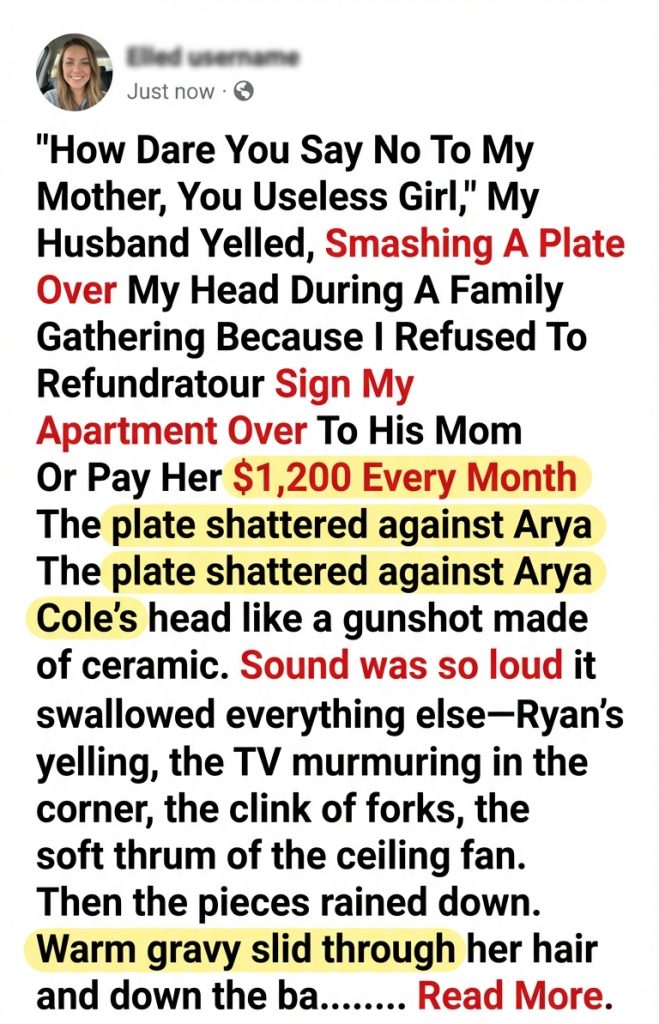
“How Dare You Say No To My Mother, You Useless Girl,” My Husband Yelled, Smashing A Plate Over My Head During A Family Gathering Because I Refused To Sign My Apartment Over To His Mom Or Pay Her $1,200 Every Month
The plate shattered against Arya Cole’s head like a gunshot made of ceramic.
For a fraction of a second, the sound was so loud it swallowed everything else—Ryan’s yelling, the TV murmuring in the corner, the clink of forks, the soft thrum of the ceiling fan. Then the pieces rained down. Warm gravy slid through her hair and down the back of her neck. A sliver of white porcelain caught at her scalp, not deep, but sharp enough to sting and remind her that this wasn’t an accident. It was a message.
How dare you say no to my mother, you useless girl.
Ryan stood over her, chest heaving, a man performing rage as if he believed fury was a kind of leadership. His face was red, his jaw clenched so tight Arya could see the tendon in his neck jump with every breath. He didn’t look ashamed. He looked entitled. Like the world had wronged him by refusing to obey.
Arya’s chair scraped as she rose slowly. The scrape sounded indecently calm.
Across the table, Eleanor—Ryan’s mother—lifted a hand to her throat, pearls pressed between two fingers as if she were auditioning for a tragedy. But her eyes were bright, hungry. Not worried. Not horrified. Interested.
On the couch, Ryan’s sister, Paige, tilted her phone just enough to keep the camera trained on Arya’s face. Her mouth curled into a little smile, the kind people wore when they loved the idea of another person’s humiliation more than they loved being decent.
The cousins and aunts and whoever else Ryan called “family” sat frozen, staring at their plates like their potatoes might offer moral guidance. No one stood. No one asked if Arya was okay. Nobody reached for a towel. Arya’s parents weren’t there. Ryan hadn’t allowed them to come. He’d called them “a bad influence” the way abusers called outside love a threat.
Arya lifted her hand to her hair and felt the shard.
Her fingers closed around it. She pulled it free and set it on the table.
A little white piece. A small thing. But the movement made the room hold its breath.
Arya wiped her shoulder with the back of her hand, smearing gravy across fabric that Eleanor had picked out for her because Eleanor liked to choose what Arya wore. Then Arya looked directly at Ryan, her eyes steady, her voice low enough that it forced everyone to listen.
“You have no idea what I’m capable of,” she said.
Ryan blinked like the words didn’t fit the version of her he’d built.
He’d married the polite wife. The woman who smiled for photos and asked how everyone’s day had been. The woman who cooked and cleaned and paid the bills while being called ungrateful. The woman who swallowed insults because she believed patience was love.
The woman who let his mother call her apartment a family asset.
Arya’s apartment. The one she’d bought before Ryan existed in her life, with double shifts and cheap dinners and no help from anyone. The last thing she owned that felt like herself.
Ryan took a step closer, as if proximity could make him powerful again. “Sit down,” he snapped. “Sign the transfer papers. You embarrassed my family.”
Eleanor leaned forward, voice bright and cutting. “Oh, please. Arya, don’t act dramatic. Ryan barely touched you.”
Paige giggled softly, like this was a show she’d paid for.
Arya glanced down at the table. The transfer papers were already there, slid under a pen like it was normal to demand someone sign their property away between bites of roast chicken. An envelope with a sticky note in Eleanor’s handwriting: monthly support—$1,200.
Eleanor wanted the apartment transferred to her name and a monthly payment on top of it, as if Arya’s life was a faucet they could keep turning until the water stopped.
Arya lifted her eyes. “No,” she said simply.
Ryan’s hand shot out, grabbing her wrist. His grip was familiar. Too familiar. He squeezed like he was trying to remind her who he thought she belonged to.
“You think you’re brave now?” he hissed. “Tomorrow morning you’ll apologize.”
Arya didn’t yank away—not because she couldn’t, but because she refused to give him the satisfaction of seeing her panic. She let the room see his hand on her skin. She let the room see what control looked like when it had nowhere left to hide.
In that tight circle of silence, she noticed details she’d never let herself name before: the way Eleanor’s mouth barely twitched upward, the way Paige’s camera angle adjusted to catch every tremor, the way the relatives kept their eyes down like obedience was a family tradition.
Arya’s scalp burned. Gravy cooled against her neck. And still, what hurt most wasn’t the sting—it was the certainty that if she signed, she’d disappear. Not physically. Slowly. Legally. Financially. Emotionally. Piece by piece, like that plate.
She’d heard Eleanor’s “plans” before, dressed up as advice. A wife should contribute. A son shouldn’t have to struggle. Family helps family. But it always meant Arya giving, and them taking, and Ryan calling it love.
The apartment had been Arya’s proof that she existed outside of them. She’d bought it with overtime and sacrifice, carrying boxes up stairs alone, painting the bedroom herself, sleeping on the floor the first night because she couldn’t afford a bed yet. It wasn’t just property. It was her spine.
Ryan tightened his fingers. “Sign,” he said again, quieter now, as if lowering his voice made the demand more reasonable.
Arya turned her wrist slightly, not fighting—just shifting—until the overhead light caught the smear of gravy on her dress, caught the red spot beginning at her hairline, caught the porcelain shard sitting on the table like evidence.
Then she did something that didn’t feel cinematic in the moment. It felt small. Practical. Final.
She lifted her free hand and reached into her pocket for her phone.
Paige’s smile widened, thinking Arya was about to beg, about to call someone who wouldn’t come. Eleanor leaned back like a queen watching a servant break.
Arya didn’t beg.
She pressed one button, then another. Her thumb moved with the calm of a woman who had already decided she was done negotiating for her own safety.
When the dispatcher answered, Arya kept her voice steady on purpose—because she wanted the recording to sound like truth, not hysteria. “I need police at this address,” she said. “I’ve been assaulted.”
Ryan froze. Not because he suddenly felt remorse, but because authority—real authority—was the one thing he couldn’t bully with a glare.
Eleanor’s eyes sharpened. “Arya,” she warned, syrupy and cold, “don’t make a scene.”
Arya looked at her, gravy and all, and thought: You already did. You just expected Arya to play the part of the woman who accepts it.
Ryan released her wrist like it burned him. He took one step back, then another, and his face shifted into that public mask—the one he used outside the home. “She’s exaggerating,” he said quickly, turning to the room as if gathering witnesses. “It was an accident.”
But accidents don’t come with transfer papers.
Accidents don’t come with a sticky note that says monthly support—$1,200.
Accidents don’t come with a room full of people trained to stare at their plates while a woman bleeds.
When the officers arrived, the house suddenly became polite. Everyone spoke in careful tones. Eleanor’s hands fluttered. Paige lowered her phone as if it had never been up. Ryan tried to stand tall, tried to look like the wounded party.
Arya didn’t raise her voice. She didn’t scream. She simply told the truth in complete sentences, and she pointed to the table.
She showed them the shard. She showed them the smear of gravy and the red line at her scalp. She showed them the transfer papers and the pen.
One officer asked quietly, “Is this your apartment?” Arya nodded. “Yes. It’s mine.”
“Did you agree to transfer it?” He gestured to the document.
Arya looked Ryan dead in the face and said, “No.”
That single word sounded different with a badge in the room. It sounded like a door locking from the inside.
Paramedics checked Arya’s head. The cut was small, but the message wasn’t. The officer’s pen scratched across a notepad. He asked Ryan to step aside. He asked Eleanor to stop interrupting. He asked Paige to put her phone away.
For the first time all night, Ryan looked uncertain—not guilty, not sorry, just uncertain. Because uncertainty is what happens when control doesn’t work.
Arya’s hands shook later, after the adrenaline dropped. They shook when she signed a statement. They shook when she rode to the station to answer questions. They shook when she finally sat alone in her car and realized she had crossed a line he never wanted her to cross: she had told someone.
Abusers hate witnesses. They hate records. They hate paper trails. They hate a woman who stops handling it “privately.”
By morning, Ryan was calling. Apologizing the way men like him apologize—half apology, half threat. By afternoon, Eleanor was texting paragraphs about forgiveness and family and how Arya was “ruining everything.”
Arya saved every message.
Then she called her parents—the ones Ryan said were a “bad influence”—and when her mother heard what happened, her mother didn’t ask what Arya did to “set him off.” She didn’t ask why Arya stayed so long. She said, “Come home. Right now.” The kind of love that doesn’t negotiate.
Legal steps came next, not dramatic, but powerful in their own way: a restraining order request, a call to the bank, a password reset, a safety plan. Arya changed the locks on her apartment. She updated her will. She moved her important documents to a safe place. She told her boss. She told a friend. She built a circle, brick by brick, around the life Ryan tried to claim.
And when Ryan showed up at her door days later—flowers in one hand, anger in the other—Arya didn’t open it. She spoke through the door. She told him to leave. She told him she would call the police again. She told him he no longer got access to her simply because he felt entitled to it.
The silence on the other side of the door was the sweetest sound she’d heard in years.
In the weeks that followed, the shame tried to crawl back in, the old poison whispering that Arya had embarrassed herself, that she had made the family look bad, that she should’ve stayed quiet.
But then she’d touch the healed place on her scalp and remember: the embarrassment belonged to the people who watched and did nothing.
Arya didn’t win by humiliating them back. She won by refusing to hand over her life.
She kept her apartment. She kept her name on the deed. She kept her money in her own accounts. She kept every piece of evidence. And the next time she sat at a table with food and candles, it wasn’t to be trapped.
It was to breathe.
Because the moment she said “No,” and meant it, the story stopped being about what they demanded—and became about what she reclaimed.