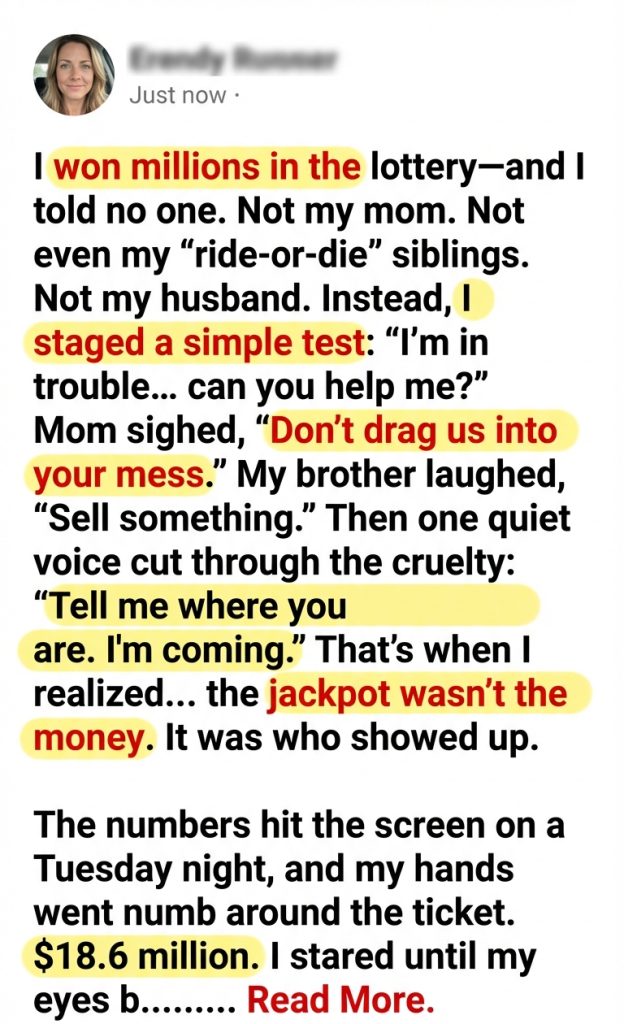
I won millions in the lottery—and I told no one. Not my mom. Not even my “ride-or-die” siblings. Not my husband. Instead, I staged a simple test: “I’m in trouble… can you help me?” Mom sighed, “Don’t drag us into your mess.” My brother laughed, “Sell something.” Then one quiet voice cut through the cruelty: “Tell me where you are. I’m coming.” That’s when I realized… the jackpot wasn’t the money. It was who showed up.
The numbers hit the screen on a Tuesday night, and my hands went numb around the ticket. $18.6 million. I stared until my eyes burned, then locked myself in the bathroom and whispered, “Don’t tell anyone, Claire. Not yet.” In my family, money didn’t just change people—it revealed them.
I’d spent my whole life being the reliable one. The one who loaned gas money, covered late rent, paid for my mom’s prescriptions “just this once.” My husband, Ryan, loved calling me “practical,” which was his polite way of saying easy to lean on. My older brother, Derek, called me “soft.” My sister, Megan, only texted when she needed something.
So I decided on a test. Not cruel. Just clear.
The next morning, I sent a group text: Emergency. I’m short on a payment. I need help—today.
Within minutes, my mom, Linda, called. I put on my best shaky voice. “Mom, I’m really scared. I can’t cover it.”
She didn’t ask if I was okay. She asked, “What did you do now?” When I tried to explain, she exhaled dramatically. “Claire, I can’t keep bailing you out. Figure it out. Maybe Ryan can pick up more hours.”
I thanked her anyway, because that’s what daughters like me were trained to do.
Ryan came home for lunch. I sat at the kitchen table with a blank envelope and a fake overdue notice I printed online. “Babe, I’m behind,” I said quietly. “Could you help me this month?”
He scanned the paper and frowned like it offended him. “Seriously? You handle the bills. That’s your thing. Don’t dump stress on me.” Then he added, “Ask your mom. Or your brother. Someone.”
Derek texted back: Sell your car. Stop being dramatic. Megan sent a single emoji—and nothing else.
By late afternoon, my chest felt tight, not because I needed money, but because I’d finally seen the truth in plain daylight: I wasn’t family to them. I was a resource.
I sat alone in the parking lot of a grocery store, pretending I was stranded. The sun was dropping and my phone buzzed again.
A new message appeared—Ethan. My younger cousin, the one everyone forgot at Thanksgiving.
Where are you? he wrote. Don’t explain. Just tell me. I’m coming.
I typed the location. Two minutes later, he called.
“Claire,” he said, breathless, “stay in your car. I’m five minutes away.”
And for the first time that day, I actually believed someone.
Then I looked up—and saw Ryan’s truck turning into the same parking lot, creeping down the row like he was hunting for me…
He parked two spaces away, engine still running. For a second he just sat there, staring at my car like he was deciding which version of himself to perform. Then he got out and walked over with his phone in his hand and irritation on his face, not concern.
“Why are you out here?” he demanded, tapping my window with one knuckle. “Mom called me. She said you’re having another episode.”
Another episode. Like needing help was a personality flaw.
I cracked the window just enough to speak. “I’m handling it,” I said.
Ryan leaned closer, voice sharp. “No, you’re not. You’re making it everyone’s problem. You know Derek thinks you’re being dramatic.”
I stared at him and felt something settle inside my chest—cold, clean clarity. He hadn’t come to help. He’d come to manage the narrative.
“I didn’t ask you to come,” I said.
He scoffed. “Well, someone has to. You can’t just sit in parking lots like a teenager. We have responsibilities.”
We. The word almost made me laugh.
Ryan’s eyes flicked toward my passenger seat, like he expected to see evidence of my “mess.” “Where’s the overdue notice?” he asked, already reaching for the door handle.
I locked the doors with a soft click.
His face tightened. “Seriously?”
Before he could say more, a compact sedan turned into the lot too fast and braked beside my car. Ethan jumped out, hair windblown, breathing hard like he’d sprinted from the driver’s seat. He didn’t look at Ryan first. He looked at me.
“Are you okay?” he asked, voice low.
I nodded once, throat tight.
Ethan turned to Ryan like Ryan was a stranger in the way. “Who are you?” he asked.
Ryan blinked, offended. “I’m her husband.”
Ethan’s expression didn’t change. “Then why are you standing here yelling at her?” he asked calmly.
Ryan’s mouth opened, then closed. He wasn’t used to being questioned by someone he considered background family.
I unlocked the door and stepped out, feeling unsteady on my feet but steady in my decision. Ethan moved slightly closer—not crowding me, just positioning himself like a shield without making a show of it.
“I’m fine,” I said quietly. “I needed someone to show up.”
Ryan’s eyes narrowed. “So you called him?” he snapped, jerking his chin at Ethan. “This is what you do? You embarrass me in public?”
Ethan glanced at me. “Do you want to leave?” he asked, ignoring Ryan completely.
“Yes,” I said.
Ryan stepped forward. “No. We’re going home. Get in the truck.”
I looked at him and realized something that made my stomach go calm: he thought he had authority because I’d spent years acting like he did.
I didn’t raise my voice. “I’m not going anywhere with you,” I said.
Ryan’s face flushed. “You’re being ridiculous.”
Ethan opened his car door. “Claire, you can ride with me,” he said. “I’ll take you wherever you want.”
Ryan stared, stunned, like the world had broken a rule.
I got into Ethan’s car.
Ryan shouted something behind us—my name, then an insult, then “You’ll regret this!”—the classic lines men use when they think fear is a leash. Ethan didn’t react. He just drove.
For a few minutes we rode in silence, the city lights starting to flicker on, the sky turning that bruised purple that makes everything feel cinematic even when your life is falling apart.
Finally Ethan said softly, “Do you want to tell me what’s happening?”
I stared out the window, my reflection faint in the glass. “I ran a test,” I admitted. “I needed to know who I could trust.”
Ethan’s hands tightened on the wheel. “And you found out.”
I nodded. My voice came out smaller than I wanted. “I thought I was being smart by not telling anyone about the lottery,” I whispered. “But I didn’t realize… I’d been living like this even before the money. Always proving I deserved basic care.”
Ethan’s jaw clenched. “You don’t have to prove anything to me,” he said.
When we reached my apartment, Ethan walked me to the door and waited while I locked it behind me. “Do you want me to stay nearby?” he asked.
“I don’t want to drag you into my mess,” I said automatically—my mother’s phrase coming out of my mouth like a curse.
Ethan shook his head once. “It’s not your mess,” he said. “It’s your life.”
I swallowed hard. “Okay,” I whispered. “Stay.”
That night, Ryan texted me twelve times. The first few were angry. Then apologetic. Then angry again. Then manipulative: You’re unstable. Don’t make me call your mom. Like my mother was a threat he could wield.
I didn’t reply.
Instead, I opened a new note on my phone and wrote: Lawyer. Separate accounts. Safety plan.
Then I opened a lockbox and took out my lottery ticket—still folded like a secret that had weight. I stared at the numbers again, and for the first time, I didn’t feel dizzy. I felt determined.
The next morning, I went to the lottery office alone. I wore sunglasses and a plain hoodie. I spoke softly, signed forms, and listened carefully to the security rules. It wasn’t glamorous. It was procedural. That’s how life-changing things often are.
After I finished, I sat in my car and called Ethan.
“Can you meet me?” I asked.
He didn’t ask why. He just said, “Where?”
When I told him, he arrived in ten minutes with two coffees and a paper bag of muffins, like he’d decided ordinary kindness was the best antidote to yesterday.
I took a breath. “I won,” I said quietly.
Ethan blinked. “Won what?”
“The lottery,” I said. “Eighteen point six million.”
His eyes widened, but his face didn’t change into greed. It changed into concern. “Claire,” he said softly, “are you safe?”
That question almost broke me.
I nodded. “I’m safe,” I said. “But I needed you to know because… you’re the only one who showed up.”
Ethan let out a slow breath and looked down at his coffee like he was grounding himself. “Then we do this smart,” he said. “We protect you.”
Over the next week, I did exactly that.
I hired an attorney. A financial advisor. A security consultant who taught me how to keep my address off public records. I opened new accounts under a trust. I set aside money for my kids’ futures—college funds, emergency funds, therapy if they ever needed it.
And then I did the hardest part: I stopped paying for people who treated me like a bank.
When my mother called again, her voice suddenly soft—“Honey, I’ve been thinking… maybe we were too harsh”—I listened without reacting. She didn’t know about the money yet. She was just sensing my distance, sensing that her old control wasn’t working.
“I’m okay,” I said. “I’m handling it.”
Derek texted later: Heard you were freaking out. Need me to talk to Ryan? Like he was offering heroism after offering nothing.
Megan sent: U good?—three letters, minimal effort.
I didn’t answer any of them right away.
I answered Ryan first.
I met him in a café with my attorney’s number saved in my favorites and Ethan waiting in the parking lot. Ryan walked in acting charming, like yesterday hadn’t happened.
“I’m sorry,” he said quickly. “I was stressed.”
“I’m done,” I replied calmly.
Ryan’s smile faltered. “Done with what?”
“With being spoken to like I’m less,” I said. “With being used. With a marriage where ‘support’ is a one-way street.”
He scoffed. “You’re overreacting.”
I slid divorce papers across the table—prepared, clean, professional. His eyes widened.
“You’re serious?” he demanded.
“Yes,” I said. “And you’re going to be civil, because I have every message you sent, and I’m not negotiating my safety.”
Ryan stared at the papers like they were written in a language he didn’t understand. Then he looked up at me, and for the first time, he looked afraid—not of losing me, but of losing control.
I stood up. “Goodbye, Ryan,” I said. “I hope you find someone on your level.”
Outside, the air felt lighter.
A month later, I hosted a small dinner—not a test this time, but a thank-you. I invited Ethan. Just Ethan. We ate takeout at my kitchen table, laughing quietly about how my family used to forget his name.
“You know what’s wild?” I said, smiling. “I thought the money would be the miracle.”
Ethan shook his head gently. “The miracle is you finally seeing your worth,” he said. “Even without it.”
And that’s when I understood the real ending of my story:
The jackpot wasn’t what I won on Tuesday night.
It was who showed up on Wednesday afternoon—without conditions, without judgment, without asking what it would cost.