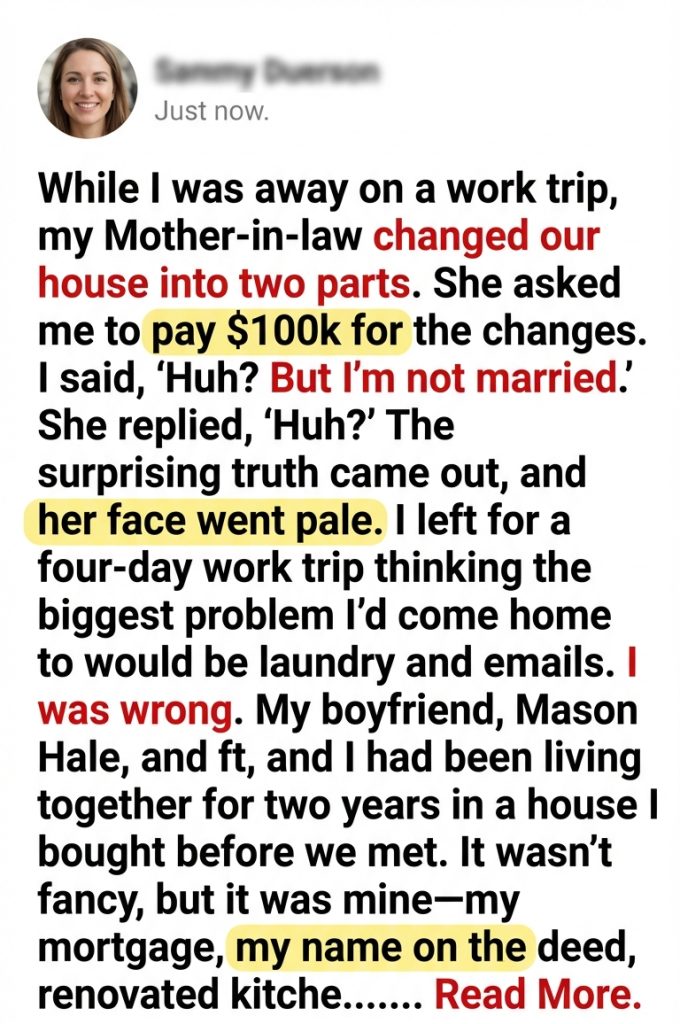
While I was away on a work trip, my Mother-in-law changed our house into two parts. She asked me to pay $100k for the changes. I said, ‘Huh? But I’m not married.’ She replied, ‘Huh?’ The surprising truth came out, and her face went pale.
I left for a four-day work trip thinking the biggest problem I’d come home to would be laundry and emails.
I was wrong.
My boyfriend, Mason Hale, and I had been living together for two years in a house I bought before we met. It wasn’t fancy, but it was mine—my mortgage, my name on the deed, my renovated kitchen I’d saved up for piece by piece. Mason paid utilities and groceries. We had a routine that worked.
His mother, Linda, never liked that arrangement.
She called my house “temporary,” like it was a waiting room for the life she wanted her son to have. Every time she visited, she’d comment on “space” and “privacy” and how “a man needs his own wing.” I assumed it was just her controlling personality.
Then I went to Denver for work.
On the second day, Mason texted: “Mom’s helping with a small improvement. Don’t freak out.”
I stared at the message and typed back: “What improvement?” He replied with a laughing emoji and, “You’ll see.”
When I got home, I didn’t even recognize my own entryway.
A brand-new wall had been built down the center of the living room. The hallway had been turned into a narrow passage. My dining area was cut in half. There were two separate doors where there used to be one open space, each with its own lock. It looked like someone had tried to turn my home into two rental units overnight.
I dropped my suitcase. “Mason… what is this?”
He walked in behind me, chewing gum, acting like he’d just repainted a bedroom. “Mom had a great idea,” he said. “Now we can have ‘our side’ and ‘her side’ when she stays. It’s more organized.”
“More organized?” I touched the fresh drywall like it might disappear. “You built a wall in my house.”
Linda appeared from what used to be my office, smiling proudly. “Surprise! Isn’t it smart? Two sections. One for you two, one for… family.”
My stomach tightened. “You did this while I was gone?”
Linda waved a hand. “It’s an upgrade. Contractors are expensive, though. We kept it reasonable.”
Mason nodded along like a trained assistant. “It’s a big improvement. You’ll thank us.”
I looked at the new doors. The locks. The way my home suddenly felt like territory being divided. “How much did this cost?”
Linda pulled out an envelope as if she’d been waiting for that exact question. “A hundred thousand. You can write a check or do a transfer. Mason said you’d be responsible since it’s your property.”
I actually laughed—one sharp sound that surprised even me. “Huh? Why would I pay you a hundred thousand?”
Mason’s smile faltered. “Because… we improved it,” he said, like it was obvious. “And Mom fronted the contractors.”
Linda’s eyes glittered with triumph. “You’re welcome,” she said. “Most women would be grateful.”
I stared at her. My hands were cold, but my mind was suddenly clear in a way it hadn’t been in days. “Linda,” I said slowly, “you’re not my mother-in-law.”
She blinked once, confused. “Excuse me?”
“I said,” I repeated, voice calm, “you’re not my mother-in-law. Mason and I aren’t married.”
Linda’s mouth tightened. “So? You live together.”
“That’s not how legal relationships work,” I replied. I turned to Mason. “Did you tell her we were married?”
Mason’s eyes flicked away. “I—no—”
Linda laughed sharply, impatient. “Don’t play word games,” she snapped. “This house is for my son’s future. You’re just being difficult because you don’t like sharing.”
Sharing. The word made me look at the locks again, at the new doors, at the clean cut down the center of my living room. This wasn’t sharing. This was claiming.
I took a slow breath, then asked the question I should have asked the moment that first “small improvement” text came in.
“Who signed the contractor agreement?” I said.
Linda’s smile wavered. “We handled it.”
“That’s not an answer,” I replied. “Whose name is on the contract?”
Mason shifted his weight. “Mine,” he mumbled.
My stomach dropped. “You signed a $100,000 contract… on a house you don’t own… while I was out of town?”
Linda lifted her chin. “He lives here. He has rights.”
“No,” I said, and my voice didn’t shake. “He has permission. There’s a difference.”
Linda’s eyes narrowed. “So you’re refusing to pay.”
“I’m refusing to be extorted,” I corrected.
Mason’s tone turned defensive. “It’s not extortion. It’s improvements. And Mom did it for us.”
“For you,” I said, meeting his eyes. “You mean for you.”
Linda stepped closer, lowering her voice as if intimidation was more effective when quiet. “Listen,” she said, “my son has invested years here. If you think you can just throw him out, you’re mistaken. We have documentation.”
That word—documentation—hit like a bell. Because I suddenly remembered something odd from months ago: Mason asking for copies of the deed “for insurance,” Mason taking pictures of my signature “for the HOA,” Linda asking what county the house was recorded in like she was making casual conversation.
My chest tightened. “What documentation?” I asked.
Linda didn’t answer directly. Instead, she reached into her purse and pulled out a folded sheet of paper—creased like it had been handled many times, like a talisman. She slapped it onto the counter.
At the top, in bold letters, I saw the words: Residential Lease Agreement.
My name was printed on it.
So was Mason’s.
And below, a signature that looked like mine—almost.
Almost.
My skin went cold. “Where did you get this?” I asked softly.
Mason’s face went gray. “It’s… nothing,” he said quickly. “Mom just printed it. It’s—”
“It’s fraud,” I cut in.
Linda’s smile reappeared, brittle. “It’s protection,” she said. “A man should have protection. You could kick him out tomorrow.”
“I could,” I said. “But I didn’t. Because I trusted you both.”
Mason raised his voice. “You’re overreacting!”
I looked at the lease again—my name, my “signature,” the dates. It claimed I’d rented out part of my own house to Mason and Linda for a set term, with rights to “modify living areas for household use.”
I lifted my eyes slowly. “Linda,” I said, “did you forge my signature?”
Her mouth opened, then closed. She glanced at Mason, and in that glance I saw it: the little reflex of people who lie together—checking if the other one will hold the line.
Mason didn’t. He looked away.
Linda’s face went pale.
It was subtle at first, like the blood just stepped back from the surface. Then it drained more, leaving her makeup looking like a mask that didn’t fit.
Because she realized she’d crossed from “rude” into “criminal.”
I picked up my phone and said, still calm, “You have ten minutes to tell me the truth before I call the police.”
Mason lunged forward. “Don’t do that,” he hissed.
I stepped back, keeping distance. “Then start talking,” I said.
Linda’s voice turned sharp with panic. “You can’t prove anything,” she snapped, but it sounded weaker now.
I tilted my head. “Actually, I can,” I said. “Because my deed is recorded, my signature is on file in multiple places, and the contractors are licensed and traceable. Also—” I gestured to the drywall. “You altered a structure you didn’t own. That’s not a family dispute. That’s vandalism.”
Mason’s eyes widened. “Vandalism?”
“Yes,” I said, and my voice stayed steady because the truth steadies you when fear doesn’t. “And if you forged documents, that’s another charge.”
Linda swallowed hard. “We didn’t forge—”
Mason finally blurted, “She did it!” His voice cracked. “Mom said it was fine because we’re basically married, and she said if you ever tried to leave me, I’d be protected.”
The room went silent.
Linda’s eyes flashed toward him, furious. “Mason!”
He looked like a man waking up mid-disaster. “You told me to sign the contractor thing,” he said, voice shaking. “You told me it was ‘our house’ now.”
I stared at him. “And you believed that?” I asked quietly.
His eyes filled. “I didn’t think you’d… I thought we were building something.”
“No,” I said softly. “You were taking something.”
Linda straightened, trying to recover authority. “You’re being dramatic,” she snapped. “We’re family.”
I laughed once, humorless. “Again,” I said, “we are not.”
Then I did the first real thing a person does when they decide to stop negotiating with disrespect: I took control of my space.
I walked to the hallway, turned the deadbolt on the door that now separated “sides,” and said, “Both of you—out.”
Mason’s voice rose. “You can’t just—”
“Yes,” I replied, “I can. This is my home.”
Linda stepped forward like she might argue physically. But then she saw me open my phone and start recording—steady hands, steady voice.
“This is my property,” I said into the camera. “I left for work and returned to find unauthorized construction, forged documents, and a demand for $100,000.”
Linda’s confidence collapsed further. She didn’t want evidence. People like her thrive in private pressure, not public record.
“Stop filming,” she snapped.
“No,” I said.
Ten minutes later, they were gone. Mason left first, face tight, carrying a backpack like a teenager being sent to the principal’s office. Linda lingered at the door, eyes bright with anger, then hissed, “You’ll regret this.”
I didn’t answer.
That night, I stayed in my house—my real house, the one still under my name—while my attorney friend reviewed the fake lease and confirmed what I already knew: it was fraud, and it was sloppy enough to be proven.
The next morning, the contractors returned—this time hired by me—to remove the wall. I documented every invoice, every signature, every conversation.
Mason texted apologies. Linda texted threats. I didn’t argue with either of them.
I sent one message back to Mason:
You don’t get to pretend we were married when it benefits you. We’re done.
And the surprising truth that came out—the one that turned Linda pale—wasn’t just that I wasn’t married.
It was that she had built her entire plan on the assumption that I would be too polite to call it what it was.
A crime.
People like Linda confuse kindness with weakness. They mistake silence for consent. They think “family” is a magic word that erases boundaries.
But my name was on that deed.
My signature was my own.
And for the first time in a long time, the house felt like mine again—not because of drywall, but because of the one thing I finally reclaimed:
My authority.