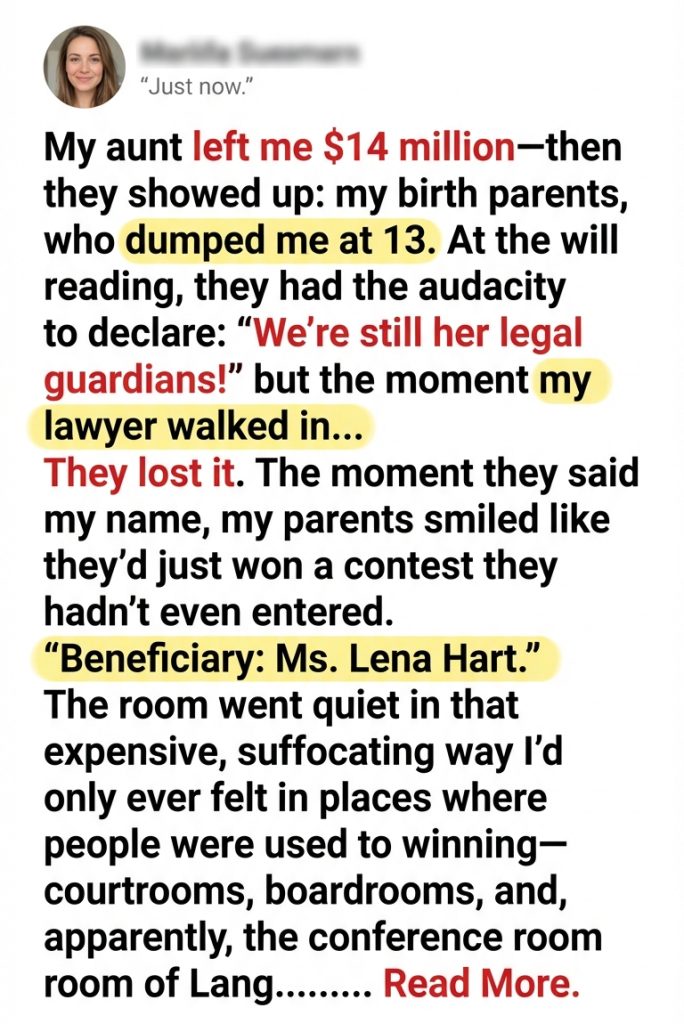
My aunt left me $14 million—then they showed up: my birth parents, who dumped me at 13. At the will reading, they had the audacity to declare: “We’re still her legal guardians!” but the moment my lawyer walked in… They lost it
The moment they said my name, my parents smiled like they’d just won a contest they hadn’t even entered.
“Beneficiary: Ms. Lena Hart.”
The room went quiet in that expensive, suffocating way I’d only ever felt in places where people were used to winning—courtrooms, boardrooms, and, apparently, the conference room of Langford & Price, Attorneys at Law.
The chairs were overstuffed leather, the table was polished oak long enough to land a plane on, and the air conditioning hummed like it was trying to soothe a room that had no interest in peace.
I could hear my own breathing. Slow. Controlled.
Hands folded in my lap, left thumb resting over right. Aunt Evelyn had corrected that gesture a hundred times when I was a teenager, tapping my fingers with the end of a fountain pen.
“Never fidget,” she’d say. “Composure is a weapon if you know how to use it. People who want something from you are always watching for cracks.”
My parents sat across from me like strangers who knew my face too well. My father had chosen the seat directly opposite mine, as if this were a negotiation and not the last step in closing a life.
He leaned back now, arms crossed, his shirt a little too tight at the buttons. His hairline had retreated since I’d last seen him, but the entitlement in his posture was unchanged.
Beside him, my mother perched on the edge of her chair, knees angled toward him, fingers clenched around a designer handbag that still had a plastic tag looped on the inside. Her perfume hit first—cheap florals layered over something sourer. Desperation has a smell if you’ve lived with it long enough.
They hadn’t seen me in twelve years.
Not since the night they left my suitcase on the porch.
Not since the night my father had stood in the kitchen, listing my failures like expenses he was tired of covering.
“You’re a problem, Lena,” he’d said, thumb pressing against the countertop with each word. “Your grades, your attitude, your… everything. You argue with teachers. You mouth off at me. You’re always ‘anxious’ or ‘sad’ or ‘struggling’.”
He’d said those words like they were offensive. Like my brain chemistry was an insult to his image.
My mother had stood at the sink, hands in soapy water, staring at a point somewhere on the backsplash. She didn’t say anything. Didn’t turn around. Didn’t flinch when he said, “We’re done.”
The suitcase had appeared two hours later. Half-packed with clothes I hadn’t chosen, none of my books, none of the small things I cared about. Just enough to say they’d tried.
I remember standing on the porch in the dark, gripping the handle until my knuckles hurt, watching the light in the kitchen window. My mother’s silhouette moved once—just once—like she might come out and stop it. She didn’t.
Aunt Evelyn arrived before midnight.
She stepped out of her car in a long coat, hair pinned back, face hard in the way it gets when kindness has been forced into action. She didn’t knock. She opened my parents’ front door like she’d paid for it, walked straight into their kitchen, and said, “Where is she?”
My father tried to act offended. “Evelyn, this is none of your—”
Aunt Evelyn’s eyes cut through him. “You don’t get to decide what’s yours,” she said. “Not tonight.”
She took me home with her. Not to rescue me with hugs and soft words—Aunt Evelyn wasn’t built that way—but to rescue me with structure. A spare bedroom. A school transfer. A therapist appointment. A printed schedule taped to the wall like a promise: you will not drift.
She never asked me to forgive them. She didn’t make speeches about family. She just said, one morning over toast, “You will not beg people to love you. You will build a life so solid they can’t shake it.”
And I did.
Aunt Evelyn raised me in a world of rules and quiet luxuries: good books, clean sheets, private tutors, and the kind of conversations where people referenced contracts the way other families referenced sports scores. When I cried, she handed me tissues and asked what the facts were. When I panicked, she taught me to breathe and write lists. When I succeeded, she nodded like it was expected. That was her kind of love: relentless preparation.
She also never hid her money. She taught me where it came from, how it grew, and how quickly it could rot people’s morals.
“Money doesn’t change people,” she’d say. “It reveals them.”
So when I got the call that she’d died, it didn’t feel real. It felt like losing gravity. I sat in my apartment for an hour staring at my phone, waiting for it to buzz again with correction—mistaken identity, false alarm, she’s fine.
No correction came.
The week after her funeral was a blur of black fabric and quiet condolences. People I barely knew hugged me like I was fragile. They asked if I had support. I didn’t know how to answer. Evelyn had been my support system. Without her, everything felt exposed.
Then the summons arrived: formal will reading, mandatory attendance, conference room at Langford & Price.
I showed up early. I dressed in navy. I sat with my hands folded the way Evelyn had taught me. I didn’t want to cry in front of strangers.
Then my parents walked in.
My father looked around like he belonged. My mother’s eyes scanned the room, hungry. They didn’t hesitate. They didn’t look ashamed. They looked… confident.
My father sat across from me and smiled like we were catching up after a long weekend, not twelve years of silence.
My mother leaned forward and whispered, “Hi, sweetie.”
Sweetie.
The word almost made me laugh out loud. It was so wrong it sounded rehearsed.
Before I could respond, the attorney, Mr. Langford, cleared his throat and began reading the basics—estate details, legal formalities, confirmations of sound mind and witness signatures.
Then he said the sentence that made my parents’ posture change.
“Beneficiary: Ms. Lena Hart.”
My father’s smile widened. My mother’s eyes shone. It was like watching people smell food after starving—except they hadn’t been starving. They had just been waiting for someone else to feed them.
My father stood abruptly. “We’d like to make something clear,” he said, voice loud and confident. “We are still her legal guardians.”
The room went still.
Mr. Langford blinked. “Sir, Ms. Hart is twenty-five.”
My father’s smile didn’t falter. “And we never signed anything,” he said. “We never legally relinquished custody. We allowed her to stay with Evelyn temporarily. So if there’s an inheritance, it belongs under our control.”
My mother nodded vigorously, clutching her purse like it contained her dignity. “We’re her parents,” she said. “We never stopped being family.”
I stared at them, and for the first time in years I felt fourteen again—standing on a porch with a suitcase, trying not to cry because crying had never softened them.
I opened my mouth, but Mr. Langford held up a hand gently. “Ms. Hart,” he said, “do you have counsel present?”
“Yes,” I replied calmly.
My father scoffed. “Counsel?” he repeated. “For what? We’re not enemies.”
My phone buzzed once. A text message, short and simple:
In the lobby. Walking up now.
I didn’t look away from my father. “You’ve been my enemies since I was thirteen,” I said quietly.
My mother’s face tightened. “How dare you—”
The door opened.
My lawyer stepped in.
Dana Fletcher—tall, composed, hair in a neat twist, carrying a slim black folder like it was a weapon she didn’t have to swing. She didn’t smile at my parents. She didn’t greet them. She walked straight to my side and placed the folder on the table with a soft, final tap.
“Good morning,” she said to Mr. Langford. Then she turned her eyes to my father. “I’m counsel for Ms. Hart.”
My father’s confidence wavered slightly. “We’re her guardians,” he repeated, louder, as if volume could make it true.
Dana opened the folder. “No,” she said calmly. “You’re not.”
She slid one document across the table—stamped, certified, undeniable.
Termination of Parental Rights — Court Order.
My mother made a sound like air being punched out of her.
My father’s face went pale. “That’s—” he stammered. “That’s not possible.”
Dana’s voice stayed even. “It is possible,” she said. “Because your sister, Evelyn Hart, pursued legal guardianship after you abandoned a minor. She documented your neglect. She petitioned the court. You were served. You failed to appear. The court ruled.”
Mr. Langford adjusted his glasses, reading. “This… appears valid.”
My father stood up so fast his chair scraped. “We never got anything!”
Dana didn’t blink. “We have proof of service,” she said, and slid another paper forward. “And proof you cashed the certified mail refund checks.”
My mother’s hands began shaking. “We—we were in a hard place,” she whispered.
Dana’s tone hardened slightly. “A hard place does not excuse abandoning a child,” she said. “Nor does it create a claim on her assets.”
My father’s voice rose into anger. “She’s ours!”
I felt my spine straighten. “No,” I said, and my voice surprised me with its steadiness. “I’m mine.”
The room held its breath.
Mr. Langford cleared his throat again, visibly rattled now—not by emotion, but by the sudden legal clarity. “Thank you,” he said to Dana. Then he looked at my parents. “Given this documentation, you have no standing as guardians.”
My father’s face twisted. “Then we contest,” he snapped.
Dana nodded once, like she’d expected that. “You can attempt to contest,” she said. “But you will be responsible for legal fees, and you will lose. Additionally, Ms. Hart has grounds for a restraining order given your intimidation today.”
My mother started crying—not soft, genuine grief tears, but loud, performative tears meant to recruit sympathy. “Lena, please,” she pleaded. “We’re still your parents.”
I looked at her and felt something I didn’t expect: nothing. Not hatred. Not warmth. Just distance.
“You’re my birth parents,” I said quietly. “That’s all.”
Mr. Langford continued reading the will. Donations. Properties. Trust structures. Then the number landed in the room like a weight.
“Fourteen million dollars,” he said, “to be held in trust with immediate access provisions for Ms. Hart.”
My father’s jaw trembled. My mother stopped crying mid-sob.
Dana leaned close to me and whispered, “Stay composed.”
I nodded, because Aunt Evelyn’s lessons were sitting in my bones.
When the meeting ended, my parents tried one last move—stepping in front of the door as I stood.
“We can fix this,” my father said, voice low. “We can be a family again.”
Dana stepped between us. “Do not approach my client,” she said calmly.
My mother’s face twisted. “She owes us!”
I looked her in the eye. “I owed you nothing at thirteen,” I said softly. “I owe you less now.”
Then I walked out of that conference room without shaking.
Outside, in the hallway, I finally exhaled. My hands trembled—not from fear, but from the aftershock of standing in front of the people who once made me feel disposable and realizing they could no longer touch my life.
Dana squeezed my shoulder once. “Your aunt protected you,” she said.
I swallowed hard. “She did,” I whispered. “Even after she was gone.”
And as we stepped into the sunlight outside Langford & Price, I understood Aunt Evelyn’s final gift wasn’t the money.
It was the fact that the people who abandoned me would never be able to claim me again.