Some betrayals don’t start with shouting. They start with routines—soft lights, warm water, a voice that sounds like safety. And then one night, you see the routine from the wrong angle, and it becomes something else entirely.
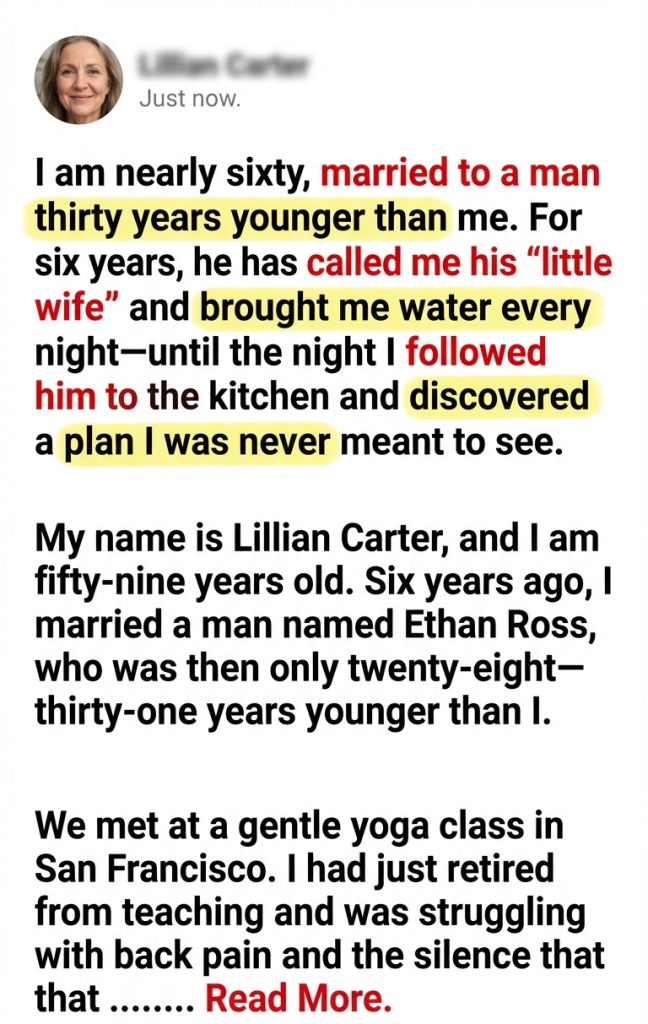
I am nearly sixty, married to a man thirty years younger than me. For six years, he has called me his “little wife” and brought me water every night—until the night I followed him to the kitchen and discovered a plan I was never meant to see.
My name is Lillian Carter, and I am fifty-nine years old. Six years ago, I married a man named Ethan Ross, who was then only twenty-eight—thirty-one years younger than I.
We met at a gentle yoga class in San Francisco. I had just retired from teaching and was struggling with back pain and the silence that follows the loss of someone you love. Ethan was one of the instructors: kind, patient, with that quiet confidence that could make the whole room breathe more serenely. When he smiled, the world seemed to slow down.
I was warned from the beginning: —”He wants your money, Lillian. You’re lonely. Be careful.”
Yes, I had inherited a comfortable life from my late husband: a five-story townhouse downtown, two savings accounts, and a beachfront villa in Malibu. But Ethan never asked me for money. He cooked, he cleaned, he gave me massages, and he called me his “little wife,” or his “baby,” in a sweet voice.
Every night before bed, he brought me a glass of warm water with honey and chamomile. —”Drink it all, honey,” —he would whisper—. “It helps you sleep. I can’t rest if you don’t sleep.”
So, I drank. For six years, I believed I had found peace: a sweet, constant love that expected nothing in return.
One night, Ethan told me he would stay up late to prepare an “herbal dessert” for his yoga friends. —”You go to sleep first, baby,” —he said, kissing my forehead.
I nodded, turned off the light, and pretended to fall asleep. But something inside me—a stubborn little voice—refused to be quiet. I got up noiselessly and crept down the hallway. From the doorway, I watched Ethan in the kitchen. He was standing by the counter, humming softly. I saw him pour warm water into my usual glass, open a drawer, and take out a small amber vial.
He tilted it—one, two, three drops of a clear liquid—into my glass. Then he added honey, chamomile, and stirred. My entire body froze. When he finished, he picked up the glass and headed up the stairs, toward me.
I backed away so quietly my own heartbeat sounded loud. I returned to bed and lay flat, arranging my face into sleep the way I used to arrange lesson plans—neat, believable, unremarkable. The door creaked. Ethan entered with gentle footsteps, like a man who thought tenderness could erase whatever he’d just done.
“Here you go, honey,” he whispered, placing the glass on my nightstand. The smell was the same as always—sweet and floral, comforting—exactly the kind of scent you trust without thinking. His hand brushed my hair. He kissed my forehead again. Then he waited.
That was new. He lingered near the bed, watching in the dark. Not watching like a husband admiring his wife, but watching like someone waiting for a result. I felt the weight of his gaze on my closed eyelids, and I understood something in my bones: the water was never just water.
I forced my fingers to move lazily, as if I were half-asleep, and I lifted the glass. The warm rim touched my lip. I let a second pass, then lowered it again and breathed out softly, the way people do when they sip something soothing. I didn’t swallow.
Ethan exhaled too, satisfied. “Good,” he murmured, like a nurse praising a patient. Then he climbed into bed and turned his body away from me, his breathing slowing quickly as if his conscience slept easily.
I stayed awake for a long time, staring into darkness, listening to the city’s distant sounds. Six years of honey water. Six years of being called “little wife.” Six years of trusting the most intimate routine in our home. My mind tried to protect me with denial—maybe it’s vitamins, maybe it’s harmless, maybe I’m imagining danger because I’m lonely—but my body didn’t believe the excuses. My body remembered the way he watched me drink.
When I was sure he was asleep, I slipped out of bed and carried the glass into the bathroom. I poured it into an empty travel bottle and hid it in the bottom of my makeup bag behind a compact mirror I never used. Then I rinsed the glass, refilled it with plain warm water, honey, and chamomile, and returned it to my nightstand exactly where it had been.
Back in bed, I held my breath until I heard Ethan stir. He reached for the glass in the dark, fingers tapping the rim, checking—habit, control—then he relaxed and went still again.
In the morning, he woke cheerful, making breakfast like always, humming as if the world was safe. He asked about my plans. He asked if I wanted to walk by the waterfront. He kissed my cheek with the same soft confidence that had once made me feel rescued from grief.
I watched him while he spoke, and every loving gesture suddenly looked like a skill. A technique. A performance he’d perfected through repetition.
“Are you okay?” he asked, noticing my quiet.
“I’m fine,” I lied smoothly. “Just didn’t sleep well.”
He nodded, too quickly. “We’ll fix that tonight,” he said, smiling.
That afternoon, I did the first thing I should have done years ago: I looked at my life like an adult, not like a woman grateful to be loved again. I called my attorney—Karen Soto, the woman who handled my estate planning after my first husband died. Karen answered in her brisk voice, and I felt something steady enter my chest.
“Karen,” I said, keeping my voice controlled, “I need to review my assets and access today. Quietly.”
There was a pause. “What happened?” she asked.
“I’m not sure yet,” I admitted. “But I saw something last night. I need my safety net in place before I ask questions.”
Karen didn’t push for gossip. She just said, “Come in at four. Bring any documents you have.”
At Karen’s office, I signed a stack of forms I hadn’t realized I needed: updated passwords on key accounts, a fresh review of beneficiary designations, a confirmation of property titles. I learned, with a cold clarity that made my palms sweat, that Ethan had been trying to insert himself into my financial life in small ways—requests to “help with paperwork,” suggestions that we “simplify accounts,” casual mentions of putting his name on the Malibu property “for emergencies.”
I had always smiled and said, “Maybe later.”
Now “later” felt like a cliff I’d stepped away from just in time.
Karen advised me to move my liquid funds into an account requiring dual verification—mine and hers as counsel—until I understood what was happening. She advised me to request a fresh copy of my medical records from the last year too, because she’d learned the hard way that some betrayals hide behind the word “health.”
“You’re not accusing anyone,” Karen said gently. “You’re protecting yourself. Big difference.”
That evening, I returned home with my face calm and my mind sharp. Ethan greeted me with a kiss and asked how my “girls’ lunch” was. I nodded along, listening to him lie with ease, and I realized something painful: the person you trust most is usually the one who knows exactly how to deceive you.
Night came again. He made his herbal dessert. He joked about his yoga friends. He dimmed the lights and told me to rest. I pretended to sleep. Then I listened.
The kitchen sounds were familiar now—the kettle, the spoon, the drawer. I didn’t creep down this time. I used the small camera I’d had installed months earlier for “security”—a quiet device pointed toward the back door that happened to catch part of the counter in its frame. I watched from my phone as Ethan opened the same drawer, lifted the same amber vial, and tipped the same careful drops into my glass.
My stomach turned.
When he brought the glass upstairs, I repeated the performance: lift, sip, lower. Breathe out softly. Smile faintly. “Thank you, baby,” I murmured, playing the role he needed.
He watched my mouth. Then he relaxed.
Later, when he slept, I transferred the liquid again into my travel bottle. I wasn’t collecting it like evidence in a crime show. I was collecting it because my instincts were finally louder than my hope.
The next day, I went to my primary care physician. I didn’t tell her a dramatic story. I told her a simple truth: I believed my nightly drink might contain something I hadn’t consented to, and I wanted my body checked. Blood work. A full medication review. Toxicology screening if she felt it was appropriate. I watched her expression change—not into panic, but into professional seriousness.
“Who has access to your food and drink?” she asked.
“My husband,” I said. The word felt strange in my mouth.
She nodded slowly. “We’ll run tests,” she said. “And we’ll talk about safety.”
By the time I left the clinic, my hands were shaking, not from fear of a result, but from grief. Grief for the version of my marriage I had loved. Grief for the tenderness I had believed was real. Grief that the routine I associated with comfort might have been designed for control.
That night, I didn’t wait for him to bring the glass.
I met him in the hallway as he came upstairs, tray in hand. I smiled the way I always did. “Ethan,” I said softly. “Come sit with me for a moment.”
His eyes flicked to the glass, then back to my face. “Of course, baby,” he said, but his voice tightened slightly.
I sat on the edge of the bed and patted the spot beside me. He sat. I took the glass from his hands and set it on the nightstand without drinking.
“What’s wrong?” he asked, trying for gentle concern.
I looked at him and let my voice stay calm. “What’s in the vial?”
For a split second, his face went blank. Then his smile returned—too quick, too polished. “What vial?” he asked lightly.
The lie was automatic. That was what chilled me most.
“The amber vial,” I said. “The one you’ve used twice in the last two nights.”
He laughed—soft, dismissive. “You must have been dreaming.”
I didn’t raise my voice. I didn’t accuse wildly. I simply reached into my makeup bag, pulled out the travel bottle, and set it on the bed between us.
Ethan’s eyes dropped to it. The color drained from his face.
“I’m done drinking anything you hand me,” I said quietly. “And I’m done pretending I didn’t see what I saw.”
His mouth opened. Closed. He swallowed hard. “Lillian—”
“Tell me the truth,” I said. “Or leave.”
For the first time in six years, he looked frightened—not of losing me, but of losing control of the narrative.
“It was just… to help you sleep,” he said quickly. “You were anxious. You were lonely. You—”
My voice stayed steady. “Without my consent,” I said.
He flinched. “I didn’t think it mattered,” he whispered.
That sentence—I didn’t think it mattered—told me everything I needed to know about who he was when he thought no one was watching.
I stood and reached for my phone. “I’m calling Karen,” I said.
Ethan’s hand shot out—not to hit me, but to stop me, to hold my wrist like he could hold the moment still. “Don’t,” he pleaded, voice cracking. “Please. We can fix this.”
I pulled my wrist free. “No,” I replied. “You don’t get to ‘fix’ something you were doing in secret.”
I called my attorney. I didn’t cry. I didn’t scream. I said, “I need you now.” And Karen’s voice came back calm and immediate: “Leave the house. Go to the hotel we discussed. I’m sending someone.”
Ethan followed me down the stairs, talking fast, trying to turn my certainty into confusion. “You’re overreacting,” he insisted. “You’re paranoid. You always listen to people who don’t understand us.”
But his words sounded smaller in the open air, like they couldn’t survive outside the kitchen drawer where he kept his vial.
I took my keys and left. I didn’t slam the door. I didn’t give him a scene. I gave him something worse: silence with a plan behind it.
The next week unfolded in appointments and paperwork. My doctor called with results—nothing conclusive enough to name in a sentence, but enough concern to recommend further testing and absolute avoidance. Karen finalized emergency changes to my accounts and filed protective measures. A locksmith changed the codes on my townhouse entry system. My assistant at the property management office was notified that Ethan had no authority to access any of my properties.
Ethan texted constantly—love-bombing, apologizing, blaming stress, pleading. Then, when begging didn’t work, he switched to anger. He called me ungrateful. He called me old. He called me paranoid. Each message sounded like a man cycling through masks, searching for the one that would open the door again.
But I was no longer standing at the door hoping he’d choose kindness.
I was standing behind a locked gate of my own making, watching him reveal who he had been all along.
In the end, the strongest revenge wasn’t public humiliation or dramatic exposure. It was reclaiming my life with quiet precision—legal boundaries, medical protection, and the refusal to accept “love” that required surrender.
Because peace doesn’t come from being called “little wife.”
Peace comes from knowing the glass on your nightstand is just water—nothing hidden, nothing forced, nothing you didn’t choose.
And that night, for the first time in six years, I slept without honey, without chamomile, and without him.