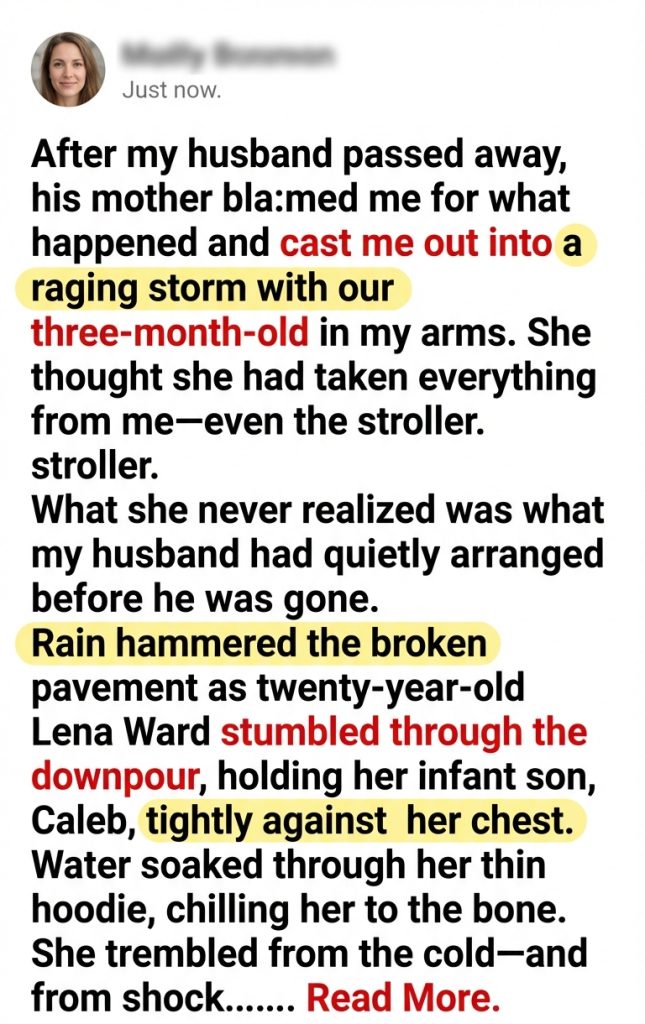
After my husband passed away, his mother blamed me for what happened and cast me out into a raging storm with our three-month-old in my arms. She thought she had taken everything from me—even the stroller. What she never realized was what my husband had quietly arranged before he was gone.
Rain hammered the broken pavement as twenty-year-old Lena Ward stumbled through the downpour, holding her infant son, Caleb, tightly against her chest. Water soaked through her thin hoodie, chilling her to the bone. She trembled from the cold—and from shock. It had only been nine days since the accident that took Ethan, the one person who had always stood between her and the world’s cruelty. With him gone, that shield had disappeared, and his mother had turned on her.
Margaret Ward confronted her that morning, grief twisted into fury.
“You’re why my son is dead,” she hissed. “If you hadn’t sent him out, he’d still be here.”
“It was just groceries,” Lena pleaded through tears. “The storm came out of nowhere.”
“Get out,” Margaret ordered.
Before Lena could gather the stroller or the diaper bag, Margaret snatched the stroller back.
“That stays. Anything I bought belongs to me.”
“But Caleb needs—”
“You should have thought about that before ruining my family.”
The front door slammed, leaving Lena standing alone in the pounding rain, her baby wrapped in a thin blanket. Water filled her shoes as she moved blindly down the street.
For two endless hours she wandered, arms aching as she held Caleb close to keep his tiny body warm. Every shelter she called was full—none could take a newborn. Her phone blinked a final warning: 5% battery.
At last, she sank beneath the small awning of a closed hardware store as thunder cracked overhead. Caleb whimpered faintly, his breaths shallow and uneven.
“I’m trying,” she whispered, pressing her lips to his damp hair. “I promise I am.”
Lightning flashed, illuminating a black sedan pulling up to the curb. The window slid down, and a familiar voice spoke her name.
“Lena?”
Grant Douglas—Ethan’s closest friend—stepped out with an umbrella. The color drained from his face when he saw her. She couldn’t form words. Tears answered for her.
Without hesitation, Grant guided her into the warmth of the car. When Caleb began to cry, his expression hardened.
“Where’s the stroller? His clothes?” he demanded quietly. “What happened?”
“She made me leave,” Lena whispered. “She said I deserved nothing.”
Grant inhaled slowly, steadying himself.
“Lena… Ethan didn’t leave you with nothing,” he said, his voice low but firm. “There’s something you need to hear.”
Her heart skipped. “What is it?”
He held her gaze, urgency flickering in his eyes.
“Before he passed, Ethan made arrangements for you and Caleb—arrangements his mother doesn’t even know about.”
Lena stared at Grant, the words barely landing because her body was still stuck in survival. Warm air blasted from the vents, but her hands wouldn’t stop shaking. Caleb’s little cries rose and fell, thin and tired, as if he’d already learned the world could be harsh.
Grant drove without wasting time, his knuckles white on the steering wheel. He didn’t ask Lena to explain again. He didn’t demand every detail while she was soaked and half-frozen. He just kept glancing at her in the rearview mirror like he couldn’t believe anyone had left her out in that storm.
“Where are we going?” Lena managed, voice hoarse.
“Somewhere safe,” Grant replied. “Then somewhere official.”
Lena looked down at Caleb’s damp blanket. She could see the tiny tremors of his body, feel the warmth of his breath against her collarbone. Her throat tightened with guilt so sharp it almost made her nauseous. Not guilt for Ethan. Not guilt for the accident. Guilt for the helplessness of being a mother without the tools she needed.
Grant pulled into an urgent care parking lot first. He insisted. “He needs to be checked,” he said, and his tone left no room for argument. Inside, a nurse took one look at Lena’s soaked hoodie and Caleb’s pale lips and moved them ahead of the waiting line without asking questions.
When the doctor confirmed Caleb wasn’t in immediate danger—but warned about exposure and dehydration—Lena nearly collapsed with relief. She sat on the edge of the exam table and cried silently, the kind of crying that doesn’t make sound because you’ve already used up your voice on pleading.
Grant waited outside the room, phone in hand, making calls in a low voice. Lena caught fragments—“executor,” “documents,” “it’s happening now,” “she threw them out”—and each word sounded like a door unlocking somewhere far away.
After urgent care, Grant drove them to a small townhouse across town. It wasn’t fancy, but it was warm, and it smelled like laundry detergent and coffee. He carried Caleb’s car seat in with more care than Lena had seen anyone show her in days.
“There’s clothes in the spare room,” he said. “My sister keeps a box here for her kids. It’ll fit him for now.”
Lena changed Caleb into a dry onesie with little blue stars while Grant laid out towels and made tea she couldn’t drink because her stomach was too tight.
When Lena finally sat on the couch with Caleb sleeping against her chest, Grant knelt in front of her and spoke carefully, like he was handling something fragile.
“Ethan knew his mother,” Grant said.
Lena flinched at the name. The grief was still a bruise everywhere. “He loved her,” she whispered.
“Yes,” Grant said softly. “But he didn’t trust her with you.”
Lena’s eyes snapped up. “What do you mean?”
Grant exhaled slowly. “Ethan changed his life insurance beneficiary two months ago,” he said. “From Margaret… to you.”
Lena went still. “He told me he had a policy through work,” she whispered. “But he never talked about it.”
“He didn’t want his mom to know,” Grant replied. “He asked me to witness the change. He also set up a small trust for Caleb with an independent trustee.”
The words felt unreal, like someone describing a different family. “A trust?” Lena echoed.
Grant nodded. “Ethan was afraid of exactly this—his mom claiming everything, using grief as permission, pushing you out when you were vulnerable. He made it so she can’t.”
Lena’s breath caught. The room blurred for a second. “But… she has the house,” Lena said. “She has everything.”
Grant’s gaze hardened. “Not for long,” he said. “That house was in Ethan’s name. And Ethan left a will.”
Lena stared at him. “He had a will?”
Grant nodded again, and there was something close to anger in his eyes now—not at Lena, but at the cruelty of what she’d been subjected to. “Ethan did it when Caleb was born,” he said. “He said, ‘If anything happens to me, Mom will try to swallow them whole. I need it in writing.’”
Lena’s throat tightened. She thought of Ethan in the kitchen late at night, rocking Caleb, whispering promises into the dark. She’d assumed those promises were emotional. She hadn’t realized he’d made them legal too.
Grant pulled a folder from his bag. “This is a copy,” he said. “The original is with the attorney.”
Lena’s hands trembled as she reached for it. She didn’t understand half the language, but she saw her name. She saw Caleb’s name. She saw the words “sole beneficiary” and “guardian preference,” and something inside her unclenched for the first time since the funeral.
“Why would she do that?” Lena whispered, voice breaking. “Why would she throw us out?”
Grant’s mouth tightened. “Because she needed someone to blame,” he said. “And you were the easiest target.”
Lena swallowed hard. “She said I killed him.”
Grant’s eyes softened slightly. “The accident report didn’t blame you,” he said gently. “But Margaret doesn’t live in facts. She lives in feelings, and feelings don’t require evidence.”
Lena looked down at Caleb, sleeping peacefully now, and felt a strange thing inside her grief: resolve.
“What happens now?” she asked.
Grant sat back, phone vibrating with a new message. “Now we do exactly what Ethan planned,” he said. “We go to the attorney. We secure the insurance claim. We file for immediate access to the house and property. And we document what she did to you.”
Lena’s stomach tightened again. “Document?”
Grant nodded. “Illegal eviction. Endangerment. Threats. Taking essential items from a newborn,” he said, each word calm but heavy. “Even if you don’t want to press charges, you need a record. So she can’t rewrite the story later.”
Lena’s eyes burned. “I don’t want revenge,” she whispered.
Grant’s voice stayed steady. “This isn’t revenge,” he said. “This is protection.”
Two hours later, Grant drove Lena and Caleb to a law office with a brass sign and warm lights. The attorney—Mr. Hargrove—was older, measured, and kind in a way that didn’t feel like pity. He offered Lena water and asked her to sit comfortably, then asked one simple question.
“Did Margaret force you out today?” he said gently.
Lena nodded, tears rising again. “In the storm,” she whispered. “With my baby.”
Mr. Hargrove’s expression tightened. “I’m sorry,” he said, and it sounded like truth, not politeness. “Ethan anticipated conflict, but I didn’t imagine she would move this quickly.”
He opened a file and slid a copy of Ethan’s will across the desk. “Ethan left the house to you,” he said. “He also left a written instruction that Margaret is not to have custody of Caleb.”
Lena’s hands shook as she read her name again. It felt like Ethan reaching across the distance between life and death, putting his hand on her shoulder.
Mr. Hargrove continued, “We will file an emergency petition to secure the property and protect you from harassment. We will also notify the insurance carrier today.”
Grant leaned forward. “And the incident?” he asked.
Mr. Hargrove nodded. “Yes,” he said. “We will document what happened. If Margaret contests, this record matters.”
That evening, Mr. Hargrove made a call to the local police department—not to arrest Margaret on the spot, but to create an official report: a young widow forced out in severe weather, an infant exposed, essential items withheld.
Lena felt sick signing her name at the station, like she was betraying the memory of the man who loved his mother. But then she remembered Margaret’s face—how she’d taken the stroller like it was a trophy—and Lena’s guilt turned into something clearer.
Family does not get to harm you and call it grief.
The next morning, while the storm clouds broke into pale sunlight, Mr. Hargrove obtained a temporary court order granting Lena access to the house and prohibiting Margaret from interfering with property or custody.
Grant drove Lena back to the house, his car steady, his eyes scanning the street like he expected Margaret to appear with a new weapon.
Margaret was waiting on the porch.
Her face was swollen from crying—or anger. Hard to tell. She took one look at Grant and stiffened, then turned her glare on Lena like Lena was still a problem she could remove.
“You have nerve,” Margaret spat. “After what you did.”
Lena’s arms tightened around Caleb’s car seat. Her body wanted to tremble, but she forced her voice to stay calm.
“I didn’t do anything,” Lena said quietly. “But Ethan did.”
Margaret blinked. “Ethan—”
Grant stepped forward and held out the court order. “Ma’am,” he said firmly, “this is a legal directive. Lena has the right to enter the home and retrieve her property. You must step aside.”
Margaret snatched the paper, eyes scanning the words. The color drained from her face as she read Ethan’s instructions in ink.
“No,” she whispered. “He wouldn’t. He was my son.”
“He was also Caleb’s father,” Grant replied.
Margaret’s rage flared instantly, like a match to gasoline. “She manipulated him,” she screamed. “She—”
Lena cut through it softly, the way you cut a thread you’re done holding. “He knew you,” she said. “That’s why he wrote it down.”
The porch went silent. Even Margaret seemed stunned by the calm certainty in Lena’s voice.
For the first time, Lena walked past Margaret and into the house without asking permission.
Inside, everything smelled like Ethan—aftershave and old wood and the faint sweetness of baby powder. Lena’s knees nearly buckled with grief, but she kept moving, because Caleb needed more than memories. He needed safety.
They found the stroller in the garage, still folded, still clean, as if Margaret had hidden it like a prize. Grant loaded it into the car without speaking.
Upstairs, Lena found her baby’s clothes piled in a plastic bag like trash. She didn’t cry. She folded them carefully, each tiny sleeve a reminder of what Margaret had tried to steal: dignity.
Before leaving, Lena stood in the living room and looked at Ethan’s photo on the mantel. “Thank you,” she whispered, voice breaking. “For seeing it coming.”
Later, Margaret tried calling—dozens of times. Then she texted threats. Then she cried to relatives. But Lena had something she’d never had before: a barrier made of law, documents, and Ethan’s final decision.
Over the next weeks, life became paperwork and healing. Insurance claims. Trust documents. Therapy appointments. Sleep-deprived nights with a newborn. But every time Lena felt the world tilt, she reminded herself: Ethan had built her a bridge.
Margaret didn’t win. Not because Lena got “revenge,” but because the truth finally had structure.
And in the quiet hours when Caleb slept on Lena’s chest, Lena understood something she hadn’t understood before Ethan died:
Love isn’t just words.
Sometimes love is a signature on a document, made in advance, so the people you leave behind don’t have to beg for the right to survive.