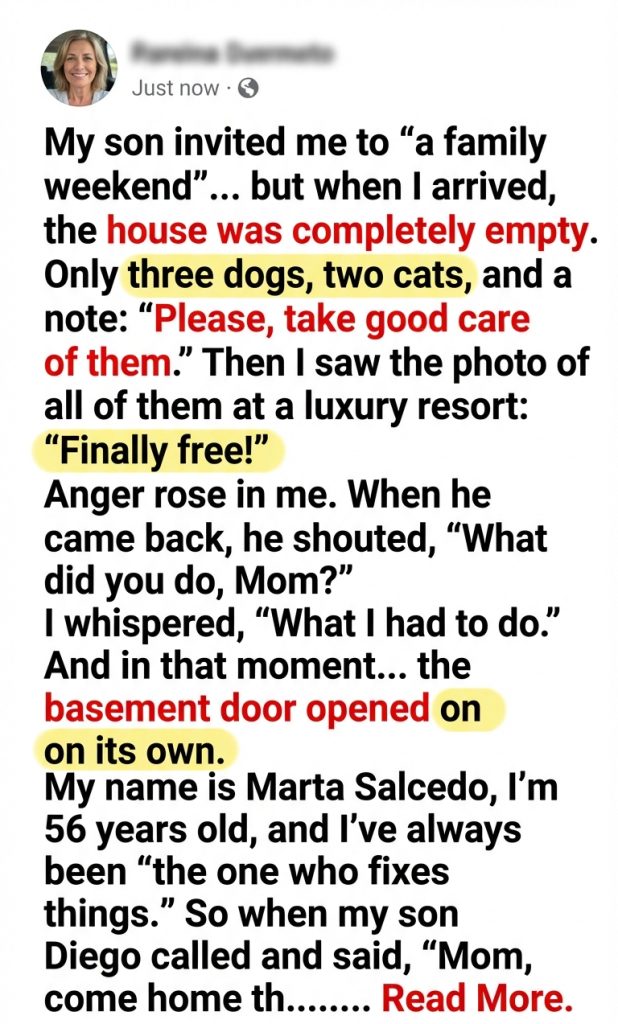
My son invited me to “a family weekend”… but when I arrived, the house was completely empty. Only three dogs, two cats, and a note: “Please, take good care of them.” Then I saw the photo of all of them at a luxury resort: “Finally free!” Anger rose in me. When he came back, he shouted, “What did you do, Mom?” I whispered, “What I had to do.” And in that moment… the basement door opened on its own.
My name is Marta Salcedo, I’m 56 years old, and I’ve always been “the one who fixes things.” So when my son Diego called and said, “Mom, come home this weekend, we need a family weekend,” I didn’t hesitate. I dressed up, brought a cake, and even bought food for everyone. In my mind, I could already hear laughter, dishes clinking, and warm hugs.
I should have noticed how quickly he ended the call. No warmth. No details. Just urgency dressed up as nostalgia. But I’m the kind of mother who hears “we need you” and responds like it’s a fire alarm, even when the house isn’t burning—yet.
When I arrived, the excitement dropped to the floor. The house was empty. No Diego, no his wife Laura, no children. I only heard claws on the floor and soft meowing. Three dogs and two cats surrounded me as if I were the backup plan. On the kitchen counter, there was a hastily written note: “Please, take good care of them.” I froze. It wasn’t an invitation. It was a trap.
The animals didn’t look neglected exactly, but they looked confused—like they’d been promised someone would come back quickly and then watched the hours stretch. One of the dogs, an old golden mix with cloudy eyes, pressed his head against my leg and sighed like he recognized a familiar kind of disappointment.
I walked into the living room, and there was the “proof”: a printed photo of the whole family smiling at a luxury resort. Underneath, in large letters: “Finally free!” I felt a mix of shame and anger, but I took a deep breath. “Marta, don’t make a scene,” I told myself. I opened the fridge: almost empty. In the trash can, gas receipts and a torn envelope.
For a moment, I stood there with the fridge door open, staring at nothing. Free. That word had teeth. Free from what? From the pets? From responsibility? From me?
The dogs circled my ankles while the cats watched from a chair like judges. I set my cake on the counter, suddenly embarrassed by my own optimism, and began doing what I always do when I’m hurt: I start solving.
As I poured water for the animals, my phone vibrated. A bank notification: “Payment authorized: €1,980.” I hadn’t bought anything. Two minutes later, another: “Loan request in progress.” My mouth went dry. I opened the app and saw transactions I didn’t recognize. My hands were shaking so badly I nearly dropped the phone.
At first, my mind tried to blame the world. Scammers. Data leaks. A hacked website. Anything but the obvious thing sitting in my kitchen: my own son had lured me here, and my personal information was suddenly being used like someone else’s tool.
I searched for Wi-Fi, called the bank, blocked my card. The agent asked, “Do you know anyone who might have access to your personal data?” I didn’t want to think the obvious. In Diego’s office, I found an open file cabinet. Inside: copies of my ID, receipts, a document with my signature—or something trying to look like it. On top, a sticky note: “Sign Marta — Monday.”
My stomach dropped so hard it felt like I’d missed a step. The kind of betrayal that makes your body go cold first—because warmth would mean feeling it, and feeling it would mean breaking.
I sat in Diego’s desk chair, holding a copy of my own ID in my hand like I’d never seen my face before. The forged signature was close enough to be dangerous, and messy enough to be arrogant—like whoever practiced it assumed I’d never fight back.
I took pictures of everything with my phone. Every page. Every sticky note. Every date. Then I pulled open the drawer beneath the desk and found a small folder labeled “RESORT.” Inside were reservation confirmations and a printed itinerary with the same smug cheerfulness as the living room photo. The luxury wasn’t accidental. It was planned. It was funded. And judging by the loan request, it was being funded by me.
I didn’t scream. I didn’t cry. I fed the animals and moved them into the living room where I could see them. I locked the front door, then locked it again, like I could double-lock my heart.
Then I did what fixing looks like when you’re done being kind about it. I called the bank back and asked for the fraud department. I filed an immediate report, requested a hold on any pending loan applications, and asked them to flag my profile for identity verification.
Then I called my credit bureau to place a freeze. Then I called a friend of mine—Rosa—who has worked at the courthouse for twenty years and doesn’t scare easily.
“Rosa,” I said, voice steady, “I need to know how to file a police report for identity theft, and I need to do it today.”
Rosa didn’t gasp. She didn’t ask why. She just said, “Are you safe?”
“I’m in Diego’s house,” I replied.
Rosa exhaled slowly. “Okay. Take photos. Don’t confront him alone. And if he shows up, keep your tone calm. You hear me? Calm.”
I told her I understood. I did. Calm was a tool, and I was done using my emotions to protect people who were using me.
I swallowed hard. I heard a key in the door. Diego rushed in, pale, and when he saw the file cabinet on the table, his face fell apart.
“What… what are you doing with that, Mom?” he stammered.
I didn’t raise my voice. I simply looked at him and said: “Close the door. Sit down. And call Laura. Now.”
His hands shook as he shut the door. His eyes flicked toward the hallway like he expected someone else to walk in and save him. Then he sat on the edge of the couch, knees bouncing, and pulled out his phone.
“Mom, you don’t understand,” he blurted before the call even connected. “It’s not—this isn’t what it looks like.”
I nodded toward the documents. “Then tell me what it looks like,” I said. “Because from where I’m standing, you invited me over to babysit your pets while you stole my identity.”
Laura answered on speaker, cheerful at first, already half-laughing over resort noise. “Diego? What is it? We’re at the pool—”
Diego’s voice cracked. “Mom’s here. She found the cabinet.”
Silence.
Then Laura’s tone sharpened like a blade. “Why is she in the office?”
I leaned closer to the phone and spoke clearly. “Because you left my ID in your drawer,” I said. “And you tried to take out a loan in my name.”
Laura inhaled fast. “Marta, don’t be dramatic—”
“Don’t,” I cut in, the word flat. “I have the bank on hold. I have photos. And I am filing a report.”
Diego made a small sound that was almost a sob. “Mom, please—just—give me one day. We’ll fix it. I’ll pay it back.”
“That’s not fixing,” I said. “That’s covering.”
Laura snapped, “You’re going to ruin us over a misunderstanding?”
“Over fraud,” I corrected. “Over dumping animals and calling it ‘finally free.’ Over treating me like a tool.”
Diego’s voice turned desperate. “Mom, we needed money. The resort was already booked. Laura said if we didn’t go, we’d lose the deposit. And then the kids—everyone’s been stressed—”
“And your solution was my identity?” I asked.
His eyes filled. “I didn’t think it would go through. Mark at the dealership said—”
I held up a hand. “Stop,” I said. “I don’t want names. I want the truth.”
Diego stared at the floor. “Laura’s brother,” he whispered. “He said he’d ‘help’ us consolidate debt. He took my laptop. He filled out forms. He said all we needed was your signature, and he could make it look like you signed because you ‘always help.’”
Laura’s voice snapped through the phone, furious. “Why are you telling her that?”
Because Diego finally saw it, I thought. The difference between help and harm.
I stood up and gathered the pets’ leashes. “Here’s what’s going to happen,” I said calmly. “I’m taking the animals to my house. I’m filing a report. And you’re coming home today.”
Laura laughed sharply. “We’re in the Maldives, Marta.”
I smiled without warmth. “Then you should enjoy the sunlight,” I said. “Because you’re about to spend the next weeks dealing with what you tried to do in the dark.”
Diego’s face crumpled. “Mom—please—”
“I love you,” I told him, and my voice surprised me because it was true. “But I will not be used.”
I ended the call with Laura still talking.
Then Diego shouted, “What did you do, Mom?”
I whispered, “What I had to do.”
I didn’t say it like a threat. I said it like a boundary.
I walked to the basement door because something had been bothering me since I arrived: the way it sat slightly ajar, the way a faint draft seemed to breathe from below, cold and metallic.
And in that moment… the basement door opened on its own.
Diego went still. The dogs barked once, then stopped, like even they sensed something underneath.
The door didn’t swing wide like a movie. It creaked slowly, the way a door does when the latch doesn’t catch and the house shifts. But the timing was too perfect, and Diego’s face changed in a way that told me this wasn’t the house settling.
“What’s down there?” I asked quietly.
Diego swallowed. “Nothing.”
I stared at him until he looked away. Then I stepped down one stair, then another, my phone flashlight cutting through the darkness. The smell hit first—damp concrete, dust, and something sweet and wrong, like old spills that never truly dried.
At the bottom, I saw a storage corner with plastic bins and a small metal safe—newer than everything else in that basement.
Diego followed behind me, breathing fast. “Mom, don’t—”
I pointed my light at the safe. “Open it,” I said.
He shook his head. “I can’t.”
“Yes, you can,” I replied. “Because you’re going to stop hiding behind ‘can’t’ and start choosing ‘right.’”
He fumbled with a key ring and finally opened it.
Inside were more documents. Not just my ID copies. Not just receipts. There were passports—two of them—plus a stack of prepaid cards, and a folder labeled with my name and something I’d never seen before: POA.
Power of attorney.
My throat went tight. That wasn’t a weekend mistake. That was planning.
Diego started crying then—quietly, ashamed. “Laura wanted… security,” he whispered. “She said if something happened, we needed ‘control.’”
Control. The same word people use when they mean ownership.
I took photos of everything. Then I closed the safe and walked upstairs without running, because running would have felt like fear, and fear is what they counted on.
That afternoon, I filed the report. I handed over copies of my photos. I placed fraud alerts. I contacted the resort’s concierge desk and reported suspected identity theft connected to pending charges. I didn’t ask them to punish my son. I asked them to protect my name.
Then I brought the animals home, fed them, and let them sleep in a warm room where nobody would call them a burden.
Two days later, Diego returned, not with Laura’s confidence, but with the hollow look of someone who finally understands consequences. He tried to hug me at the door, and I stepped back—not to be cruel, but to be clear.
“We’re going to fix this,” I said. “But we’re going to fix it correctly.”
He nodded, tears in his eyes. “I’ll do whatever you want.”
I shook my head. “Not what I want,” I corrected. “What’s right.”
In the weeks that followed, there were meetings and forms and uncomfortable truth. Laura’s brother disappeared from the picture the moment paperwork appeared. Diego learned the difference between being “free” and being accountable. Laura learned that calling someone “dramatic” doesn’t erase evidence.
And me?
I learned something too.
Being “the one who fixes things” doesn’t mean sacrificing yourself until there’s nothing left. Sometimes fixing means breaking a pattern—cleanly, firmly—so it can’t grow back.
The pets stayed with me. The house stayed quiet. And whenever my phone buzzed with another notification, I no longer felt panic first.
I felt readiness.
Because the moment I stopped begging my own family to treat me with respect, I finally became someone they couldn’t trap again.