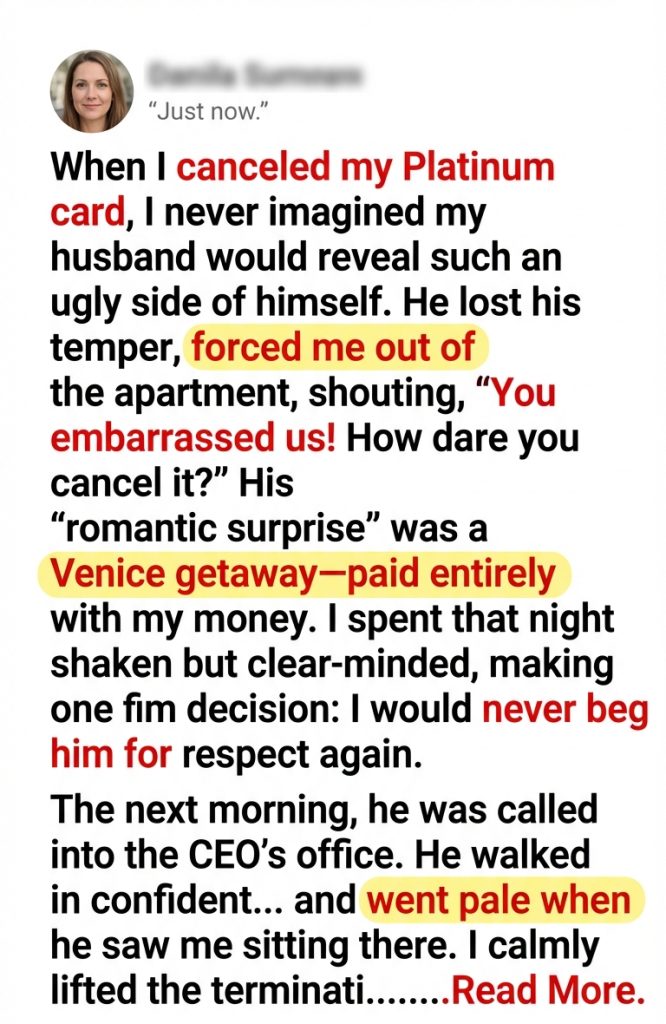
When I canceled my Platinum card, I never imagined my husband would reveal such an ugly side of himself. He lost his temper, forced me out of the apartment, shouting, “You embarrassed us! How dare you cancel it?” His “romantic surprise” was a Venice getaway—paid entirely with my money. I spent that night shaken but clear-minded, making one firm decision: I would never beg him for respect again.
The next morning, he was called into the CEO’s office. He walked in confident… and went pale when he saw me sitting there. I calmly lifted the termination letter and placed it on the table like a final decision.
It started at 8:12 a.m. with a bank notification:
“Purchase approved: €4,980 — travel agency.”
I was in our Barcelona kitchen, coffee brewing, soft gray light slipping through the blinds. I opened the banking app and saw flights to Venice, a boutique hotel, and a “romantic package.”
The charge was on my Platinum card—the one linked to my personal account since my promotion in finance at Llorente Tech.
Ethan walked in, humming.
“What is this?” I asked, showing him the screen. “You didn’t talk to me about it.”
“It’s for our anniversary. Venice. You’ll love it,” he said lightly.
“With my money. Without asking me first.”
His smile faded.
“Don’t overreact. It’s just a card. You’re the one who handles finances.”
My hands trembled slightly, but my voice remained steady. “I’m canceling it. Right now.”
I expected an argument. Instead, he reacted badly.
“You humiliated us!” he shouted. “How could you cancel it?”
I walked down the stairs instead of taking the elevator, holding the railing tightly. The cold air outside helped steady my thoughts. A neighbor glanced at me, then quickly looked away. I sat on a bench across the street and called the bank. Within minutes, the card was permanently blocked.
Then I called Clara from HR.
“I need a meeting tomorrow morning. With the CEO.”
“What happened, Isla?”
“I’ll explain tomorrow. But I’m done pleading.”
That night, I stayed in a small hotel in Eixample. My body ached, but my mind was calm. Ethan hadn’t planned a romantic trip—he had tried to assert control.
The next morning, he was summoned to the CEO’s office.
I didn’t sleep much in that hotel room. Not because the bed was uncomfortable, but because my brain refused to stop running its own audit. I kept replaying his words—You embarrassed us—as if my only job was to protect his image while he spent my money like it was a perk he’d earned.
At some point near midnight, the shock burned off and left something sharper behind: clarity. I wasn’t dealing with a one-time mistake. I was dealing with a pattern—one I’d been smoothing over because it was easier than admitting the person I married felt entitled to my life.
And the truth was, the travel charge wasn’t the first strange thing. It was just the first time he’d been bold enough to do it in a way the bank could put in a clean, undeniable line of text.
For weeks, little expenses had appeared with descriptions that were always vague: “services,” “reservations,” “membership.” Not enough to trigger fraud flags, but enough to trigger my intuition. Whenever I asked, Ethan’s answers arrived with a laugh—it’s nothing, it’s work, don’t stress. The same way he told me not to stress when he forgot anniversaries, not to stress when he missed family dinners, not to stress when he started treating my achievements like they were his good luck.
By the time I reached out to Clara, I wasn’t calling as a wife in pain. I was calling as someone in finance who knew what misuse looks like when it hides behind charm. Clara had been with Llorente Tech long enough to know my reputation too—steady, discreet, not dramatic.
That’s why she didn’t dismiss me when I asked for the CEO.
She simply said, “Be here at 8:30. Bring documentation.”
So I did.
At 8:00 a.m., I walked into Llorente Tech’s headquarters with a folder in my bag and a calm face I didn’t fully feel yet. The lobby smelled like polished stone and expensive cologne, the kind of scent that tries to convince you everything inside is controlled.
I used to love that building. I’d worked hard to be there. I’d taken night courses, earned certifications, fought for my promotion. When they gave me the Platinum corporate card years earlier, it wasn’t a status symbol to me. It was responsibility. It meant they trusted me to keep the numbers clean.
Ethan didn’t understand that. To him, a card meant access.
Clara met me near the elevators and led me through a quiet corridor to a small conference room outside the CEO’s suite. She didn’t ask for gossip. She asked for facts.
I gave her everything: screenshots of the €4,980 travel agency charge, the previous suspicious transactions, and the most important piece—Ethan’s text from last night, sent after he forced me out, when he thought anger could keep me silent:
“You don’t get to make me look small. Fix it tomorrow.”
Clara stared at the screen for a long second, then exhaled slowly. “Isla,” she said, voice low, “he used your personal card for this charge?”
“Yes,” I replied.
“And he is not authorized on that account,” she confirmed.
“No,” I said. “And he knows it.”
Clara’s jaw tightened. “Okay,” she said. “Then this isn’t a marital issue. This is a conduct issue.”
The CEO, Mateo Llorente, didn’t keep people waiting when something threatened the company’s integrity. Ten minutes later, his assistant opened the door and nodded for us to enter.
Mateo was sitting behind his desk, expression unreadable. He didn’t smile the way executives smile when they want you to feel grateful for being in the room. He simply gestured to a chair and said, “Isla. Tell me.”
I told him the truth in the cleanest language I could manage. I didn’t describe my humiliation. I didn’t describe the shouting in the hallway. I described the financial facts: unauthorized use, coercion, and the reason it mattered beyond my marriage—Ethan worked in partnerships. He had access to vendor conversations, reimbursement processes, and travel bookings.
Mateo listened without interrupting. When I finished, he leaned back slightly and said, “You’re certain he booked this as an anniversary trip.”
“Yes,” I said. “He said it to my face.”
Mateo nodded once, then looked at Clara. “Bring Legal,” he said.
While we waited, my phone buzzed twice with missed calls from Ethan. I didn’t answer. Not because I was playing games—because I needed everything to stay formal and documented.
At 9:05 a.m., Ethan was called in.
I didn’t hear his footsteps until the door opened, but I felt his presence the moment he entered—confident, rehearsed, the posture of a man who expected the room to bend around him.
He smiled when he saw Mateo, then looked to Clara, then finally to me.
The confidence fell off his face like a mask ripped away.
“Isla?” he blurted, too loud for the room.
Mateo’s voice stayed calm. “Sit down, Ethan.”
Ethan didn’t sit right away. His eyes kept darting between us like he was searching for the version of the story where this ended with him still in control. When he finally dropped into the chair, he tried the tone he used at dinner parties—the charming one.
“This is… a misunderstanding,” he said with a laugh that didn’t land. “Couples fight. Isla overreacted.”
Mateo’s gaze didn’t change. “We’re not discussing your relationship,” he said. “We’re discussing financial misconduct and professional ethics.”
Ethan blinked rapidly. “I didn’t do anything illegal.”
Clara slid a printed page across the desk—transaction details, timestamps, and the travel agency vendor info. “This charge was made on Isla’s personal Platinum account,” she said. “Not the company’s. Not a joint account. Not an authorized cardholder.”
Ethan’s throat bobbed. “It was for our anniversary. I was surprising her.”
Mateo’s tone sharpened slightly—not angry, just precise. “With her money,” he said.
Ethan opened his mouth, then shut it, like the words had finally failed him.
Mateo looked at me once. “Isla, do you want to add anything?”
I didn’t talk about the way he shoved me toward the door. I didn’t talk about the neighbor watching. I didn’t need to. I simply said, “He tried to punish me for canceling the card.”
Ethan snapped his head toward me. “You did embarrass me,” he hissed before he caught himself.
The room went still.
Mateo didn’t raise his voice. “Thank you,” he said quietly, and made a note.
Then Legal walked in.
The lawyer—Ms. Rojas—was calm in the way people are calm when they’ve seen every way arrogance collapses. She asked Ethan three questions: Did he have authorization? Did he use personal financial information without permission? Did he retaliate when the unauthorized access was revoked?
Ethan tried to talk his way out with half-truths: we’re married, she said it was fine before, she handles finances. Each sentence sounded worse than the last.
Because in a corporate office, “she handles finances” doesn’t mean “you can take.” It means “you had access and abused it.”
That’s when Clara placed the termination letter in front of Mateo and nodded slightly.
Mateo slid it across the desk toward Ethan. “Effective immediately,” he said. “You are terminated for breach of trust and misconduct connected to financial access.”
Ethan’s face drained. “You can’t be serious.”
Mateo’s voice didn’t move. “I am.”
Ethan looked at me again, eyes sharp now, angry. “You did this,” he said, like my existence was the offense.
I met his gaze steadily. “You did this,” I corrected. “I just stopped covering for it.”
He stood up abruptly. “You’re ruining my life.”
Ms. Rojas spoke calmly. “You should consider yourself fortunate this is handled internally first,” she said. “There are criminal implications for unauthorized access and coercion. Do not contact Isla regarding this matter except through counsel.”
Ethan’s mouth opened, but no words came out. For the first time, he looked like a man who realized charm doesn’t work on paper.
Security escorted him out quietly—no spectacle, no shouting—just consequences moving at the speed of procedure.
When the door closed, I finally exhaled fully.
Mateo looked at me and said, “Isla, I’m sorry this happened. You did the right thing.”
Clara touched my arm lightly. “Do you have somewhere safe to go today?”
“Yes,” I said, and it surprised me how true it was. Because safety, I’d learned, wasn’t a feeling. It was a plan.
That afternoon, I met a locksmith at the apartment with a friend present. Ethan’s key was removed from the building access system. My bank accounts were secured. My phone number was set to filter unknown calls. I changed my passwords in a single sweep like clearing debris after a storm.
Ethan tried calling anyway. He tried texting from a new number. The messages swung wildly from rage to pleading in under an hour. I didn’t answer.
Not because I wanted him to suffer.
Because I wasn’t negotiating for respect anymore.
Two weeks later, the Venice trip never happened. The refund partially processed back into my account, flagged for review. I kept the documentation. I kept the lesson too: a man who calls your boundary “humiliation” will always treat you like you exist to protect him.
I filed for divorce quietly, with the same calm I used when I closed accounts and balanced budgets. No dramatic posts. No vague quotes online. Just paperwork, signed and submitted.
The last time I saw Ethan in person was at a café near the courthouse. He looked smaller without his job title, without his “important” office badge. He asked me, voice low, “Was it worth it?”
I stared at him for a long moment and realized I felt nothing like I used to—no urge to soothe, no urge to explain.
“Yes,” I said. “Because now I can finally afford my own peace.”
And when I walked out into the Barcelona sunlight afterward, it felt like breathing in a life I’d almost forgotten I was allowed to have.