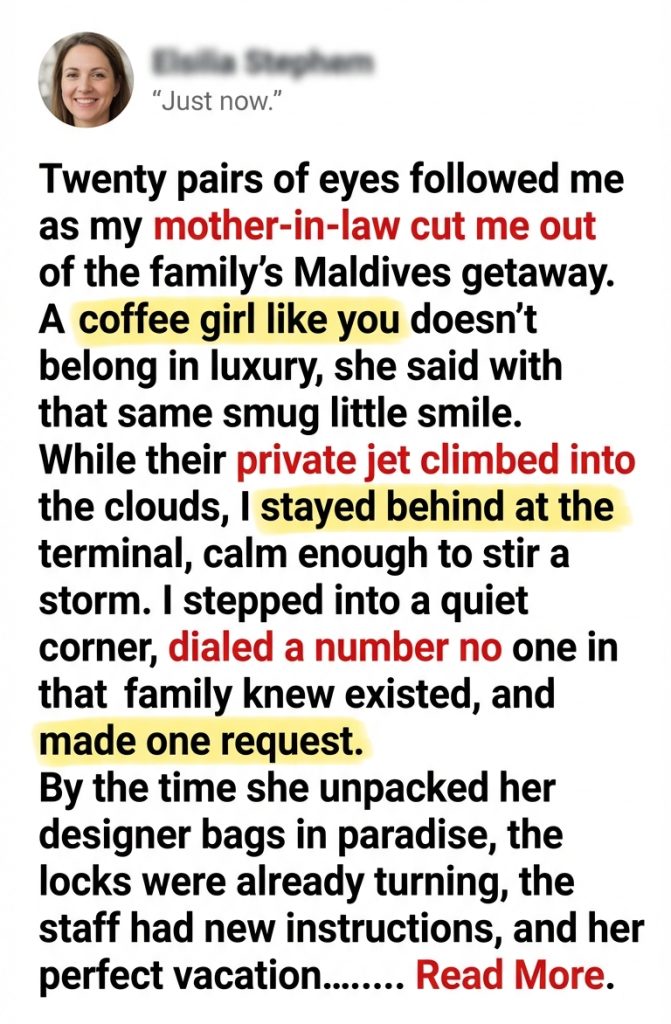
“Twenty pairs of eyes followed me as my mother-in-law cut me out of the family’s Maldives getaway. A coffee girl like you doesn’t belong in luxury,” she said with that same smug little smile. While their private jet climbed into the clouds, I stayed behind at the terminal, calm enough to stir a storm. I stepped into a quiet corner, dialed a number no one in that family knew existed, and made one request. By the time she unpacked her designer bags in paradise, the locks were already turning, the staff had new instructions, and her perfect vacation was about to become a nightmare with my name written between the lines. Some thrones become cages.
I used to think humiliation was something loud—shouting, slammed doors, a scene you can point to and say, that’s where it broke. But the Sinclair family did humiliation the way they did everything else: quietly, elegantly, with witnesses who smiled politely and pretended they hadn’t seen.
Twenty pairs of eyes tracked Maya Carter as Vivian Sinclair stood at the front of the dining room like a queen delivering a sentence. The Sinclair family’s annual “bonding trip” was scheduled for the Maldives, and Vivian had chosen to announce the final guest list at Sunday brunch—when the cousins, uncles, and in-laws were all present and politely trapped.
Vivian didn’t raise her voice. She didn’t have to.
“Maya won’t be joining us,” she said, dabbing her mouth with a linen napkin. “It’s a luxury resort. A coffee girl like you wouldn’t belong.”
Maya felt Ethan’s hand tense on her knee under the table. Her husband opened his mouth, but Vivian’s look shut him down—an old, rehearsed choreography. The room filled with the careful silence of wealthy people refusing to witness cruelty directly.
Maya forced a steady breath. She worked at a high-end coffee roastery in Brooklyn, yes. She also handled procurement, contracts, and compliance—skills the Sinclairs never bothered to ask about because they’d already decided who she was.
Vivian’s smile sharpened. “You can stay home. Rest. We’ll send you photos.”
Maya stood, chair legs scraping lightly. “Of course,” she said, quiet enough to keep the humiliation contained. She kissed Ethan’s cheek, ignoring the way Vivian’s eyes flicked to it like it was something sticky. Then she walked out with her back straight, through the marble foyer that Ethan’s grandfather had built to make people feel small.
In the driveway, she waited until the chatter inside resumed. Then she pulled out her phone.
Three months earlier, Maya had helped Vivian “clean up” a situation—an accidental overcharge, Vivian called it—when a vendor invoice for a Maldives villa had been routed through a Sinclair foundation account. Maya had noticed the invoice wasn’t from the resort. It was from a shell travel concierge with a mailbox address in Delaware. Maya had asked one question too many and Vivian had snapped, then smoothed it over with a laugh and a warning: Let the adults handle it.
Maya still had the forwarded emails. She still had the invoice. And she knew exactly what it was: foundation funds used for personal luxury, disguised as a “donor retreat.”
Now she dialed a number she hadn’t used since her last compliance training.
“Atlas Risk & Travel,” a man answered.
“Jordan Kline,” Maya said. “It’s Maya Carter. I need you to run an urgent integrity check on a booking in the Maldives—Sinclair party, departing tonight. And I’m sending documents.”
A pause—then the tone shifted from casual to precise. “Send them. What’s your objective?”
Maya watched the Sinclair cars load luggage at the curb. “I want the truth to meet them before the welcome cocktails do.”
As their jet rolled toward the runway, Maya hit send.
Some thrones become cages.
That was the last sentence she let herself think in full. After that, she moved on muscle memory—like she was back at her desk in Brooklyn with a compliance checklist open, the kind you follow when you want the facts to speak louder than anyone’s status.
The airport terminal in New York felt oddly bright as she stood alone near a charging station, watching the private jet through the glass. Ethan’s family moved like they owned gravity—porters in coordinated uniforms, garment bags lifted with care, Vivian’s sunglasses already on even though they were indoors. They didn’t look back. And why would they? In Vivian’s mind, Maya was background music.
Maya didn’t call Ethan. Not then. She knew how those conversations went: his guilt turning into irritation, his irritation turning into “just let my mom have this,” and her voice shrinking until she didn’t recognize herself. If she called, she’d waste energy explaining reality to people invested in denying it.
She checked her inbox once. Then again. Nothing yet.
Atlas Risk & Travel wasn’t a travel agency in the casual sense. They were the kind of firm wealthy people hired when their lives required discretion: background checks for international hires, fraud screenings for vendor payments, quiet investigations when “something feels off.” Maya had worked with them once through the roastery when a supplier’s documents didn’t match. They were fast. They were thorough. And most importantly, they kept records.
An hour after takeoff, Jordan texted: Received. Reviewing. Stand by.
Two hours later: Need confirmation of foundation entity name.
Maya replied without hesitation. She had the name, the EIN, the email chain. Vivian had been sloppy—not with money, but with arrogance. Vivian assumed Maya wouldn’t dare do anything with what she’d seen.
By the time the Sinclair jet crossed the Atlantic, Jordan called.
“Maya,” he said, voice low, “this isn’t just messy bookkeeping.”
Maya stared at the terminal floor, jaw tight. “I know.”
“No,” Jordan said, and the word carried weight. “This looks like misrepresentation tied to a charity entity. Multiple transactions. Concierge shell. And the resort booking is listed under a ‘donor summit’ cover narrative. If that cover touches any regulated funds or triggers any reporting, it’s bigger than embarrassment.”
Maya’s pulse stayed steady, but her stomach rolled. “What happens now?”
“We do what you asked,” Jordan said. “Truth meets them before cocktails.”
Maya didn’t ask for details that would turn her into a participant in anything unethical. She didn’t need theatrics. She needed consequences that followed rules. The kind Vivian couldn’t buy her way around with a smile and a donation photo.
Jordan continued, “I’m contacting the resort’s compliance liaison and the booking partners. If your documents are correct, the resort will have to freeze access until they confirm lawful payment sources. Also—private aviation manifests and concierge services can trigger flags if the cover story is false.”
Maya exhaled slowly. “Do it.”
She hung up and sat in her car in the airport garage for a full minute. Not because she was unsure, but because she felt something unfamiliar: relief. The kind you feel when you stop begging to be treated like a person and start acting like one.
That night, Ethan finally called.
“Maya,” he said, voice strained, “what the hell happened? Mom says you’re being dramatic.”
Maya kept her voice even. “Your mother called me a coffee girl in front of your whole family and told me I didn’t belong.”
Ethan sighed, the sound of a man trying to keep two worlds from colliding. “You know how she is.”
Maya’s hand tightened around the steering wheel. “Yes,” she said. “I know exactly how she is. That’s why I’m done pretending it’s normal.”
There was a pause. “Where are you?” Ethan asked.
“Not on the jet,” she replied.
Another pause—longer. “Maya… please don’t make this bigger.”
Maya’s laugh was quiet and almost sad. “I didn’t make it bigger. I just stopped making it invisible.”
In the Maldives, the air was warm and wet like a gentle blanket when Vivian Sinclair stepped onto the dock in designer flats that never touched inconvenience. The resort staff greeted her with practiced smiles—until their eyes flicked to a tablet, then to each other, then back to Vivian with a politeness that had suddenly become cautious.
“Welcome to—” the concierge began, then stopped. “Ms. Sinclair, may I confirm your booking details?”
Vivian lifted her chin. “Of course. We’re expected.”
The concierge’s smile remained, but something in the posture changed. “Yes, ma’am. One moment.”
Vivian’s family drifted behind her—cousins with sunglasses, Eleanor’s sister with a wide hat, Ethan with his hand on a carry-on, trying not to look like he’d rather be anywhere else. Twenty pairs of eyes, all trained on the staff now, waiting for the resort to perform the kind of worship they believed their money required.
The concierge returned with a manager.
“Ms. Sinclair,” the manager said smoothly, “there’s been a temporary hold placed on the reservation pending verification of payment method and booking authorization.”
Vivian blinked. “Hold? That’s ridiculous.”
“We’re happy to resolve it quickly,” the manager continued. “But until the documentation is verified, access to the villa keys and amenities is restricted.”
Vivian’s smile sharpened into something dangerous. “Do you know who I am?”
“Yes,” the manager replied, and the calmness was worse than insult. “That’s why we need to be precise.”
In New York, Maya’s phone buzzed with a single email from Jordan: Hold placed. Resort notified. Concierge accounts paused. Expect escalation.
Maya didn’t respond with glee. She responded with one word: Understood.
Because the point wasn’t to ruin a vacation. The point was to stop being treated like an object in someone else’s story.
Vivian did what Vivian always did when she felt control slipping: she made it public. She raised her voice, not loud enough to be vulgar, but loud enough to recruit witnesses.
“This is outrageous,” she said, turning slightly so her family could hear. “We were invited. We were approved. Someone is sabotaging us.”
The manager didn’t argue. He offered a private office and paperwork. Vivian refused. She wanted a stage.
Ethan’s phone rang. He stepped away, answered, and his face changed as he listened. A quick glance at Vivian, then at the resort staff, then down at the sand like the ground itself had become untrustworthy.
When he returned, his voice was tight. “Mom,” he said, “we need to… talk.”
Vivian’s eyes narrowed. “Not now. Handle it.”
Ethan swallowed. “They’re asking questions about the foundation account.”
That word—foundation—landed like a slap in a place where people wore sunscreen and pretended money was clean.
Vivian went still. Just for a second. It was small, but Maya would have recognized it from a thousand miles away: the micro-panic of someone realizing the wrong person is reading the receipts.
Across the ocean, Maya’s email dinged again: Resort counsel requesting confirmation that you are authorized contact for document trail.
Maya stared at the screen and felt the moment sharpen into a choice.
She could step back and let the system churn without her. She could disappear and let Vivian spin it as “a misunderstanding.” Or she could do what she’d never done with the Sinclairs: place herself firmly in the truth.
She replied: I am the source of the documents. I will provide full chain-of-custody emails.
She attached everything. Dates. Forward chains. PDF invoices. The Delaware mailbox address. The “donor retreat” language. The mismatch between resort vendor name and shell concierge.
Then she waited.
What followed wasn’t a dramatic movie scene. It was something far more terrifying to people like Vivian Sinclair.
It was procedures.
The resort offered temporary standard accommodations away from the villa while verification was processed. Vivian refused. The foundation account’s payment method was paused by a third-party intermediary pending review. The concierge service stopped returning calls. A local compliance officer requested a meeting. Quiet. Neutral. Polite.
Vivian’s perfect vacation began to feel like a room with doors that only opened outward.
The next morning, while the Sinclair family sat in a resort lounge with sweating iced drinks they suddenly couldn’t enjoy, a staff member approached Ethan privately and asked for identification and additional documentation. Not accusations. Not drama. Just forms.
Ethan’s hands shook slightly as he signed. He looked like a man realizing he’d lived inside his mother’s shadow so long he didn’t know where it ended.
When Vivian finally got Ethan alone, her voice turned cold. “Did Maya do this?”
Ethan didn’t answer fast enough.
Vivian’s face hardened. “That girl is trying to destroy us.”
Ethan’s voice cracked. “Mom, she’s my wife.”
Vivian’s laugh was sharp. “Then she should act like one.”
Across the ocean, Maya stood in her Brooklyn roastery in the early morning, the smell of toasted beans thick in the air, and realized something quietly devastating: Vivian didn’t want a daughter-in-law. She wanted a servant with a wedding ring.
At noon, Jordan called again. “Maya,” he said, “the resort has escalated to their external counsel. The foundation irregularities are being reported through proper channels. Also—your mother-in-law’s staff accounts in the villa system have been disabled. That’s the ‘locks turning’ piece you mentioned.”
Maya’s throat tightened—not with fear, but with finality.
“What does that mean for them?” Maya asked.
“It means,” Jordan replied, “they can’t access the private villa, can’t charge amenities to the foundation, and can’t move forward until legal sign-off. Their ‘paradise’ is now a compliance waiting room.”
Maya closed her eyes briefly. “Good.”
She didn’t say it with cruelty. She said it with the calm of a person choosing air after years underwater.
That evening, Ethan called again. His voice was different this time—smaller, stripped of his mother’s confidence.
“Maya,” he said quietly, “I need to know… did you really do this?”
Maya leaned against the counter, watching baristas work like normal life still existed. “Yes,” she said. “I did.”
Ethan’s breath caught. “Why?”
Maya didn’t raise her voice. “Because you didn’t stop her,” she replied. “Because you let her call me less than human in front of your whole family and expected me to smile through it.”
Ethan whispered, “I didn’t know what to do.”
Maya’s voice softened only slightly. “You could have done the simplest thing,” she said. “You could have said, ‘No. She’s coming with us. She’s my wife.’”
Silence.
Then Ethan said, “What happens now?”
Maya looked out the window at the street, at people walking their dogs, living ordinary lives that weren’t built on humiliation.
“Now,” she said, “I stop being the person who fixes your mother’s messes while she calls me a coffee girl. And you decide whether you want to be married to me—or married to her.”
She didn’t wait for him to answer.
Because she already knew the truth that mattered most: she had finally answered herself.
The Sinclair “bonding trip” ended early—not in a screaming match, but in a quiet scramble. Flights rebooked. Calls made. Smiles forced. Vivian’s family whispered about “unfortunate misunderstandings.” But their eyes had changed. People who live on status hate one thing more than scandal: exposure of the machinery behind the status.
When Vivian returned home, she found more doors than expected closing politely. A board meeting request. A foundation audit notice. A “temporary pause” on accounts. The kinds of consequences that look like nothing until you understand how much they cost.
Maya didn’t post about it. She didn’t gloat. She didn’t even tell her coworkers the full story.
She simply went back to work, poured coffee, signed contracts, and built a life that didn’t require anyone’s approval.
Some thrones become cages.
And the moment Maya stopped begging for a seat at Vivian’s table, she realized she had something Vivian didn’t.
A life she could walk away with—clean, intact, and finally her own.