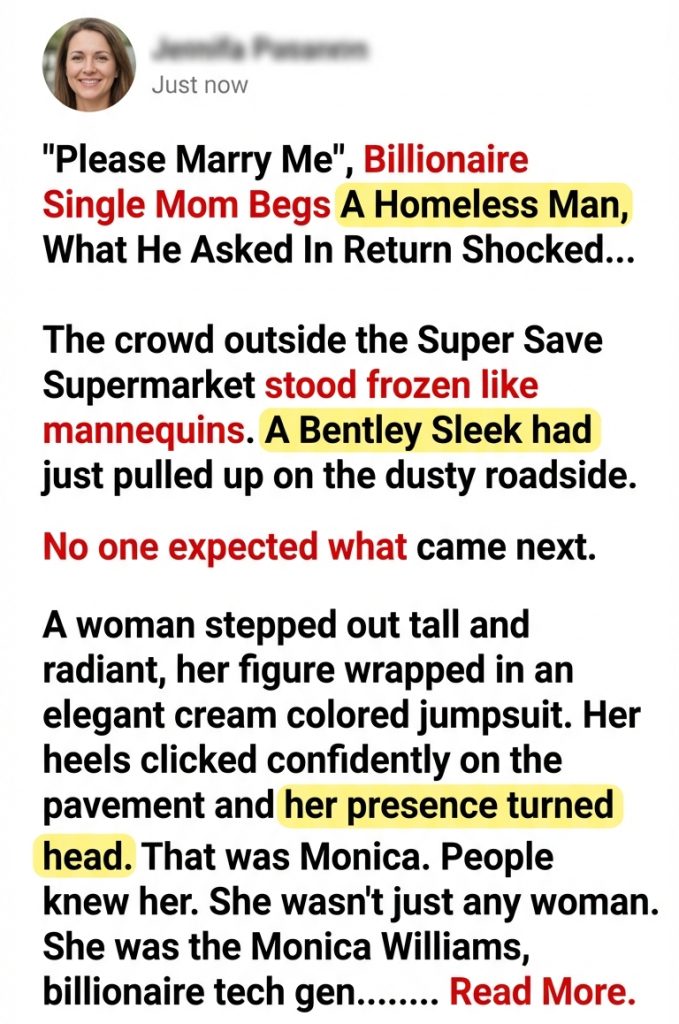
The crowd outside the Super Save Supermarket stood frozen like mannequins. A Bentley Sleek had just pulled up on the dusty roadside. No one expected what came next. A woman stepped out tall and radiant, her figure wrapped in an elegant cream colored jumpsuit. Her heels clicked confidently on the pavement and her presence turned every head. That was Monica. People knew her.
She wasn’t just any woman. She was the Monica Williams, billionaire tech genius, Africa’s software queen, the moniker behind Mtech, the face on Forbes Africa, the one every mother prayed their daughters would become. But today, Monica wasn’t here for an interview or a board meeting or to shop for exotic wine.
She was walking straight toward a homeless man. He sat on the sidewalk near a stack of empty crates. His tattered brown coat layered over a faded green shirt that hadn’t seen soap in weeks. His beard was tangled like a forest. His hair spilled out in every direction. A ragged black bag hung from his shoulder like it was carrying his entire life.
He looked up slowly, confused. No one ever came to him, especially not a woman like that.
She paused in front of him and smiled. “My name is Monica,” she said softly.
The man blinked. “Jacob. Jacob Uch.”
And then, just as everyone’s jaws dropped, she did the unthinkable.
“I’ve seen you here,” she said. “You speak like a scholar.
You talk about data and business like someone who’s lived in that world. I don’t know who you are or where you’re from, but I believe you just need a second chance.”
She took a deep breath. Her heart thundered in her chest.
“So, I’m asking you something crazy. Will you marry me?”
The street went silent. Jacob’s mouth parted in disbelief.
He shook his head slightly, trying to process what he had just heard. Then he smiled, but it was sad.
“If you really mean that,” he said slowly. “Go inside that supermarket, buy a ring, come back, kneel down, and ask me like you mean it.”
Gasps erupted from the onlookers. Is he mad? Who rejects a billionaire? But Monica didn’t flinch.
She turned, walked calmly into the supermarket, and just 5 minutes later, she returned. In her hand was a diamond ring worth more than most people’s houses.
And without hesitation, right there, in front of dozens of shocked strangers, the billionaire single mom bent one knee and raised the ring.
Jacob Uch. Her voice trembled.
“Will you marry me?”
He froze. People filmed. Some cried. Others laughed. Cars slowed down. One woman put her hand on her head out of disbelief.
Jacob looked down at her. This stunning woman who had everything and still saw something in him. In his weakness…
What the crowd didn’t see was Monica’s hands. Up close, they shook—not from embarrassment, but from something deeper, older. Monica Williams had stood on stages with presidents. She’d signed contracts worth more than the entire neighborhood. She’d been called fearless in magazines that liked neat stories. But kneeling on that pavement felt like the first time she’d ever done something purely human, with no PR team to buffer the moment.
And Jacob? Jacob didn’t look at the ring first. He looked at the way she was kneeling. The posture. The humility. The refusal to perform superiority. For years, people had walked past him like he was invisible. For years, anyone who did look at him looked down. Monica was looking up.
He swallowed, and the hard part wasn’t the answer. The hard part was allowing himself to believe it could be real.
“You want the truth?” he said quietly, voice rough like it hadn’t been used gently in a long time.
Monica nodded once. “Always.”
Jacob’s fingers hovered over the ring but didn’t touch it yet. “Then you need to hear what you’re actually asking.”
Around them, the sidewalk held its breath. Even the grocery cart wheels seemed to stop squeaking for a second. A teen with a phone forgot to keep recording and just stared.
“I’m not a charity case,” Jacob said. “And I’m not a headline.”
Monica didn’t blink. “I know.”
He let out a small, almost incredulous laugh. “Do you?”
Then he reached into his ragged black bag—the bag everyone assumed was filled with trash and scraps—and pulled out a thin, worn notebook. The kind of notebook students carry. The kind no one expects a homeless man to protect like gold.
He opened it to a page covered in tiny handwriting and boxes and arrows—diagrams, flow charts, numbers that looked like they belonged on a whiteboard in a glass office.
Monica leaned forward, eyes narrowing. Not in suspicion—recognition.
“This…” she whispered.
Jacob nodded once, and for the first time, his voice sounded like someone who used to be heard. “I built systems. I built models. I built things that worked.”
Monica’s throat tightened, because she’d seen that kind of handwriting before. In early prototypes. In the first days of Mtech, when everything was messy and brilliant and fragile.
“Jacob,” she said, slower now, “where did you learn to do this?”
His eyes flicked to her face, and something sharp moved behind them. “I didn’t learn it,” he said. “I lived it.”
The crowd didn’t know any of this history. To them, it was still just a billionaire and a homeless man. But Monica felt the air tilt. Her mind raced through faces she’d known, names that had disappeared from emails years ago, the silent gaps people never questioned because success makes everyone too polite to ask how it happened.
“You disappeared,” Monica whispered, more to herself than to him.
Jacob’s smile was small and sad again. “So did you,” he said softly. “Just in a different way.”
Monica stayed on one knee. The diamond ring glittered like a spotlight she hadn’t asked for. But she didn’t stand, even when her thigh burned. She didn’t stand because she understood: this wasn’t just a proposal. It was a doorway.
“You asked what I want in return,” Jacob said, voice low enough that only Monica and the nearest few could hear. “Not money. Not a house. Not pity.”
Monica’s eyes stayed locked on his. “Then tell me.”
Jacob’s jaw tightened like it always did when truth was expensive. “I want dignity,” he said. “I want you to promise that if you say you see me, you’ll see all of me—before and after the street. No pretending. No rewriting.”
Monica nodded, immediately. “Yes.”
He held up a finger. “And I want you to do one more thing.”
The crowd leaned in again, hungry for drama.
Jacob looked at the phones pointed at them, at the people who would turn this into a viral clip by dinner. Then he looked back at Monica and said the request that truly shocked everyone who heard it.
“Don’t marry me today,” he said. “Not for them. Not for a story.”
Monica’s breath caught. “Then when?”
“When you’ve gone one week without anyone knowing where I sleep,” Jacob replied. “When you’ve sat with me in the quiet, without cameras, without applause. When you’ve listened to everything I’ve been carrying. If you still want to marry me after that… then I’ll say yes.”
A ripple of confusion moved through the crowd. People wanted the ending fast. They wanted the “yes” for their feed. Jacob was refusing to be consumed.
Monica didn’t look disappointed. She looked relieved.
“Okay,” she said softly. “One week. No cameras.”
Jacob nodded once, then finally—carefully—touched the ring and closed Monica’s fingers around it.
“Keep it,” he said. “Not as proof for them. As proof for you.”
Monica stood slowly, legs stiff, and for a moment she looked less like a billionaire and more like a woman holding her breath. She turned to the crowd, and her voice carried—calm, controlled, unmistakable.
“Everyone go home,” she said. “This isn’t your story.”
Some people laughed nervously. Some kept recording anyway. But the tone in her voice changed the air. Security from the Bentley stepped forward, not aggressive—just present, like a boundary.
Monica looked back at Jacob. “Do you have somewhere safe tonight?” she asked.
Jacob hesitated, pride flickering. “I manage.”
Monica nodded as if she understood that word, then said, “I’m not asking as Monica Williams. I’m asking as Monica.”
He studied her face for a long second. Then he said quietly, “There’s a shelter two blocks away. I don’t go inside. I sit near the back gate.”
Monica didn’t argue. She simply nodded. “Then I’ll meet you there,” she said. “After I do one thing.”
She walked to her Bentley and spoke to her driver. Then she returned with a simple paper bag from the supermarket—water, fruit, a sandwich. Not luxury. Not spectacle. Basic care, offered like it wasn’t charity.
Jacob stared at the bag like it might be a trap. Monica just held it out and waited.
He took it.
That night, the internet exploded anyway—because someone always uploads. Headlines screamed about a billionaire proposing to a homeless man. People argued about motives. Strangers decided what was true in comment sections they’d never have to live inside.
But Monica didn’t post. She didn’t defend. She didn’t explain.
She showed up at the shelter gate like she said she would.
And the week that followed wasn’t romantic in a movie way. It was hard, quiet honesty. Monica listened while Jacob talked—about jobs lost, about trust broken, about how being smart doesn’t protect you when the world decides you’re disposable. About the way dignity erodes one small humiliation at a time until you stop expecting kindness to be real.
Monica told him her truth too—about being admired and still lonely, about building an empire and still feeling like a product. About raising a child alone while people praised her strength and never asked how heavy it felt.
On the seventh night, Jacob looked at her under a streetlight and said, “You really came back.”
Monica’s eyes shone, but her voice stayed steady. “I said I would.”
He nodded once. “Okay,” he said. “Ask me again. Not with a diamond. With your voice.”
So Monica asked him again—quietly, no crowd, no cameras, no parade of witnesses. Just two people standing on a sidewalk that had finally stopped feeling like a stage.
And Jacob smiled, this time without sadness.
“Yes,” he said.
Not because a billionaire saved him.
Because she saw him—and stayed.