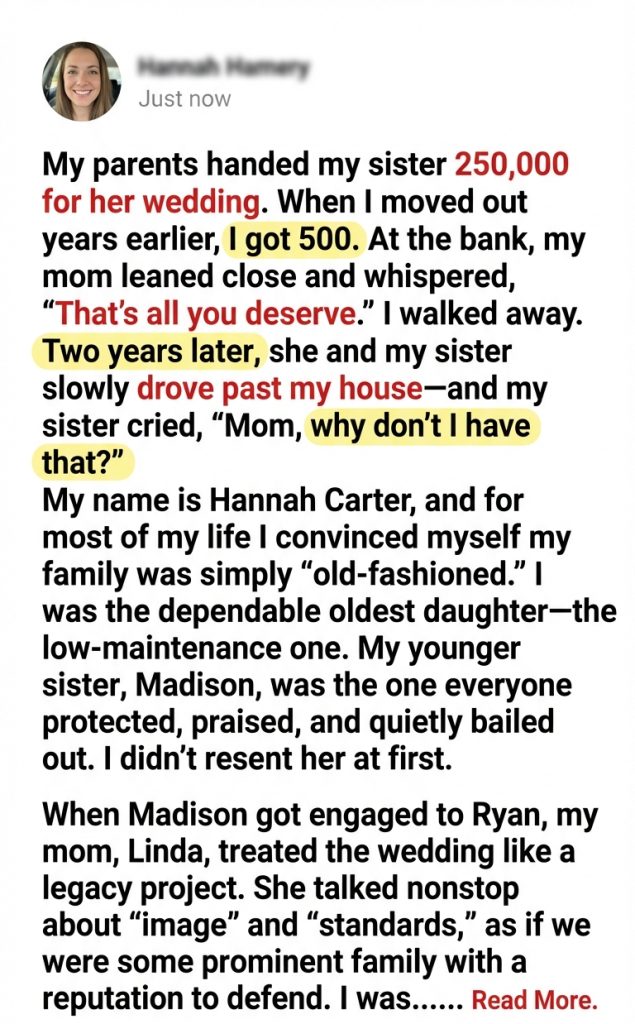
My parents handed my sister $250,000 for her wedding. When I moved out years earlier, I got $500. At the bank, my mom leaned close and whispered, “That’s all you deserve.” I walked away. Two years later, she and my sister slowly drove past my house—and my sister cried, “Mom, why don’t I have that?”
My name is Hannah Carter, and for most of my life I convinced myself my family was simply “old-fashioned.” I was the dependable oldest daughter—the low-maintenance one. My younger sister, Madison, was the one everyone protected, praised, and quietly bailed out. I didn’t resent her at first.
I told myself every family had roles. Mine just happened to be heavy. Madison’s role happened to be soft. And my parents—especially my mom—acted like that difference was a law of nature, something you didn’t question unless you wanted to be labeled “ungrateful.”
When Madison got engaged to Ryan, my mom, Linda, treated the wedding like a legacy project. She talked nonstop about “image” and “standards,” as if we were some prominent family with a reputation to defend. My dad, Tom, agreed with whatever she decided. I handled the background work—DIY centerpieces, last-minute errands, supply runs—because that’s what I do. I’m a middle school counselor. I smooth conflict for a living.
At work, I teach twelve-year-olds how to name their feelings instead of throwing them. At home, I swallowed mine so my mother wouldn’t call me “dramatic.” I was so practiced at it that I didn’t even notice how often I bent until my spine started to ache.
Madison’s wedding plans ballooned fast. There were tasting appointments, floral mockups, a planner with a clipboard and an attitude. Madison posted engagement photos every other day, and my mom replied under each one like a proud publicist. I delivered supplies and smiled until my cheeks hurt.
A few weeks before the wedding, Mom asked me to stop by the bank with her. “Quick errand,” she said. But she walked straight into a private office like she belonged there. The banker congratulated her and slid documents across the desk. I glanced down.
$250,000.
The number didn’t register as money at first. It registered as time—years of my rent, years of student loans, years of groceries, years of me saying “it’s fine” when it wasn’t.
She was issuing a cashier’s check to fund Madison’s wedding—venue, catering, planner, and a dress that cost more than my car. My voice came out sharper than I intended.
“You’re giving Maddie two hundred and fifty thousand dollars?”
Mom didn’t lift her eyes. “It’s an investment in her future.”
My dad sat beside her like a decorative lamp, nodding along. The banker’s smile stayed polite, but his eyes flicked to me—just a quick, sympathetic glance he tried to hide. I felt heat rise in my throat, not jealousy—recognition.
I tried to steady myself. “When I moved out, you gave me five hundred dollars. I paid for my own textbooks.”
It wasn’t just the textbooks. It was the second job. It was ramen dinners. It was me paying for a cracked windshield because I couldn’t afford insurance deductibles. It was the way I’d watched my parents “help” Madison through every inconvenience like it was their sacred duty.
That made her turn. Her smile stayed fixed for the banker’s benefit. She leaned in close and whispered, like she was explaining something obvious.
“That’s all you deserve.”
The words were quiet, but they were heavy. They didn’t hit me like a slap. They hit me like a verdict.
In that moment, something inside me didn’t shatter—it clarified. I stood so quickly my chair scraped the floor. The banker pretended to focus on his paperwork. Mom shot me a warning look, silently telling me not to embarrass her.
I didn’t argue. I didn’t cry. I walked out.
I walked through the lobby with my face neutral and my heart screaming. The air outside felt too bright. I sat in my car and gripped the steering wheel until my knuckles turned white, because if I let go, I might finally admit what I’d spent my whole life avoiding: they weren’t “old-fashioned.” They were unfair on purpose.
I drove home, packed a suitcase, left my key on the counter, and texted my fiancé, Ben: I can’t do this anymore.
Ben called immediately. “Hannah, where are you?” His voice wasn’t angry. It was steady—like an anchor dropped into storm water. I told him everything in broken pieces, and he didn’t interrupt. When I finished, he said, “Come home. Our home. We’ll figure it out.”
By the time my phone started lighting up with her calls, I was already on the highway, hands trembling on the steering wheel. I had just walked away from my family—right before the most important weekend of my sister’s life.
The first voicemail was my mom’s “calm” voice—tight, controlled, furious underneath. The second was my dad’s, pleading for me to “be reasonable.” The third was Madison’s, crying like she was the victim of my boundaries.
I didn’t answer.
Because I knew how this would go if I did. I’d end up apologizing for being wounded. I’d end up back at their kitchen table, being told I misunderstood, being handed a task to “make it right.”
The wedding happened without me. I saw the photos later—Madison in a glittering dress, my mom beaming, my dad smiling like nothing had been sacrificed. People commented things like “Perfect family!” and “So blessed!” and I realized how easy it is for strangers to celebrate a picture without knowing what was cropped out.
Months passed. Ben and I got married in a small ceremony with friends who felt like chosen family. No ballroom, no ice sculptures, no quarter-million check—just real laughter and food we could afford without strings attached.
I went back to school at night and earned my counseling certification upgrade. Ben’s sister taught me how to invest small amounts. We cut expenses. We worked. We built.
And for the first time, my money felt like mine—not like something my mother could measure to decide my worth.
Two years after the bank, Ben and I bought a house. Not a mansion—just a warm, sunlit place with a little backyard and a porch swing. The first thing I planted was flowers, not because I needed to prove anything, but because I finally had ground that belonged to me.
The day my mom and Madison drove by was accidental. They were in town for some bridal expo Madison was attending—because apparently she loved weddings so much she wanted to make them her “brand.” Ben and I were unloading groceries when I saw a familiar car slow down at the curb like it was approaching a crime scene.
My mom’s face was stiff behind the windshield, the same tight expression she wore when she thought she was being watched. Madison leaned forward, eyes scanning the house—my house—the porch, the yard, the new paint, the fact that I looked… peaceful.
Then Madison’s mouth opened.
“Mom,” she cried, voice cracking with disbelief, “why don’t I have that?”
The question wasn’t about siding or square footage. It was about certainty—the kind she thought money guaranteed forever. She had the wedding, the check, the praise… and yet here I was, standing in my own life, not begging for scraps.
My mom’s jaw tightened like a trap snapping shut. She glanced at me and tried to smile through glass, like we were still performing for strangers. But her eyes were hard, calculating—already rewriting the story so she wouldn’t be the villain in it.
I waited for the anger. For the guilt. For the familiar script.
Instead, I felt something new: distance.
I raised my hand—not in greeting, not in surrender—just acknowledgment. Like, yes, I see you. Yes, you see me. And no, you don’t get to step back into my life like you never whispered those words.
They drove away slowly. Madison was still crying. My mom stared straight ahead, hands locked on the wheel, as if control could be tightened by grip alone.
Ben came up beside me, slipped an arm around my waist, and whispered, “You okay?”
I watched the car disappear down the street and realized the truth that took me years to learn: fairness isn’t something you beg your family for. It’s something you build when you finally stop auditioning for love.
And that night, sitting on my porch swing in the quiet, I didn’t feel triumphant.
I felt free.