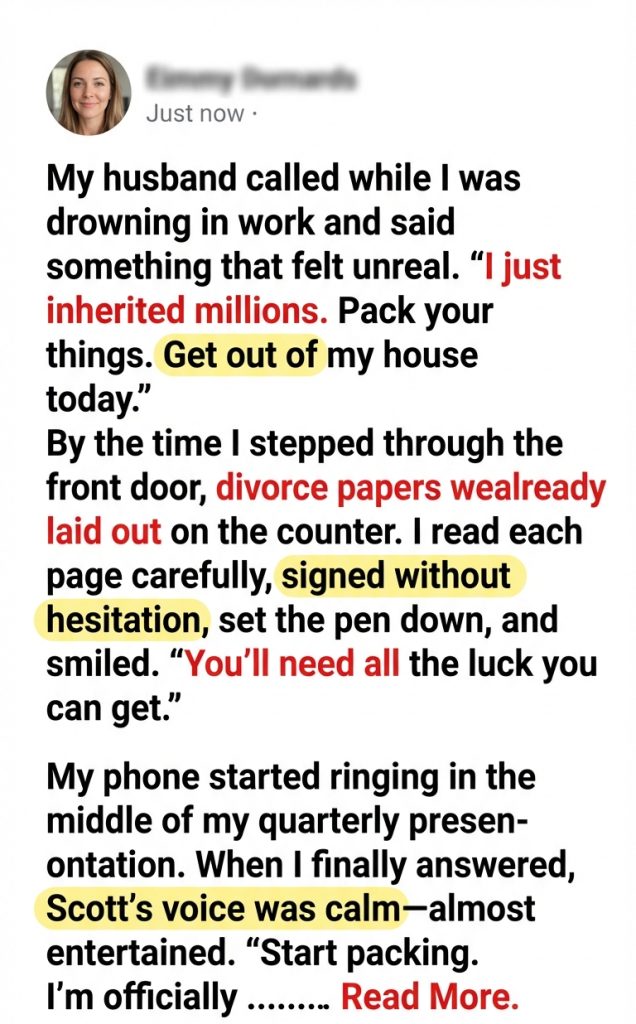
My husband called while I was drowning in work and said something that felt unreal. “I just inherited millions. Pack your things. Get out of my house today.” By the time I stepped through the front door, divorce papers were already laid out on the counter. I read each page carefully, signed without hesitation, set the pen down, and smiled. “You’ll need all the luck you can get.”
My phone started ringing in the middle of my quarterly presentation. When I finally answered, Scott’s voice was calm—almost entertained. “Start packing. I’m officially rich.”
The room fell silent. A dozen coworkers stared as my phone vibrated again and again, relentless against my side. I tried finishing the last slide, but the sharp ringing cut through the glass walls. My manager’s patience wore thin, and I could feel the eyes on me like heat lamps—curiosity, annoyance, that quiet office thrill when someone else’s life starts spilling into the workplace.
“Excuse me,” I said, standing quickly. In eight years of marriage, Scott had never once called me during work hours. My pulse pounded as I stepped into the hallway. “Scott? What’s going on? Are you alright?”
He laughed—but it wasn’t the laugh I knew. “Relax, Avery. Nothing’s wrong. Everything’s perfect.”
That word—perfect—landed wrong. Not because good news can’t happen, but because Scott wasn’t the type to share joy like a gift. He shared it like a weapon, like a win he planned to swing around until everyone else ducked.
Then he said it casually. “My grandmother died two weeks ago. She left me everything. Seven point three million dollars.”
I leaned against the wall. “That’s… incredible. I’m sorry I wasn’t there for you.”
“I didn’t want you there,” he said coldly. “Here’s what’s happening. When you get home, pack your stuff. You’ve got two hours.”
My throat tightened. “Scott, what are you saying?”
“I’m saying leave my house. I owned it before we married. It’s in my name. You get nothing. Divorce papers will be on the counter. Sign them and this stays simple.”
A woman’s voice echoed faintly behind him. Close. Comfortable. Then his quiet laugh.
“We’re married,” I whispered. “This is our home.”
“You’re free now,” he cut in. “Isn’t that what you wanted?”
The line went dead.
I walked back into the meeting room in a daze, muttered something about an emergency, grabbed my bag, and drove home on autopilot. My hands shook on the steering wheel, not from fear of being alone, but from the sudden, sick clarity that I had been living next to a stranger who’d been waiting for a reason to stop pretending.
Outside, everything looked the same—the fence I painted, the flowers I planted, the porch swing we used on quiet Sundays. But inside, it felt hollow. His gaming console was gone. Our honeymoon photos had disappeared. His closet stood bare.
On the kitchen counter was a stack of legal documents—eight years reduced to cold paragraphs. Beside them, a note.
Put it here. No drama.
I sat down slowly. Then I pulled a shoebox from behind my winter coats. Inside were receipts—restaurants, hotels, jewelry stores. Six months’ worth. Places I’d never been.
One name appeared over and over.
Kayla Jensen.
That evening, at the grocery store with my best friend Relle, I saw them. Laughing. Relaxed. Bottles of expensive wine in their cart. Prime steaks. Her hand resting on his arm like she’d always belonged there.
Scott glanced at me once—then looked away as if I were a stranger.
Later, he called again. Impatient. “Leave the keys. And one more thing—Kayla’s pregnant. We’re getting married next month.”
Three days later, Relle practically dragged me into a lawyer’s office. “He doesn’t get to erase you.” She said it like a vow, like she was physically holding my spine upright until my own strength came back.
Jerome listened without interrupting. Then he asked quietly, “What was his grandmother’s name?”
He typed for several minutes, his expression slowly changing. His eyes narrowed the way people’s eyes do when a story stops being emotional and starts being illegal.
Finally, he looked up. “Avery… I need to see that will.”
Two weeks later, Jerome slid a document across his desk. A single section highlighted in yellow.
One sentence. One condition.
Everything fell into place.
Jerome tapped the paper. “Read.”
I stared at the words. At first they looked like ordinary legal language—dense, careful, clinical. Then the meaning hit, clean and brutal: Scott’s grandmother hadn’t left the money to him the way he claimed. She’d placed it in a trust—for me—triggered by one specific event.
And suddenly, the two-hour ultimatum made perfect sense.
Scott wasn’t confidently walking away.
He was racing the clock.
Because the will’s condition was simple: if Scott initiated divorce proceedings against Avery Carter within a set window after the reading of the will, the inheritance transferred to Avery—provided Avery signed without contest. His “pack your things” wasn’t dominance; it was panic. He needed me frightened, isolated, and fast.
Jerome explained it slowly, like he was talking someone down from a ledge: Scott’s grandmother had suspected an affair, suspected greed, suspected exactly what kind of man her grandson would become the moment money entered the room. So she built a trap inside a gift—one that protected her wealth from the person least responsible enough to hold it.
Relle squeezed my hand under the desk, and I realized my smile back at the counter—when I signed—hadn’t been weakness. It had been instinct. Something in me had recognized the shape of a bluff, the rushed cruelty of someone trying to keep you from asking questions.
“Do I qualify?” I asked, voice tight.
Jerome nodded. “You already did. He forced the timeline. He wanted you out before you could speak to anyone like me.” Then he leaned back and said the part that made my stomach flip: “The moment you signed, he stopped controlling the outcome.”
The next week was quiet on the outside and thunderous underneath. Jerome filed what needed to be filed. Banks were notified. A trustee was contacted. Scott’s calls went from smug to sharp to pleading, like he was walking down the stages of grief—except what he was grieving was money, not marriage.
Kayla showed up once, outside my apartment, one hand on her stomach, the other holding her phone like it was a shield. “He said you were going to take everything,” she blurted, eyes wide with the kind of fear that isn’t moral—it’s financial.
I didn’t raise my voice. I didn’t need to. “He told you I was the villain,” I said, “because he couldn’t admit he set you up too. A man who can erase eight years can erase anyone.” Her expression cracked, just slightly, as if the future she pictured had shifted an inch off its tracks.
When Scott finally sat across from me in Jerome’s office, he looked smaller than I remembered. Not because he was sorry—because he was cornered. His knee bounced. His jaw stayed clenched. He tried to smile anyway, the way liars do when they want you to forget they’re lying.
“You think you won,” he said quietly.
Jerome slid the highlighted page toward him. “She planned for you,” Jerome replied. “And you walked straight into it.”
Scott’s face drained. For the first time since that call in my hallway, he didn’t sound entertained. He sounded afraid—not of losing me, but of being seen clearly.
I didn’t gloat. I didn’t lecture. I just looked at him and said the only honest thing left between us: “You called me during my presentation because you thought money made you untouchable.” I paused, then added, calm as glass, “It didn’t. It made you predictable.”
A month later, the trust transferred. Not all at once, not in some cinematic pile of cash, but through clean, documented steps—exactly the way his grandmother intended. I paid off my student loans. I bought a small townhouse with windows that actually let in light. I funded a scholarship at my old community college, because if wealth means anything, it should be able to rewrite someone else’s future—not just decorate your own.
The last time Scott texted, it was a single line: You ruined my life.
I stared at it for a long time, then set my phone down. Because the truth was simpler than anything he could type: he ruined his own life the moment he decided love was something you could evict.
And when I thought back to the day I walked through that front door and saw the papers waiting like a trap, I finally understood why I’d smiled. Not because I was unhurt. Because somewhere deep down, I knew that a man in a hurry is rarely holding the winning hand.