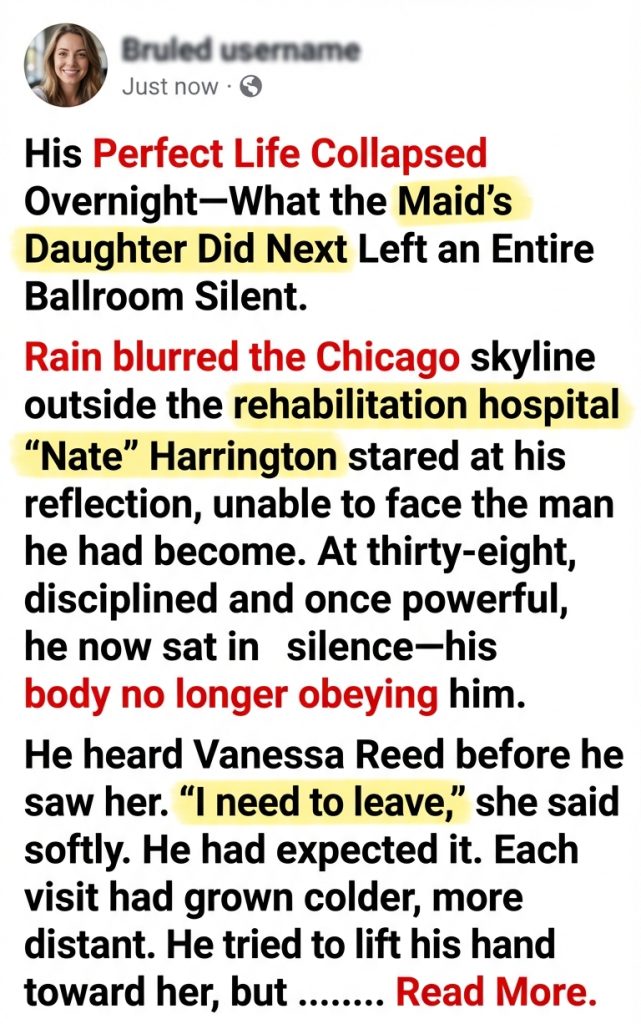
His Perfect Life Collapsed Overnight—What the Maid’s Daughter Did Next Left an Entire Ballroom Silent
Rain blurred the Chicago skyline outside the rehabilitation hospital as Nathaniel “Nate” Harrington stared at his reflection, unable to face the man he had become. At thirty-eight, disciplined and once powerful, he now sat in silence—his body no longer obeying him.
He heard Vanessa Reed before he saw her.
“I need to leave,” she said softly.
He had expected it. Each visit had grown colder, more distant. He tried to lift his hand toward her, but it trembled and fell.
“Vanessa…”
Tears filled her eyes—not heavy with grief, but light with relief.
“I tried,” she said quickly. “I really did. But I can’t live like this. I can’t watch you like this.”
Like this.
She slipped off her engagement ring and placed it on the bedside table. The quiet sound felt final.
“After seven years?” Nate asked. “Now?”
She looked away. “The doctors were clear. You’re not going to walk again. And I’m still… me.”
The heart monitor beeped sharply as she walked out, taking the life they had planned with her.
In the weeks that followed, friends slowly disappeared. Visits became texts. Texts became silence.
Only Caleb Dawson—his business partner and closest friend—remained.
When Nate was discharged, Caleb pushed his wheelchair through the hospital corridor.
“We’ll figure this out,” Caleb said, voice unsteady.
“Don’t lie,” Nate replied. “They all disappeared, didn’t they?”
“Not all of them,” Caleb said quietly. “I’m still here.”
“Because you want to be… or because you feel like you should?”
Caleb didn’t answer.
Back in his lakefront home, once a symbol of triumph, Nate felt trapped inside a museum of his former life. Caregivers came and went. He dismissed them all.
“You don’t need another nurse,” Caleb said. “You need someone to handle the house.”
That’s how Isabella Cruz arrived.
“You clean. You leave. No questions. No conversations. And no sympathy,” Nate told her.
“That works for me,” she answered calmly.
She was small, neat, and efficient—someone who moved through rooms like she was trying not to take up space. Nate liked that. It meant she wouldn’t look at him with pity the way the nurses did, or with curiosity the way old friends did when they came once and never returned.
She followed his rules. But she carried a secret—her five-year-old daughter, Sofia.
When Sofia’s preschool closed, Isabella had no choice but to bring her along.
“You stay quiet,” Isabella whispered. “You draw, you play, but you don’t leave the room.”
“Is he scary?” Sofia asked.
“He’s not scary. He’s just very sad.”
For days, Sofia obeyed. Until curiosity won.
One afternoon, she found Nate struggling to reach a book.
“Da*mn it,” he muttered.
“Do you want help?” she asked gently.
“Who are you?”
“I’m Sofia. I came with my mom.”
Anger flickered—but arguing with a child felt pointless.
“Which book?” she asked.
He pointed. She climbed up, grabbed it, and handed it to him, her small fingers warm and fearless.
“Why do you use that chair?” she asked simply.
“My legs were hurt,” he admitted. “They don’t work anymore.”
She thought for a moment, then placed her tiny hand over his.
“When I fall, my mom kisses it and it feels better. Do you want me to try?”
Nate didn’t answer right away, because the question wasn’t really about pain. It was about permission—permission to be cared for without the price of humiliation. His throat tightened in a way he hated, and he stared at a spot on the carpet until the urge to cry passed.
Sofia didn’t push. She simply leaned forward and pressed the gentlest kiss to the back of his knuckles, like it was the most normal thing in the world to comfort a stranger. Then she sat back on her heels and said, matter-of-fact, “Okay. That’s all.”
That night, Nate couldn’t sleep. Not because his body hurt—he’d lived with pain long enough to catalog it. He couldn’t sleep because the house felt different now. Less like a museum. More like something alive. He heard tiny footsteps once—Sofia padding down the hall for water—and instead of feeling invaded, he felt… anchored.
The next day, he didn’t dismiss Isabella early. He didn’t bark new rules. He simply asked, without looking directly at her, “What time do you usually pick her up?”
Isabella blinked, caught off guard. “After work,” she said carefully. “If there’s no school closure.”
Nate nodded. “She can stay in the afternoons,” he said, like he was approving a schedule change, not admitting a need. “Just… keep her safe.”
Isabella’s shoulders loosened by a fraction. “I always do,” she replied, voice quiet but steady—like someone who’d had to be the responsible adult since she was too young to be one.
Over the next weeks, Sofia became a small, stubborn light in Nate’s carefully controlled darkness. She didn’t treat him like a fallen king or a broken man. She treated him like a person who needed help reaching things, and sometimes, like a person who needed to be reminded that he still existed beyond what he’d lost.
She brought him crayons one afternoon and told him he had to draw “something happy.” He tried to refuse. She stared at him with the same serious face she used on her coloring book and said, “My mom says you can be sad. But you can’t be mean forever.” It landed harder than any lecture.
Caleb noticed the change before Nate did. “You’re… talking more,” Caleb said one evening, standing in the doorway as Sofia showed Nate a lopsided drawing of a whale. Caleb looked like he didn’t quite trust the scene, like he expected it to vanish if he blinked.
Nate’s voice came out rough. “She’s loud,” he said, as if that explained everything.
“She’s alive,” Caleb replied softly. “That’s different.”
For the first time since the accident, Nate let himself imagine a future that wasn’t just endurance. Not a miracle cure. Not a return to who he’d been. A different life—smaller, maybe, but real.
And then the consequence of that different life showed up: responsibility. Not for image. For impact. Nate asked Caleb to bring him financial reports he’d ignored for months. He asked about the foundation he’d once funded for publicity and forgotten the day after. He began making calls—short, precise calls—to redirect money toward rehabilitation programs, toward adaptive housing, toward the kinds of supports he’d never noticed until he needed them himself.
Word traveled fast in Chicago’s donor circles. People who had vanished started reappearing in his inbox. Invitations arrived again. “Hope you’re doing well.” “Would love to catch up.” Nate read them with a strange calm. He was learning, slowly, what was real.
When the hospital fundraiser invited him to a gala, Caleb assumed Nate would refuse. Nate surprised him. “We’ll go,” Nate said. “But not for them.”
“What do you mean?” Caleb asked.
Nate looked toward the hallway where Sofia’s laughter echoed faintly. “For her,” he said, and didn’t explain more.
On the night of the gala, the ballroom glittered with chandeliers and practiced smiles. People turned when Nate rolled in—some with pity, some with discomfort, some with sudden admiration for “strength.” Nate hated all of it. He kept his expression neutral and let Caleb steer him to their table.
Isabella arrived late, wearing a simple dress she probably borrowed. Sofia’s hair was slicked back with too much water, like Isabella had tried to make her look “presentable” for a world that judged quickly. Sofia clung to her mother’s hand until she saw Nate, then she brightened like she’d spotted a familiar landmark.
Nate didn’t smile often anymore, but when Sofia ran to him and pressed a crayon drawing into his palm, something in his face softened. It was small, but it was real.
The program began. Speeches about resilience, about gratitude, about “rising above.” Nate listened, unmoved, until the host announced a special moment: a short spotlight on “the people who care for us when we’re at our lowest.”
A microphone was brought to Isabella’s table. The host smiled warmly. “Isabella Cruz,” he said, “as a caregiver in Mr. Harrington’s home, what have you learned about recovery?”
Isabella froze. Her eyes flicked to Nate—panicked, like she was about to be exposed for bringing her daughter, for breaking rules, for being out of place. Nate tilted his head slightly, a silent permission.
Isabella stood, hands shaking. “I—” she began, voice thin. “I just… I clean. I help. I do what I can.”
The host leaned in, encouraging. “And what has inspired you?”
Isabella swallowed. “My daughter,” she said quietly. “She reminds me people can still be kind.”
The host’s eyes softened. “Would you like to say anything, Sofia?”
Sofia looked up at the microphone like it was a monster, then at Nate. He nodded once, slow.
Sofia stepped forward, barely tall enough to reach the mic stand. The room chuckled—gentle, indulgent.
Then she said, clear and serious, “He was very sad. But he’s not scary. He just needed someone to kiss the hurt.”
The ballroom went silent.
Not polite silent. Not “aw” silent. Real silent—the kind that happens when a simple sentence cuts through performance and lands on truth.
Nate felt it like a wave: people hearing, for the first time, that his recovery wasn’t about heroism. It was about humanity.
Sofia added, softer now, “My mom works very hard. She’s brave too.”
Isabella covered her mouth, eyes shining. Caleb stared at Sofia like he’d forgotten how powerful innocence can be.
And Nate—Nate lowered his head for a moment because his vision blurred. Not from shame. From something he hadn’t felt in a long time: gratitude that didn’t make him feel small.
After the applause, Nate asked Caleb to wheel him to the stage. The host hesitated, surprised, then handed him the microphone.
Nate didn’t give a speech about overcoming adversity. He didn’t sell inspiration like a product. He said, “I built a perfect life out of control. I lost it. And the first person who treated me like I was still a person was a five-year-old.” He paused, voice rough. “So tonight, I’m making sure the people who care for others don’t have to carry everything alone.”
He announced a new fund—quietly, specifically—dedicated to childcare support for caregivers, paid respite hours, and emergency assistance. He named it after Sofia. Not for publicity. For truth.
The room stood. Not because it was fashionable, but because they couldn’t pretend they hadn’t been moved.
Later, as Isabella gathered Sofia’s coat and tried to slip out before anyone could corner her with awkward praise, Nate stopped her. “Isabella,” he said, voice steady, “you’re not staff tonight. You’re family here.”
Isabella’s eyes widened. “I—I don’t—”
Nate interrupted gently. “You and Sofia saved me from becoming someone I don’t want to be.” He looked at Sofia. “Thank you.”
Sofia nodded solemnly, like she accepted gratitude the way adults accept contracts.
As they left, Caleb leaned down and whispered, “You realize your perfect life didn’t collapse. It… changed.”
Nate stared out at the ballroom, at the glittering people, at the soft chaos of being human. He thought about Vanessa’s ring on the hospital table. He thought about the friends who vanished. He thought about the tiny kiss on his hand that made him feel less alone.
Then he said, quietly, “Good. I hated who I was becoming.”