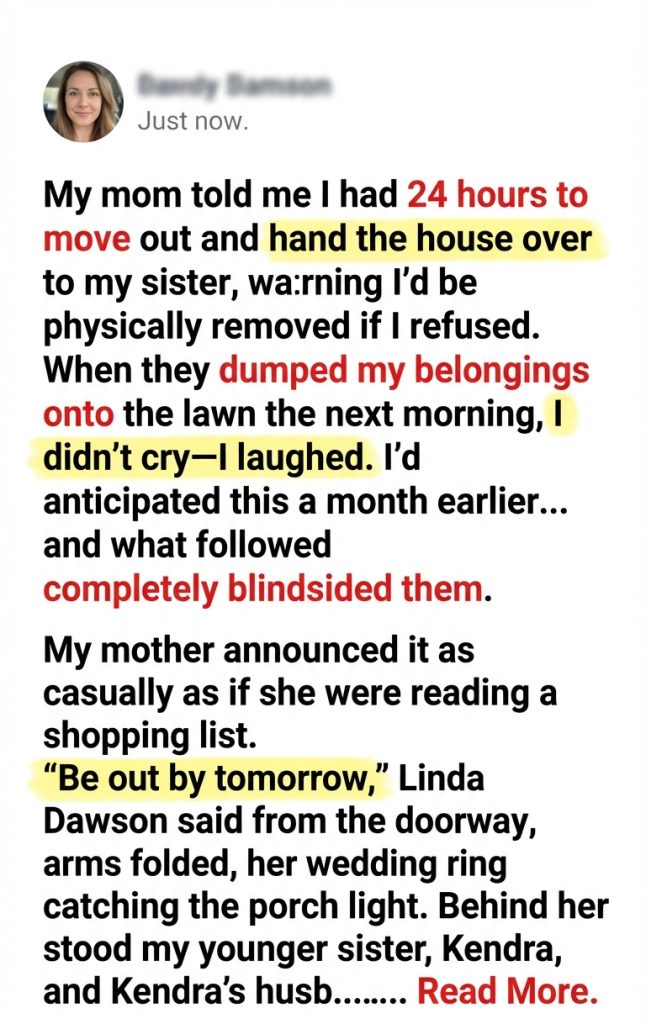
My mom told me I had 24 hours to move out and hand the house over to my sister, warning I’d be physically removed if I refused. When they dumped my belongings onto the lawn the next morning, I didn’t cry—I laughed. I’d anticipated this a month earlier… and what followed completely blindsided them.
My mother announced it as casually as if she were reading a shopping list.
“Be out by tomorrow,” Linda Dawson said from the doorway, arms folded, her wedding ring catching the porch light. Behind her stood my younger sister, Kendra, and Kendra’s husband, Mark, both wearing that rehearsed look of sympathy people use when they’re about to justify something cruel. “Your sister and her family are moving in. If you don’t leave, we’ll have you removed.”
I glanced past them into the living room—Dad’s worn leather chair, the framed photos still on the mantel, the rug I vacuumed every Saturday since his funeral. Most people would have argued. Broken down. Begged.
I simply nodded. “Okay.”
Kendra blinked, clearly expecting resistance.
“Don’t try anything, Ava,” Mom added sharply. “You have until tomorrow.”
The truth was, my mother loved deadlines. They made her feel powerful. She’d used them my whole life—“Be ready in five minutes,” “Fix this by tonight,” “Don’t embarrass me.” Deadlines were her favorite leash.
After Dad passed, I had kept everything afloat—taxes, insurance, repairs, mortgage payments. Mom called it “mooching off the family.” Kendra called it “squatting.” They conveniently forgot who sat beside Dad’s hospital bed and who stepped in when his overtime checks stopped.
They also forgot who called the insurance company when the roof leaked. Who negotiated the property tax payment plan. Who bought the furnace filter, the sump pump, the new smoke detectors. The house didn’t stay standing because of Linda’s pride—it stayed standing because I handled the boring parts that keep a life from collapsing.
That night, I packed only what mattered—clothes, my laptop, a shoebox of Dad’s letters from when I was in college. I didn’t argue about the improvements I’d paid for or the money I’d invested.
Because a month earlier, I had already prepared.
It started when I found the first clue they were planning something: Kendra “casually” asking me what day the mortgage came out, Mom suddenly wanting copies of the property tax statements, Mark offering to “help” by getting our mail. They weren’t subtle. They just assumed I wouldn’t notice.
So I made one appointment I should’ve made long ago.
I sat across from Mr. Hargrove—Dad’s old attorney—and asked him a simple question: “If my mother tries to push me out, what do I do?”
He didn’t gasp or moralize. He opened a file.
My father had signed a transfer-on-death deed naming me as the beneficiary two years before he died. Quietly. Legally. He’d done it after one too many arguments with Mom about money and “who deserves what.” He didn’t trust Linda not to punish me for being the responsible one. So he protected me the only way he knew how: with documents.
And because I’d been paying the mortgage and repairs, Mr. Hargrove helped me put everything into one clean record: proof of payments, proof of ownership, proof that I wasn’t “mooching.” I was maintaining an asset that was mine.
We also prepared something else: a written notice that any attempt to remove me or my property without a court order would be an illegal eviction.
I didn’t want revenge. I wanted safety. In real life, safety is evidence.
At sunrise, a moving truck pulled into the driveway like a final judgment. Kendra’s kids jumped out excited about “their new rooms.” Mark hauled boxes inside confidently. Mom followed with a clipboard she barely understood.
They didn’t knock.
They immediately began carrying my things outside—my bookshelf, my kitchenware, my duffel bag—and dropping them onto the grass.
“Hurry up,” Mom said briskly. “She’s stayed long enough.”
Neighbors slowed to watch. I stood on the porch, calm, as my belongings piled up in the yard. Across the street, someone covered her mouth in disbelief.
Kendra smirked. “Look at her. She thinks she’s better than this.”
I picked up my car keys and walked toward my trunk. I didn’t shed a tear. I didn’t argue.
I left laughing—soft at first, then louder—because I knew exactly what was coming next.
And none of them had the slightest idea who truly owned that house.
I drove three streets over and parked behind the community center where the Wi-Fi was strong and the parking lot had cameras. Then I made three calls in a row—calm, clear, practiced.
First: my attorney, to confirm the next step.
Second: the non-emergency police line, to request a civil standby and to report an active illegal lockout in progress.
Third: the county recorder’s office hotline, to flag any attempted fraudulent filing if my mother tried to “fix” ownership after the fact.
Then I waited.
Twenty-two minutes later, my phone buzzed with a text from my neighbor, Mrs. Ellison—the one who always watered her plants at exactly 7:00 a.m.
Honey, the police are here.
I didn’t rush back like I was going to fight. I arrived slowly, like I was showing up to a meeting I’d scheduled.
Two officers stood near the driveway, calm and bored in the way professionals get when they’ve seen every version of “family drama.” A third person stood beside them in a blazer holding a folder: my attorney’s paralegal, there as a witness with copies of the deed and the payment history.
My mother’s face was red. Mark was arguing. Kendra kept gesturing at my things on the lawn like it proved something.
One officer held up a hand. “Ma’am,” he said to my mother, “you cannot remove an occupant’s property or force them out without a court order.”
Linda snapped, “She doesn’t own anything here!”
The paralegal opened the folder, pulled out a stamped document, and said politely, “Actually, she does.”
My mother blinked. “What is that?”
“A recorded deed,” the paralegal replied.
Kendra’s smirk faltered so fast it looked painful.
Mark tried to jump in—“This is a misunderstanding—”—but the officer’s tone stayed even. “Sir, if you continue removing items, it can escalate to a criminal matter.”
That’s the moment the moving truck stopped working like a weapon and started looking like evidence.
I walked up the driveway and said nothing at first. I just looked at my belongings scattered across the lawn—my life arranged like trash—then looked at my mother.
Linda opened her mouth to speak, but the officer addressed me first. “Ma’am, are you Ava Dawson?”
“Yes,” I said.
“Do you want to re-enter your home?” he asked.
“Yes,” I replied. “And I want them to stop touching my property.”
The officer nodded once, as if this was the most reasonable request in the world. Because it was.
Kendra’s voice went thin. “Mom said—”
“Your mom doesn’t outrank the law,” the officer replied, not even looking at her.
When Linda realized she wasn’t in charge, she tried the only thing she had left: emotion. “After everything I’ve done,” she cried loudly, turning to the neighbors like they were a jury. “She’s ungrateful!”
I didn’t take the bait. I simply said, “You had no right.”
My attorney’s paralegal handed Linda a written trespass notice. Calm paperwork. The kind that feels boring until it’s not.
“This means,” she explained, “you are not to enter the property without the owner’s permission. If you do, law enforcement can remove you.”
Kendra stared at me like I’d become a stranger. “You… planned this.”
I met her eyes. “You planned it first.”
The officers supervised while my things were placed back inside, at least the fragile items, at least the important ones. The moving truck driver looked deeply uncomfortable—because most people don’t sign up to be part of someone else’s cruelty.
Before the officers left, one asked, “Do you want to press charges for the illegal eviction and property removal?”
I took a breath. “I want a report,” I said. “I want it documented.”
Because sometimes the biggest shock isn’t yelling.
It’s a paper trail.
That afternoon, my mother sent the first of many messages—rage, then pleading, then sudden sweetness. Kendra called. Mark called. Then the calls multiplied so fast my phone started overheating on the kitchen counter.
I didn’t answer.
Because the loudest response I could give was the quiet life I finally protected.
That night, after the house was still again, I sat in Dad’s worn leather chair and opened the shoebox of letters. My hands shook—not from fear, but from the aftershock of realizing my father had seen this coming.
At the bottom of the box was a note in his handwriting.
If you ever need to choose between keeping peace and keeping yourself—choose yourself. I’ll back you up, even if I’m not here.
For the first time all day, I cried. Not because of what they tried to do.
Because I finally understood: I wasn’t alone in this house. I never was.