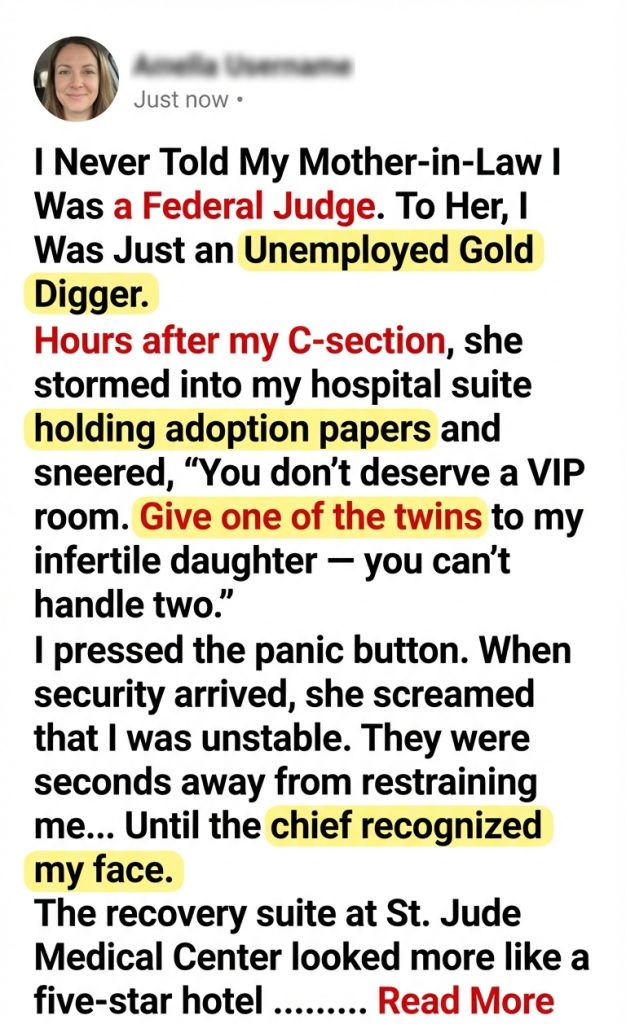
I never told my mother-in-law I was a federal judge. To her, I was just an unemployed gold digger. Hours after my C-section, she stormed into my hospital suite holding adoption papers and sneered, “You don’t deserve a VIP room. Give one of the twins to my infertile daughter — you can’t handle two.” I pressed the panic button. When security arrived, she screamed that I was unstable. They were seconds away from restraining me… until the chief recognized my face.
The recovery suite at St. Jude Medical Center looked more like a five-star hotel than a hospital room. Soft gray walls. Egyptian cotton sheets. Floor-to-ceiling windows overlooking the Boston skyline glowing at dusk.
I had asked the nurses to remove the cards from the extravagant flower arrangements — orchids from the U.S. Attorney’s Office, white roses from Senator Whitmore, lilies from the Chief Justice. I needed to maintain the illusion.
To my husband’s family, I was just Elena Brooks — a “freelancer” who worked from home.
They didn’t know I was The Honorable Elena Brooks-Vance, United States District Judge for the Southern District.
And I had intended to keep it that way.
I had just survived an emergency C-section. My abdomen burned with every shallow breath, but the sight of my twins — Leo and Luna — sleeping peacefully beside me made it worth it.
Then the door slammed open.
Margaret Sterling marched in wearing a fur coat that smelled of expensive perfume and entitlement. Her heels struck the tile like gunshots.
She didn’t look at the babies.
She looked at the room.
“A VIP suite?” she scoffed, kicking the foot of my bed hard enough to jolt my incision. “My son works himself to death while you waste his money on silk pillows and room service? You are unbelievable.”
“My insurance covers this,” I said evenly.
She laughed sharply. “Insurance? From what job? Blogging? Your little ‘consulting’ gig? Please. You contribute nothing. You sit at home while Mark pays the mortgage.”
That mortgage, ironically, was paid from my federal salary.
But I stayed silent.
Until she pulled folded papers from her designer bag and threw them onto my bedside table.
“Sign.”
I stared at the document.
Voluntary Termination of Parental Rights.
“Karen can’t have children,” Margaret said coldly. “She needs a son to carry on the Sterling name. You can keep the girl. Give Leo to Karen. It’s practical. You can’t manage two babies anyway.”
The air left my lungs.
For a heartbeat, I couldn’t tell what hurt more—the incision pulling across my abdomen or the casual way she said my son’s name like he was a spare item in a closet. Leo. A person. A newborn with a scrunched face and a tiny fist that curled around my fingertip like a promise.
“Get out,” I managed, voice tight.
Margaret’s smile widened, satisfied. “Don’t be dramatic. You should be grateful. Most women would beg for help.”
I looked past her and saw Mark—my husband—hovering in the doorway like a man who’d forgotten how to choose. He wasn’t holding a bag, or flowers, or even a worried expression. He was holding uncertainty.
“Mark,” I said quietly, “tell her to leave.”
He swallowed and glanced at his mother the way he always did—like she was gravity and he was the object that had learned not to resist. “Mom… maybe not right now,” he murmured.
Margaret’s eyes gleamed. “See? Even he knows you’re unstable.”
Unstable. That word was a weapon. It was what people used when they wanted to make your feelings sound like a diagnosis and your boundaries sound like symptoms.
Margaret leaned closer to the bassinets, peering down with sudden interest, like she was evaluating merchandise. “Look at him,” she whispered. “He has Sterling eyes.”
I felt something snap into place—cold, clean, decisive. Not rage. Not panic. A judge’s clarity: this is an emergency, and it needs a record.
I pressed the panic button.
The sound was soft at first—just a chime that signaled the nurses’ station—but it changed the air immediately. Margaret straightened, annoyed. “Oh please,” she scoffed. “Are you calling the staff to babysit your tantrum?”
Two nurses arrived within seconds, faces professional but alert. I didn’t raise my voice. I didn’t plead. I pointed to the papers on my table and said, “She is trying to coerce me into signing away my parental rights. I want her removed from my room.”
Margaret’s posture stiffened. She turned her performance on instantly. “I’m her mother-in-law,” she said brightly. “She’s confused from anesthesia. She’s been emotional all day.”
One nurse looked at me carefully. “Ma’am, are you in pain?” she asked.
“Yes,” I said. “And I am fully oriented. Please call security.”
Margaret’s tone sharpened. “She’s unstable,” she snapped. “She’s not thinking clearly. I’m protecting my son and those babies.”
That’s when Mark finally stepped forward—too late, too weak. “Elena, maybe we should just talk—”
“There is nothing to talk about,” I said, and my voice surprised even me. It wasn’t loud, but it was final. “Not now. Not ever.”
Security arrived quickly—two officers in dark uniforms, calm and practiced. Margaret spun toward them like she’d been waiting for an audience. “Thank God,” she said dramatically. “She’s having an episode. She’s refusing help. She’s screaming—”
“I’m not screaming,” I said, steady. “I pressed the panic button because I’m being threatened in my hospital room.”
One security officer approached my bedside and asked gently, “Ma’am, are you safe?”
Before I could answer, Margaret lunged into the gap, voice rising. “She’s unstable! Restrain her if you have to!”
The word restrain hit my bones like ice. I’d seen that word used as a shortcut in too many cases—when a woman’s fear gets labeled hysteria. When the powerful person’s story becomes default.
One of the security officers reached toward the bed rail, hesitating—procedures, liability, uncertainty.
And then the chief walked in.
He was older, broad-shouldered, and carried himself like someone who didn’t need to prove he belonged. His name tag read CHIEF RODRIGUEZ. His eyes swept the room once, taking in the papers, the mother-in-law, the husband, the newborn twins, the IV line, the woman in bed.
Then his gaze landed on me.
Something shifted in his face—recognition that wasn’t casual. Recognition that carried history.
He straightened sharply. “Ma’am,” he said, voice changing to pure respect, “Judge Brooks-Vance?”
The room went silent so fast it felt like the air had been cut.
Margaret blinked, confused. “Judge?” she echoed, like the word was a joke she didn’t understand.
Chief Rodriguez didn’t look at her. He looked at me. “Are you requesting assistance?”
“Yes,” I said quietly. “Remove her from my room.”
Chief Rodriguez turned to his team. “Escort Ms. Sterling out. Now.” His tone left no room for debate. Then he looked at the nurses. “Please notify administration. And contact the U.S. Marshals liaison.”
Mark’s face drained of color. His mouth opened, then closed, like he was suddenly watching his own life rearrange itself.
Margaret’s voice went shrill. “This is ridiculous! She’s lying! She’s a freelancer!”
Chief Rodriguez finally met Margaret’s eyes, calm and unmoved. “Ma’am,” he said, “I have provided security at the federal courthouse. I know her face. You will leave this unit immediately.”
Margaret’s confidence cracked. “Mark!” she snapped, desperate now. “Say something!”
Mark stared at me like I was someone he’d never truly met. “Elena… why didn’t you tell us?” he whispered.
“Because I knew exactly who your mother was,” I said. “And I wanted a marriage that didn’t depend on my title.”
Margaret was escorted out still talking—still trying to control the story—but the hallway swallowed her words. The door clicked shut behind her, and for the first time since she entered, the room felt mine again.
A nurse took my blood pressure with shaking hands. “Are you okay?” she asked softly.
“I will be,” I said. “But my babies are not leaving my sight.”
Within an hour, hospital administration arrived. Then a calm, suited representative from security coordination. Then a call from a federal liaison confirming protective protocols. Everything became paperwork and procedure—the kind of consequences Margaret had never believed could touch her.
Mark sat in a chair by the window, hands clasped, silent in a different way now. Not complicit—stunned. Like he’d finally realized his mother wasn’t “strong.” She was dangerous.
Before midnight, I asked him one question. “Did you know she brought those papers?”
He didn’t look up. “No,” he whispered. “I swear I didn’t.”
“Did you plan to give her the master bedroom?” I asked, voice flat—because that’s what this felt like: a second invasion waiting behind the first.
Mark flinched. “No.”
I nodded. “Then you’re going to prove it.”
The next morning, I filed for an emergency protective order—calmly, correctly. Not out of spite. Out of necessity. Because a woman who tries to coerce parental rights in a hospital room doesn’t stop just because she gets embarrassed.
When Margaret called later, screaming about betrayal, the line went to voicemail. Her voice filled the room like poison. “You can’t do this to family!”
I listened once, then deleted it.
Because my life wasn’t hers to manage. My children weren’t bargaining chips. And my recovery wasn’t an opening for someone else’s entitlement.
That’s what she never understood: I didn’t press the panic button because I was powerless.
I pressed it because I finally stopped pretending I had to tolerate abuse to keep peace.