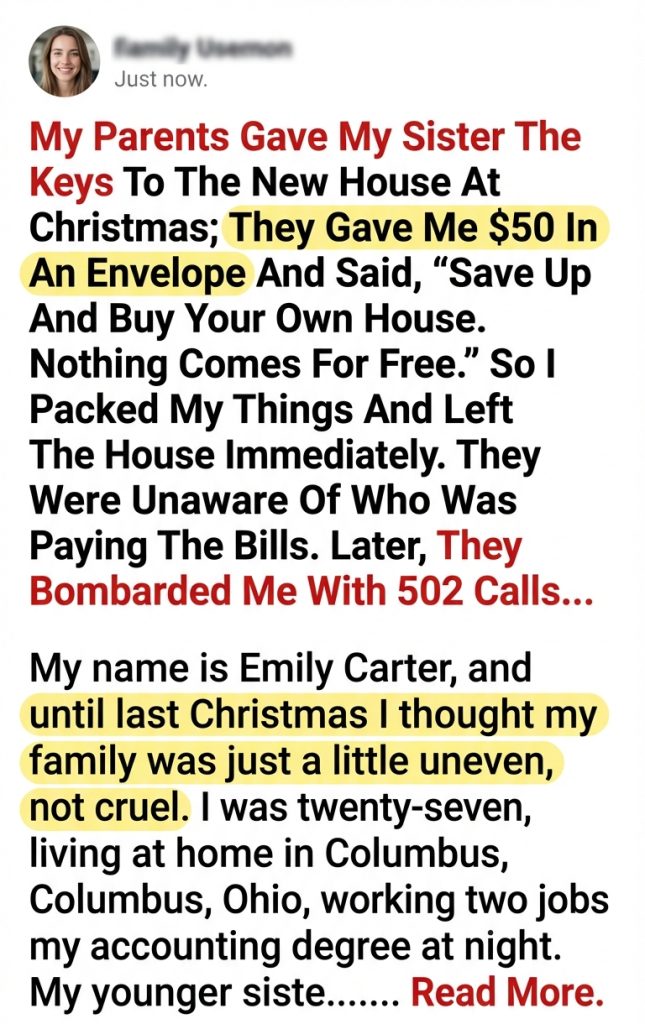
My Parents Gave My Sister The Keys To The New House At Christmas; They Gave Me $50 In An Envelope And Said, “Save Up And Buy Your Own House. Nothing Comes For Free.” So I Packed My Things And Left The House Immediately. They Were Unaware Of Who Was Paying The Bills. Later, They Bombarded Me With 502 Calls…
My name is Emily Carter, and until last Christmas I thought my family was just a little uneven, not cruel. I was twenty-seven, living at home in Columbus, Ohio, working two jobs while I finished my accounting degree at night. My younger sister, Megan, twenty-three, was the golden child. She had a marketing job she hated, a boyfriend she loved, and a talent for turning every minor inconvenience into a crisis my parents rushed to fix.
I didn’t resent Megan at first. Not really. I told myself it was normal for younger siblings to be babied. I told myself my parents meant well. I told myself a lot of things, because it was easier than admitting the truth: they had built a family where my role was to carry weight quietly.
After Dad’s hours were cut at the warehouse, I started “helping out” more. It began small—covering a utility bill “just this month,” paying the internet because I needed it for school, buying groceries when Mom’s card kept declining. Then it became routine. I made spreadsheets, tracked due dates, called companies to negotiate payment plans. My parents called it “rent,” but we all knew I was keeping the lights on.
Mom had a way of asking that made it sound like love. “You’re so responsible,” she’d say. “We’re lucky to have you.” Then she’d slide a bill across the counter like it was a note in church.
I kept paying because I lived there, and because guilt is powerful when it comes wrapped in family language. I also kept paying because I thought it meant something—that my effort would be seen, appreciated, returned someday in some quiet way.
But last Christmas Eve taught me what my effort actually was to them: a convenience they could ignore.
That Christmas Eve, the four of us gathered in the living room, the tree glowing in the corner, the smell of ham drifting in from the kitchen. Dad cleared his throat in that way that meant something “big” was coming. Mom squeezed Megan’s hand, her eyes shining.
“Girls, we have a very special surprise this year,” Dad announced. He pulled a small gift box from under the tree and handed it to Megan. “Open it, sweetheart.”
Megan peeled back the wrapping paper and lifted the lid. A shiny new key lay on a velvet cushion next to a tiny brass house charm. She gasped. “Is this—?”
“The keys to your new house,” Mom finished, practically bouncing. “Three bedrooms, fenced yard, close to your work. We closed last week. It’s all yours.”
I clapped automatically, my face frozen in what I hoped looked like happiness while my heart pounded in my ears. A house. They had bought her a house. I thought about the late-night spreadsheets I kept, juggling the mortgage on their current home, the utilities, the property taxes—bills I paid every month without complaint. They had called it “rent,” but we all knew I was keeping the lights on.
My mind tried to do math that didn’t make sense. How did you buy a house when your electricity was paid by your daughter? How did you “close last week” when you told me two months ago you couldn’t afford the water bill?
Megan squealed and hugged Mom, keys flashing in the light. Dad beamed like he’d just won an award. They talked about paint colors and furniture and how lucky she was. Lucky. The word burned.
Then Dad turned to me with a different envelope, thin and flat. His smile was different now—more instructional, like he was about to teach me a lesson.
“And for you, Em,” he said. “You’re older. Time you stand on your own two feet.”
Inside was a crisp fifty-dollar bill. “Save up and buy your own house,” he said with a chuckle. “Nothing comes for free in this world.”
For a second I couldn’t breathe. Megan waved her new keys in the air, squealing, while Mom hugged her and talked about paint colors and furniture. No one noticed I was still staring at the fifty as if it might burst into flames. Heat rose up my neck, behind my eyes, into my skull. It wasn’t just favoritism; it was a slap in the face from people who were living off my paychecks.
I folded the bill, slid it back into the envelope, and stood up. “You’re right,” I heard myself say calmly. “Nothing comes for free.”
They didn’t hear the meaning underneath. They thought I was agreeing. They thought I was learning.
While they fussed over Megan, I walked down the hallway, pulled my suitcase from the closet, and began to pack my things. Each folded shirt felt like a boundary snapping into place. I didn’t slam drawers. I didn’t cry. I packed like someone finally making a decision they’d been delaying for years.
Ten minutes later I rolled my suitcase into the living room. My parents finally turned, confused, as I shrugged on my coat.
“Where are you going?” Mom asked, her smile cracking.
“I’m giving you exactly what you wanted,” I said, my voice shaking now. “You can keep your house, your keys, and your lesson about nothing being free.”
Dad stood up, annoyed. “Emily, don’t be dramatic. Sit down.”
I looked at him—really looked—and realized he didn’t see me as a person with limits. He saw me as a resource that made his life easier.
“I’ve been paying the bills,” I said quietly. “The mortgage. The utilities. The taxes. The insurance. You knew that.”
Mom’s eyes widened, then narrowed. “We’re your parents,” she said, like that should end every conversation.
“And I’m your daughter,” I replied. “Not your bank.”
Megan laughed awkwardly, trying to smooth it over. “Come on, Em. Don’t ruin Christmas. Dad was just joking.”
I stared at her keys. “Was he joking when I paid your phone bill last month? When I covered Mom’s prescriptions? When I paid the property tax so we wouldn’t get a lien?”
Her smile faltered.
Dad’s voice sharpened. “We didn’t ask you to do all that.”
I almost laughed. “You didn’t have to. You let me.”
The room felt suddenly too small, like the truth had taken up all the air. I pulled the envelope with the fifty from my pocket and set it on the coffee table.
“Here,” I said. “Consider it my last contribution.”
Mom’s face turned red. “So you’re just abandoning us?”
“No,” I said. “I’m setting you free. Nothing comes for free, right?”
I walked out.
The night air slapped my cheeks cold. I loaded my suitcase into my car and sat behind the wheel with my hands shaking—not from fear, but from the adrenaline of finally choosing myself. My phone lit up immediately.
Mom.
Dad.
Megan.
Call after call.
I didn’t answer.
I drove to my friend Dana’s apartment and slept on her couch. The next morning, I woke up to 47 missed calls and 12 voicemails. By noon, it was over a hundred.
By the next day, it became a flood.
They weren’t calling to apologize. They were calling because reality had arrived with a shutoff notice.
You see, my parents didn’t even know how many accounts I controlled. They didn’t know I was the one with the online logins, the autopay, the reminders, the “late fee waived” calls. They thought the world simply worked because they wanted it to.
Two days after Christmas, I received a text from Mom: The heat isn’t working. Fix it.
Not “Are you okay?” Not “Come home.” Just an order.
Then Dad: Your mother is crying. Stop this now.
Then Megan: My card got declined at Target. What did you do??
That’s when I finally answered—only once, only to say what needed to be said.
“I didn’t do anything,” I told them. “I just stopped doing everything.”
Then I took my name off every account I’d been paying. I canceled autopay. I changed passwords. I sent them a simple email with a list of vendors, due dates, and customer service numbers—because I wasn’t cruel. I was done. There’s a difference.
Within a week, the calls reached the number that still feels unreal when I say it out loud: 502 missed calls.
Some were rage. Some were panic. Some were sudden, sugary apologies that didn’t sound like my mother at all.
Please, honey. We didn’t mean it.
We’re family.
Come home and we’ll talk.
You’re tearing this family apart.
But the family had been torn long before I left. I just stopped sewing it back together with my own hands.
A month later, I learned the truth from an aunt who couldn’t keep secrets: my parents had used a loan in Megan’s name and a second mortgage on their house to buy her “gift.” They expected me to keep paying their bills while they played generous parents on Christmas Eve.
They didn’t plan for me to walk out.
By spring, Megan’s “new house” was already under strain—payments too high, repairs she didn’t budget for, a boyfriend who suddenly had opinions about her spending. My parents’ finances were worse. The second mortgage didn’t care about their pride.
And me?
I finished my accounting degree. I got a better job. I rented a small apartment with sunlight and quiet. The first month I paid my own bills—only my bills—I sat on the floor and cried, not from sadness, but from relief.
Because for the first time, my paycheck belonged to my life.
The craziest part is this: my parents still tell people I “left for no reason.” They still say I’m “ungrateful.” But I don’t argue anymore, because people who use you will always rewrite the story to make themselves innocent.
I keep the $50 envelope in a drawer now. Not because it hurts me anymore—because it reminds me.
Nothing comes for free.
Not peace. Not respect. Not freedom.
But the moment I finally paid the price of leaving, I got something I’d never had in that house:
A life that was truly mine.