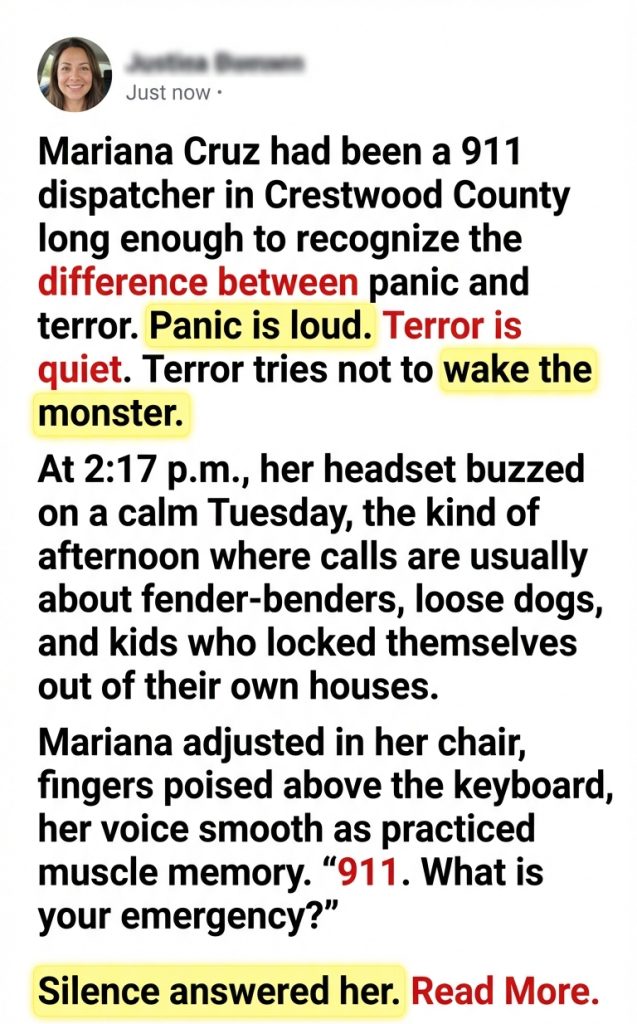
Mariana Cruz had been a 911 dispatcher in Crestwood County long enough to recognize the difference between panic and terror. Panic is loud. Terror is quiet. Terror tries not to wake the monster.
At 2:17 p.m., her headset buzzed on a calm Tuesday, the kind of afternoon where calls are usually about fender-benders, loose dogs, and kids who locked themselves out of their own houses.
Mariana adjusted in her chair, fingers poised above the keyboard, her voice smooth as practiced muscle memory. “911. What is your emergency?”
Silence answered her.
In dispatch, silence is never empty. It’s someone listening for footsteps. Someone covering a mouth. Someone deciding whether asking for help is worth the risk.
Three seconds passed—long enough for Mariana’s stomach to tighten and her eyes to flick to the clock.
Then a child’s voice came through, shaking between whispers and tears. “It was my dad and his friend. Please help me.”
Mariana’s chest went hot and cold at once. She’d spoken to children before, but this voice wasn’t just scared. It was careful—the way kids get when they’ve learned noise has consequences.
“Sweetheart,” Mariana said softly, lowering her tone as if she could make the line feel safer, “I’m Mariana. I’m right here with you. What’s your name?”
A faint crackle of static. “…Ella.”
“Hi, Ella. How old are you?”
“Seven.”
Mariana steadied herself, pressing her palm to her notepad to keep it from shaking. “You’re doing a brave thing calling, Ella. Where are you right now?”
A tiny pause. Then, a whisper. “Closet.”
“In a closet?” Mariana repeated gently. “Are you inside a closet with coats?”
“Yes,” Ella breathed. “Coats. Vacuum.”
Mariana typed fast: CHILD HIDING IN CLOSET. Then she asked the next question—always the next question. “Ella, are you hurt?”
“No,” Ella said, and then her voice cracked. “But my dad…”
“Okay,” Mariana said, voice steady. “I need you to stay as quiet as you can. Can you tell me your address, sweetheart? Do you know the numbers on your house?”
Ella didn’t know the numbers, but she knew the street name because she practiced writing it in school. She whispered it slowly, like letters could make too much sound. Mariana repeated it back and confirmed the city, then dispatched units—police and EMS—without letting a single tremor enter her voice.
In the background, Mariana heard a dull thud—heavy and muffled—followed by a man’s voice raised in anger. Ella sucked in a breath and whispered, “He’s yelling again.”
“Listen to me,” Mariana said, calm but firm. “You stay in the closet. You do not come out even if someone calls your name, okay? Not until a police officer tells you it’s safe.”
Ella’s breathing turned shaky. “My dad told me to hide. He said… if I get scared, call you.”
The sentence hit Mariana like a punch, because it meant the father had enough clarity—enough love—to protect his child even while something else was happening in the house.
“Your dad did the right thing,” Mariana said. “And you did too.”
Ella’s voice trembled. “It was my dad and his friend. His friend came over. They were talking. Then they started yelling. Then the friend pushed my dad.”
Mariana’s eyes stung, but she kept her voice smooth. “Okay. You’re doing great. What’s your dad’s name?”
“Dylan,” Ella whispered.
“Okay,” Mariana said. “Do you know the friend’s name?”
A pause, then a small, scared breath. “Jay. Dad calls him Jay.”
Mariana typed the names, her fingers moving faster than her thoughts: FATHER: DYLAN. FRIEND: ‘JAY’.
“Ella,” Mariana said gently, “is your closet door closed?”
“Yes.”
“Is it locked?”
“No,” Ella whispered, panic rising.
“That’s okay,” Mariana said, steady as a metronome. “Stay very still. Hold your phone close. If the closet door opens, don’t shout. Just keep the line open. Can you do that?”
Ella made a tiny sound—half sob, half yes.
Mariana heard another thud, then a sharper sound like something knocked over. Ella’s whisper became smaller. “I heard Dad hit the wall.”
Mariana swallowed hard. “Okay. Ella, you are not in trouble. You are not doing anything wrong. You are helping your dad by staying safe.”
“Am I bad?” Ella asked suddenly, voice breaking in that way that made Mariana’s heart ache. “Did I make him mad?”
“No,” Mariana said firmly. “No, sweetheart. None of this is your fault.”
Mariana kept her talking in tiny ways—questions that anchored the child in the present. “What color are the coats in the closet? Can you touch the floor—are you sitting or standing? Is it dark in there?” Every detail mattered. Not because Mariana needed a story, but because a calm child stays safer.
Then, faintly, sirens began to seep into the call like distant wind. Ella heard them too. Her whisper turned into a sob of relief. “They’re coming?”
“Yes,” Mariana said, her voice softening. “They’re coming. You stay where you are.”
Over the line, Mariana heard a door slam. A voice shouted, “Sheriff’s Office! Let me see your hands!” Ella flinched, and the phone rustled.
“I’m still here,” Mariana said immediately. “I’m right here. Keep breathing with me.”
A man’s voice—closer, authoritative—filled the background. Another voice answered, angry and defensive. Then the sound of quick movement, like someone stepping backward too fast.
Ella whispered, “Someone is running.”
Mariana didn’t ask who. She didn’t ask where. She just kept the child steady. “Stay in the closet. Stay in the closet.”
A moment later, a new voice—gentler—came near the phone, muffled by coats. “Sweetheart? It’s okay. My name is Officer Ramirez. Can you open the closet door?”
Ella’s breath hitched, then the closet creaked. Light spilled in. Ella cried—full-bodied now, no longer holding back.
Mariana heard the officer’s tone soften. “You’re safe now.”
The next update came through radio traffic Mariana had learned to translate without emotion: one adult male detained, one adult male injured, EMS requested, child safe. But what made Mariana’s eyes burn wasn’t the official language—it was the pause in the officer’s voice when he added, quietly, “The father kept asking about the little girl first.”
Later, after the call ended and the screen went still, Mariana sat back in her chair and stared at the gray glow of her monitor. The room around her continued—other calls, other beeps, coworkers moving—but this one stayed in her chest like a weight.
Because it wasn’t just an emergency. It was a child learning what fear sounds like. It was a father trying to keep his daughter hidden. It was a family’s worst moment squeezed into a few whispered sentences.
The report the next day was plain on paper and brutal in meaning. Dylan had tried to get his friend to leave after an argument escalated. The friend refused. Things turned physical. Dylan told Ella to hide and call 911 if she got scared. Dylan was injured but stable. The friend was arrested. The home was secured.
A week later, an envelope arrived at the dispatch center with Mariana’s name written carefully on the front. Inside was a crayon drawing: a stick-figure girl with big hair holding hands with a woman wearing a headset. Above them, in uneven letters, it read: THANK YOU MARIANA.
Mariana taped the drawing beside her console—not for praise, not for show, but as a reminder of the real job behind scripts and training: be the calm voice that keeps someone alive long enough for help to arrive.
And every time her headset buzzed after that, Mariana answered the same way—steady, composed—while quietly promising herself something simple.
If another small voice ever whispered through her line, she would lean in close and make sure it was heard.